


By John Klar, Contributor, The MAHA Report
For the first time, the Centers for Disease Control and Prevention’s newly formulated Advisory Committee on Immunization Practices (ACIP) will meet, on March 18 and 19, to address injuries from Covid-19 vaccines.
Since the pandemic, more Americans have become concerned about vaccine safety and whether their vaccine injuries will be recognized. This raises an urgent legal question: Do governments have the constitutional authority to mandate their citizens take vaccines?
That’s a question many people, in many parts of the world, have wrestled with for generations. In America, the most seminal debate on the issue is found in Jacobson v. Massachusetts, a case on which the Supreme Court of the United States (SCOTUS) ruled in 1905.
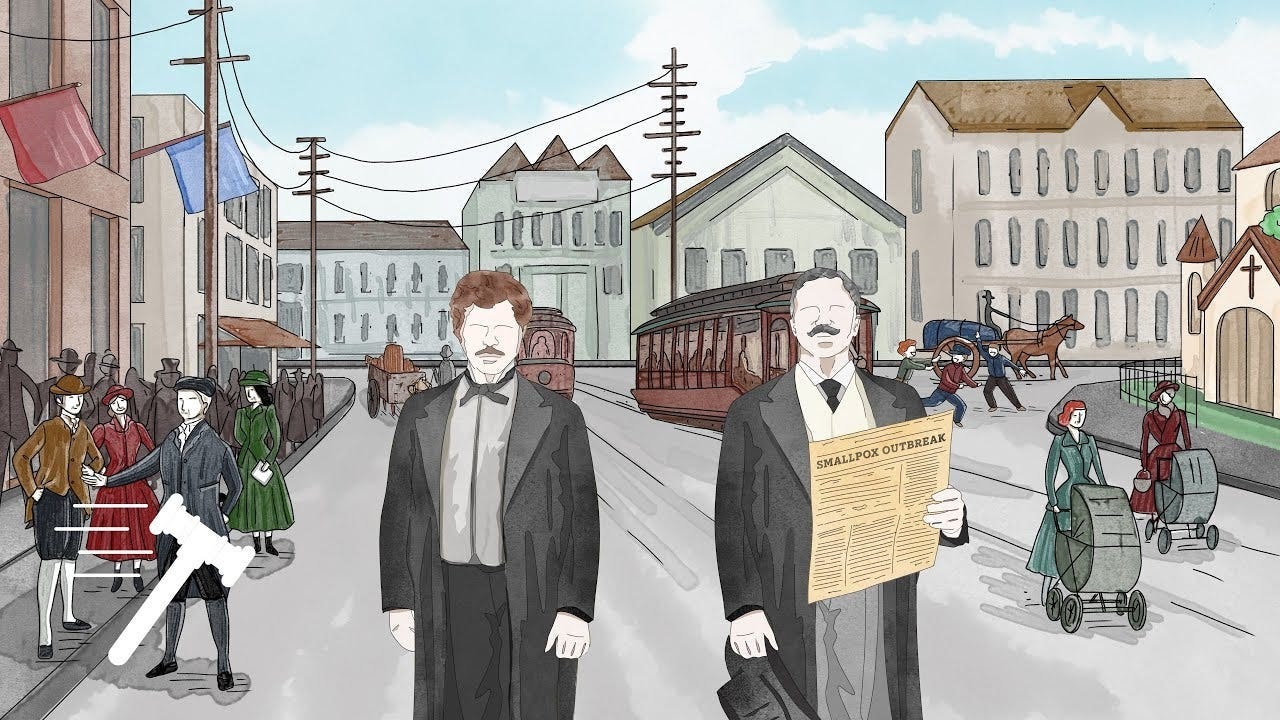
Swedish immigrant Henning Jacobson was a pastor in Cambridge, Massachusetts, when the city mandated smallpox vaccinations for all of its citizens in 1902. Pastor Jacobson had received a smallpox vaccination in his native Sweden years earlier and had suffered serious adverse health effects. He refused to take the vaccine and was accordingly fined $5 under the city’s vaccine ordinance.
Jacobson was determined to fight what he perceived to be a violation of his liberties all the way to SCOTUS. In ruling against him, the nation’s highest tribunal held that American citizens do not have an absolute right “to be at all times, and in all circumstances, wholly freed from restraint” of their constitutional liberties.

Photo of Henning Jacobson
In other words, Jacobson’s individual liberties argument, under the 14th Amendment, didn’t hold up against the perceived need to protect the public good. Mr. Jacobson’s $5 fine for noncompliance was upheld, the Supreme Court ruling that “[i]t is within the police power of a State to enact a compulsory vaccination law….”
Yet the Jacobson decision contained several important caveats that modern courts and vaccine proponents often ignore. The court noted that legislatures held authority “in the first instance,” but not without limit or judicial oversight. In other words, SCOTUS found there was a dangerous potential for abuse of power by unchecked legislative power.
The case was decided before the later enunciation of the doctrine of “strict scrutiny,” which holds that statutes and other laws are subject to very high standards when they impact fundamental liberties (such as bodily integrity). Yet the court applied a thorough analysis of the medical science surrounding smallpox vaccines to justify its decision, recounting the strong scientific consensus and the vaccine’s successful track record, which was created using an attenuated (weakened) virus to stimulate the immune response.
The “real science” for smallpox vaccines differs markedly from the “sketchy science” used to create and market mRNA Covid vaccines. Importantly, the Jacobson majority expressly warned courts must not merely rubber-stamp every government edict and should be on guard against possible abuse, writing: “The police power of a State, whether exercised by the legislature or by a local body acting under its authority, may be exerted in such circumstances or by regulations so arbitrary and oppressive in particular cases as to justify the interference of the courts to prevent wrong and oppression.”
The decision specifically limited its application to Mr. Jacobson, holding that “[w]e now decide only that the statute covers the present case….” and cautioning that in other circumstances “[w]e are not to be understood as holding … that the judiciary would not be competent to interfere and protect the health and life of the individual concerned.”
However, many modern courts have deferred to government agencies without undertaking even a modicum of judicial review of the available science, expanding Jacobson beyond smallpox vaccines and ignoring its clear warnings about potential abuse.
This was the outcome in a Vermont case in which a four-year-old boy was vaccinated with an experimental Covid shot against his parents’ specific instructions. Vermont’s Supreme Court did not undertake any substantive analysis of vaccine safety, ruling simply that because the CDC recommended the experimental jab under the federal Public Readiness and Emergency Preparedness (PREP) Act, the family had no legal recourse.
A similar result was reached soon afterwards by Maine’s highest court, in Hogan v. Lincoln Medical Partners, involving a five-year-old boy who was vaccinated with an mRNA Covid-19 product without parental consent. In dismissing the case, the Hogan court opined (in a footnote):

“As to Hogan’s assertion that the immunity provision [in the PREP Act] violates the child’s constitutional right of bodily integrity, ‘[i]n the context of COVID-19, courts across the country have concluded that Jacobson established that there is no fundamental right to refuse vaccination.’ Williams v. Brown, 567 F. Supp. 3d 1213, 1226 (D. Or. 2021); see also Norris v. Stanley, 567 F. Supp. 3d 818, 821 (W.D. Mich. 2021) (“Plaintiff is absolutely correct that she possesses those rights [to privacy and bodily integrity], but there is no fundamental right to decline a vaccination.”)
One needn’t earn a law degree to see the jurisprudential sleight of hand employed here in view of the clear language of the Jacobson decision. Jacobson went to great pains to assess smallpox vaccine effectiveness, and very pointedly did not hold that there is no fundamental right at issue.
Indeed, Jacobson specifically reserved judicial power to review future vaccines and laws to ensure people’s health is protected. More modern decisions, such as Zucht v. King, have perverted the ruling to reach a shocking result. It is outright misinformation to characterize the decision as a blanket justification for any and all government vaccines.
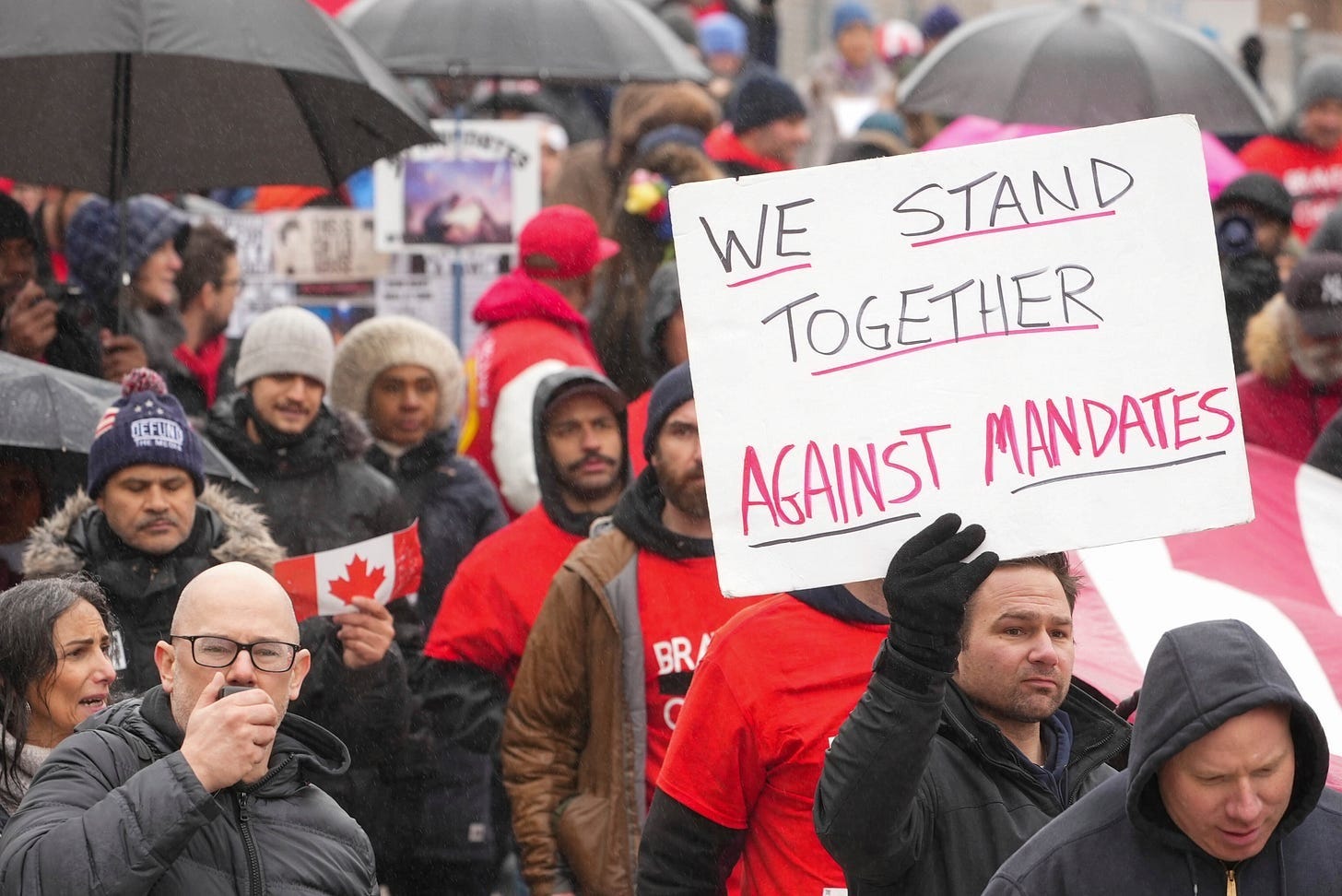
Notably, these cases both involved children who were force-jabbed. Leo Politella (my client) protested loudly and tried to resist the vaccine, but was physically held down. This, too, differs from the case of a Cambridge pastor who merely had to pay a fine.
Yet neither of these state courts made any distinction, essentially stretching a 120-year-old case into an unrecognizable proposition that the government can physically seize a citizen and vaccinate them with complete impunity (other than for damages for serious injury or death pursuant to the PREP Act).
This is a heinous perversion of the Jacobson decision. Jacobson applied solely to smallpox vaccination, ruled that an adult who refused would have to pay a fine, and specifically cautioned that courts must be vigilant in reviewing such government actions. Additionally, the Jacobson court did not address the issue of a government statute granting legal immunity to pharmaceutical manufacturers when a person suffers provable vaccine injury or is force-jabbed (which constitutes a legal battery).
Instead, Vermont and Maine (and SCOTUS, which declined to hear the Politellas’ Petition for Writ of Certiorari) relied on case law concerning a completely different vaccine to support an errant interpretation that shields Big Pharma from legal scrutiny of its clearly deficient mRNA interventions. This is a moral hazard that encourages sloppy vaccine manufacturing and ensures no accountability for medical personnel who blatantly violate a patient’s rights to informed consent and bodily integrity.
A lawsuit has been filed in the Massachusetts Federal District Court seeking a preliminary injunction to prevent the upcoming ACIP meeting on vaccine injuries. Ironically, the state that imposed mandatory smallpox vaccinations in 1905 is now the forum for a lawsuit that seeks to hinder federal regulators from reducing the number of federally recommended vaccines. Massachusetts is also one of the states seeking to create its own vaccine recommendations in defiance of the CDC’s changes.
Jacobson should be the case that protects Americans and their young children from corporate-government abuse, not the other way around.
Key Takeaways:
– Jacobson v Massachusetts addressed whether Americans have a fundamental right to refuse mandatory vaccines, but applied solely to the smallpox vaccines.
– Jacobson warned that courts should be vigilant to ensure government edicts mandating vaccines were premised on sound science and a review of the available scientific evidence.
– Modern courts have sidestepped protection of fundamental privacy, parental, and informed consent rights by wrongly applying Jacobson to other vaccines, and without any scrutiny of the substances jabbed into unconsenting young children’s bodies.

Force injecting by holding a child against his/her will, Vaxxinating a child without parental consent, injecting a child with puberty blockers with parental approval or not is an attack and abuse upon a child and should be looked on and dealt with as a crime. Insane acts on children must be stopped.
Tyranny. It's time people woke up to the realization that our government practices tyranny, not freedom.