


Under a July 15 Pentagon policy change, all active duty and reserve service members 30 and older are being screened annually for testosterone deficiency.
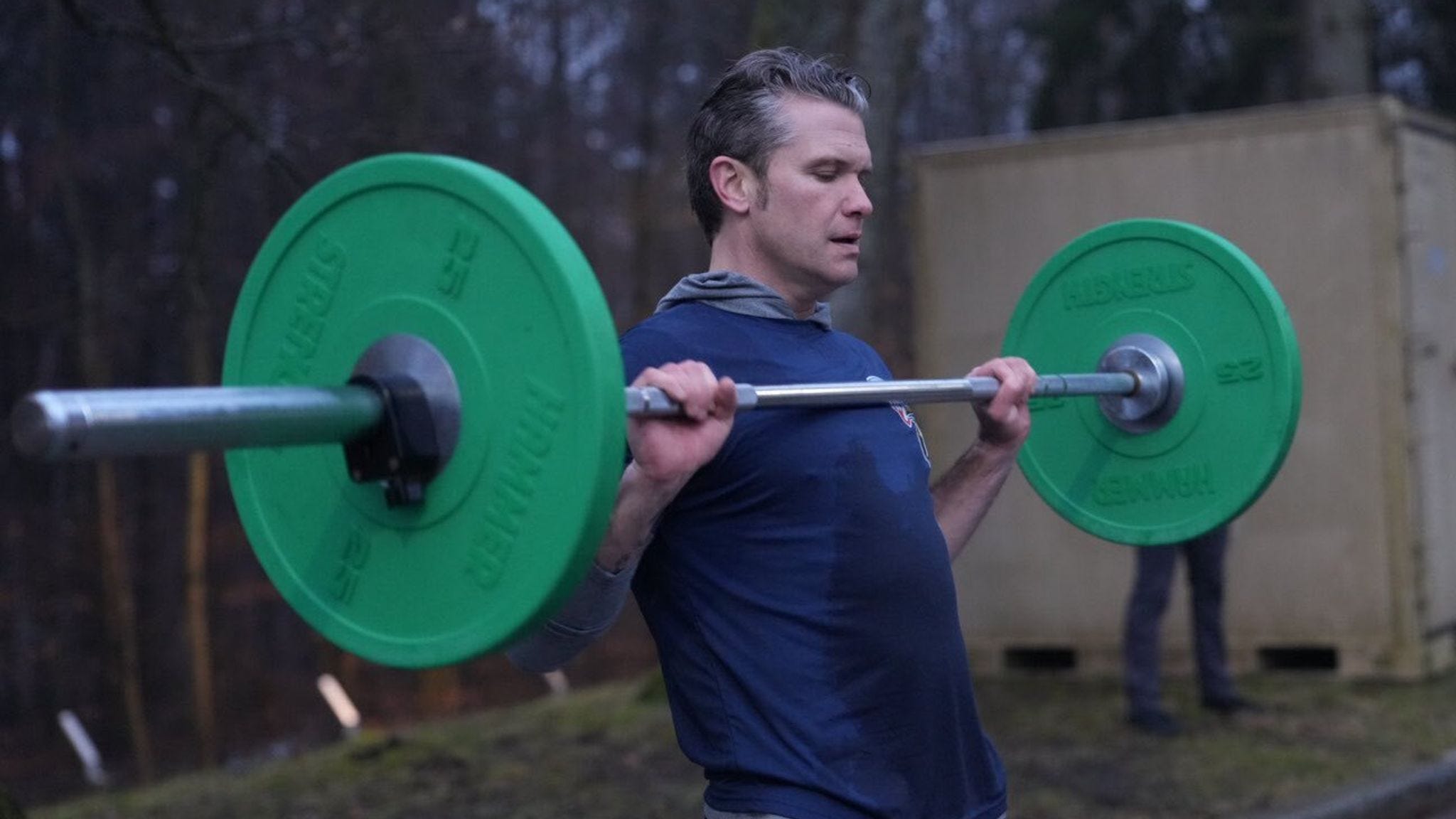
Defense Secretary Pete Hegseth introduced the program in a video captioned “The High-T Department of War,” saying the screening is “about restoring and optimizing natural capabilities, protecting longevity, and ensuring the biological foundation required to sustain the fight.”
Younger service members may request screening as well. Anyone found deficient may elect testosterone replacement therapy (TRT), a choice Hegseth leaves to each individual.
The conventional view
Upon learning about the required screening, conventional health experts were skeptical. Reuters questioned six experts about whether the screening would improve readiness, and five worried it could lead to unnecessary or harmful treatment.

It is true that supplemental testosterone lowers a man’s sperm count, affecting fertility.
“Many in our armed forces are young men who are not done having their families,” said Dr. Kevin McVary, a urologist who serves on the medical advisory board of the telehealth platform, Rugiet. “If you just dole out the testosterone, the testes will shrink.”
The American Urological Association (AUA) and the Endocrine Society advise treatment only for men with confirmed deficiency plus symptoms, a standard built to treat established disease rather than to restore function. The AUA estimates up to a third of men on TRT fall short of those criteria.
A decline that starts before enlistment
Hegseth built the policy around age, which is why the testing starts at 30. The problem is that a man in his twenties today already has less testosterone than a man his age had in 1999. He shows up to the recruiting office already low, and no one checks for another 10 years.
Testosterone levels in a healthy man between 19 and 39 typically run between 264 and 916 nanograms per deciliter, and the AUA sets the threshold for deficiency at 300. National Health and Nutrition Examination Survey (NHANES) data on 4,045 men aged 15 to 39 shows mean total testosterone falling from 605 nanograms per deciliter in 1999 to 451 by 2016. That drop held in men of normal body weight, even after accounting for age, race, activity, smoking and alcohol.
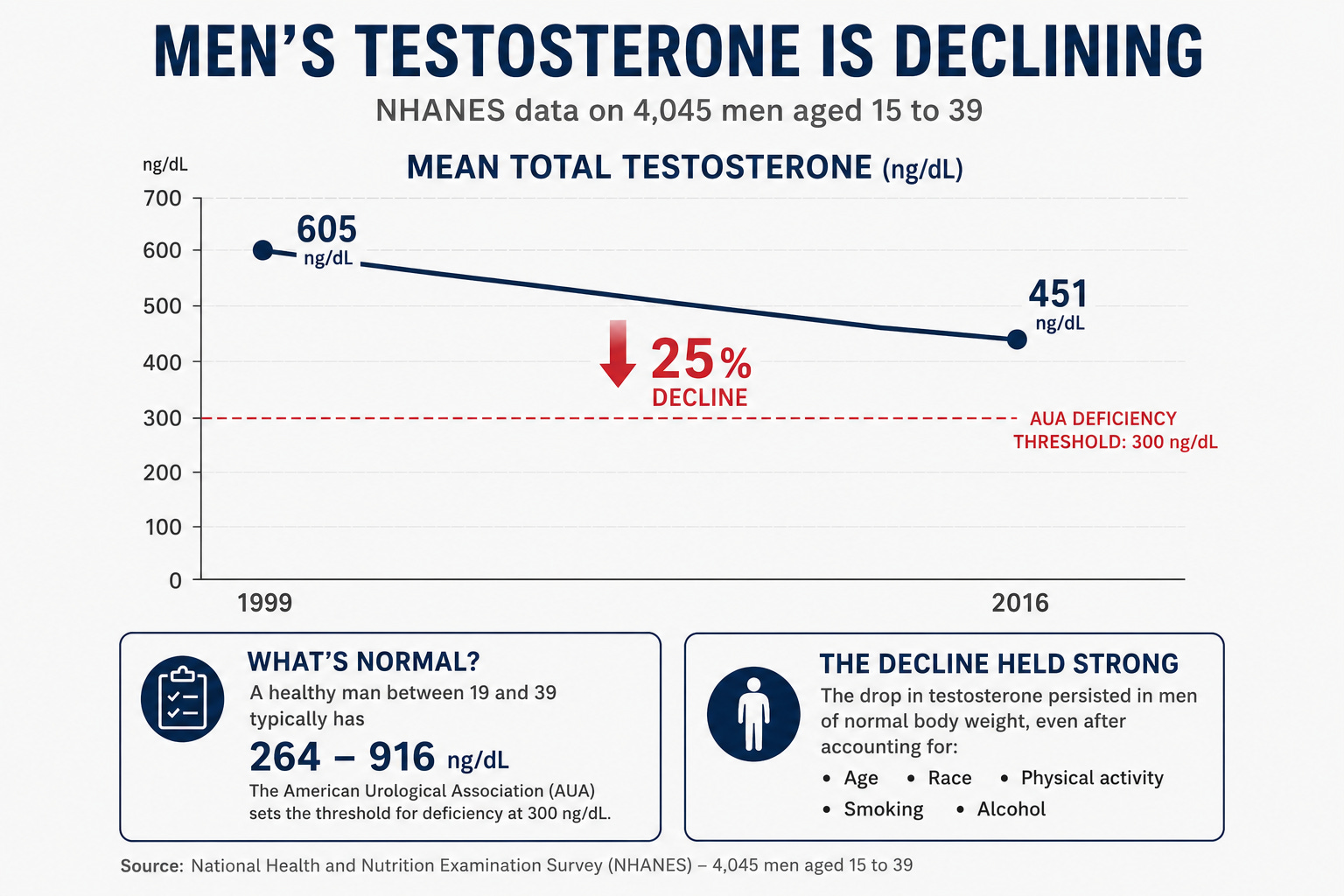
Normal is not the same as optimal. Reference ranges come from the existing population, so as testosterone falls across a generation, the definition of normal falls with it. A 25-year-old who is told his level of 320 is fine clears the threshold for disease but doesn’t have the hormone profile of a healthy young man.
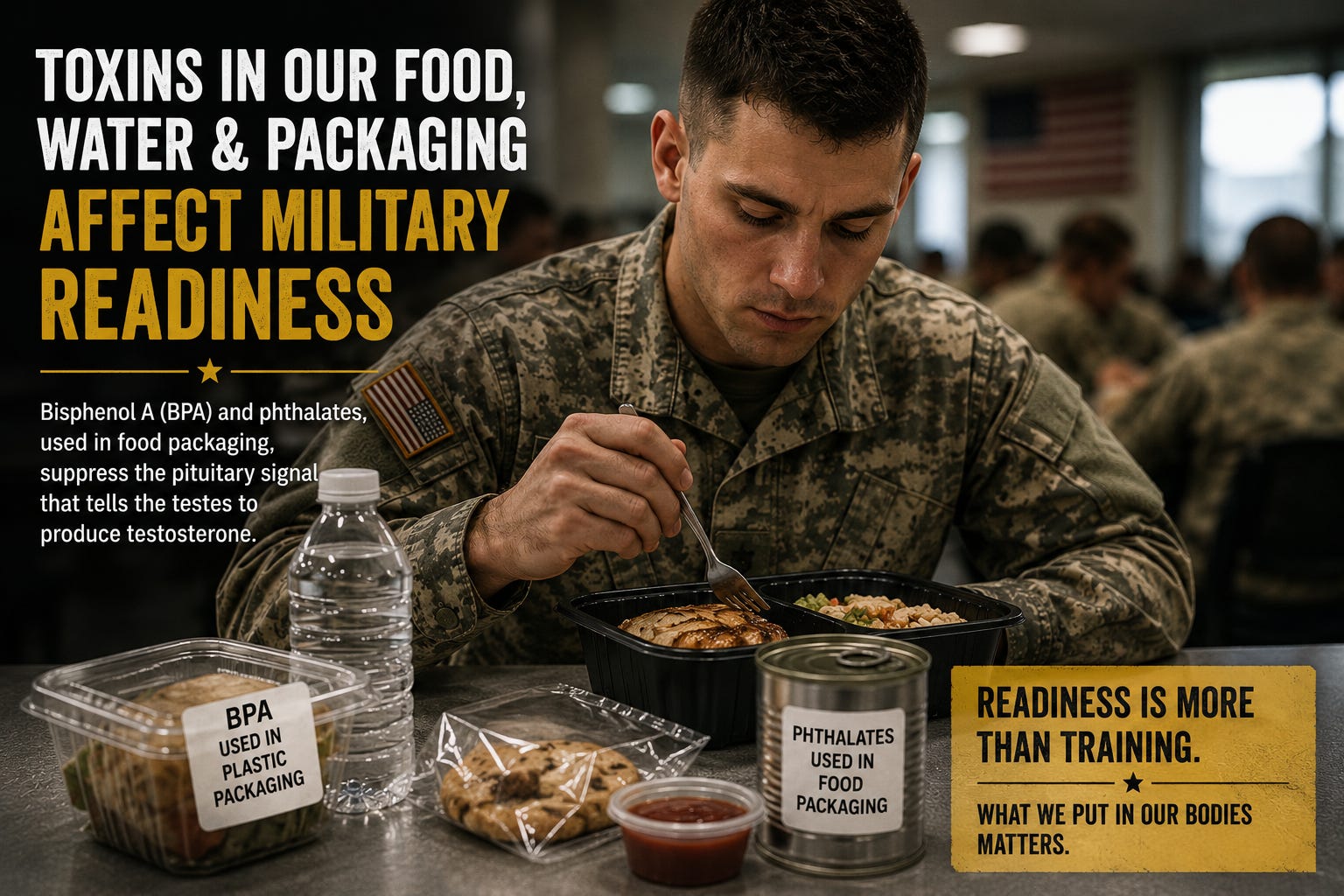
Nothing in human genetics explains a 25% drop in 16 years, but the environment does. Toxins in the food, the water and the packaging now affect military readiness as much as training does. Bisphenol A (BPA) and phthalates, both used in food packaging, suppress the pituitary signal that tells the testes to produce testosterone.
Atrazine and glyphosate, among the most heavily applied herbicides in agriculture, damage testicular tissue and interfere with testosterone synthesis. A 2024 study found microplastic particles in every human testicle examined. Those exposures reach a young man decades before a recruiter does, which puts the real cause of the problem outside the Pentagon’s reach .
What testosterone does under load
Testosterone does more than build muscles. A 1996 study found that healthy men given testosterone gained muscle size and strength with or without exercise. A follow-up study in men 18 to 35 showed that as testosterone rose, so did lean mass, muscle size, strength and power, while body fat decreased.

Testosterone also acts on dopamine pathways that determine motivation and effort. Athletes given testosterone before a physical stressor reported feeling calmer and more confident under strain.
The high physical and mental demands of military training, along with a caloric deficit, can drastically lower a man’s testosterone. Eight weeks of the Army’s most demanding course drives levels down to the range of a castrated man, and it takes roughly six weeks to recover. However, when the Army Research Institute of Environmental Medicine put men through 28 days of hard training, the group given testosterone gained muscle while the control group had no gains.
What measuring can and cannot do
Last year, on December 10, Dr. Abraham Morgentaler, the Harvard urologist who pioneered modern testosterone therapy, spoke at the Food and Drug Administration (FDA) Expert Panel on Testosterone Replacement Therapy for Men. Low levels warrant treatment whether or not symptoms appear, he argued. “You could make a very strong argument that having a normal testosterone level is important for health and prevention of illness,” he said.
TRAVERSE, the largest cardiovascular trial ever run on testosterone therapy, followed more than 5,200 men and found no increase in cardiovascular events among men treated with testosterone compared to placebo. The FDA has since removed its black box warning on testosterone.
Hegseth’s order treats men 30 and older, and it is worth doing. But supplementing a 35-year-old sergeant does nothing for the teenager who will one day replace him, the one absorbing the same plastics and pesticides now and likely to enlist with even less than the sergeant started with. Screening and TRT manage the deficit without touching what created it.
Fixing that means going after the exposures that lower a young man’s testosterone long before he is old enough to enlist. It means getting endocrine-disrupting chemicals out of the food, the water, and the packaging–the BPA and phthalates and pesticide residues that suppress the hormonal signal at its source. It means feeding young men real food, including meat and animal fats, rather than the processed or plant-only diets that leave the body short of what it needs to make testosterone.
And it means encouraging both men and women to pick up weights, because few things support healthy testosterone and hormone balance as reliably as heavy, progressive strength training. This is the foundation the MAHA movement is built on, and it reaches the problem years before a testosterone test ever could.
Shop our merch store to support the MAHA Report and the MAHA movement.
All proceeds go to supporting the cause.
Related Reading

Millions of American Men Are Suffering From Low Testosterone. The FDA Is Finally Addressing the Crisis.

Millions of American men with documented testosterone deficiency don’t qualify for FDA-approved treatment, even though, according to testimony at the FDA’s December 10, 2025 expert panel, that treatment is often life-changing and even life-saving.

Let's get some fresh fruit, vegetables and toilet paper to the sailors jumping off the Lincoln, and get them some shore-leave first, OK?
It's ok not to "make the Persian Gulf a US territory".
Testosterone goes up with vigorous daily outdoor exercise. It's ok to do that first, and to eat food without ingredients you can't read out loud.
First off, saying " Pete is right is laughable. He is hands down the most unqualified Secretary of Defense that has EVER been appointed. Secondly, our service members to not need more testosterone in order to serve their Country. They need better leaders who know what the hell they are doing, who actually CARE about what they need. They need leaders who won't go into a war with absolutely no plan and no reason to be there.