


By The MAHA Report
“Even as a trained lung surgeon, I find cases like young Shira Boehler’s shocking. Her riveting story should be grasped by all.” —Dr. Mehmet Oz, Administrator, CMS
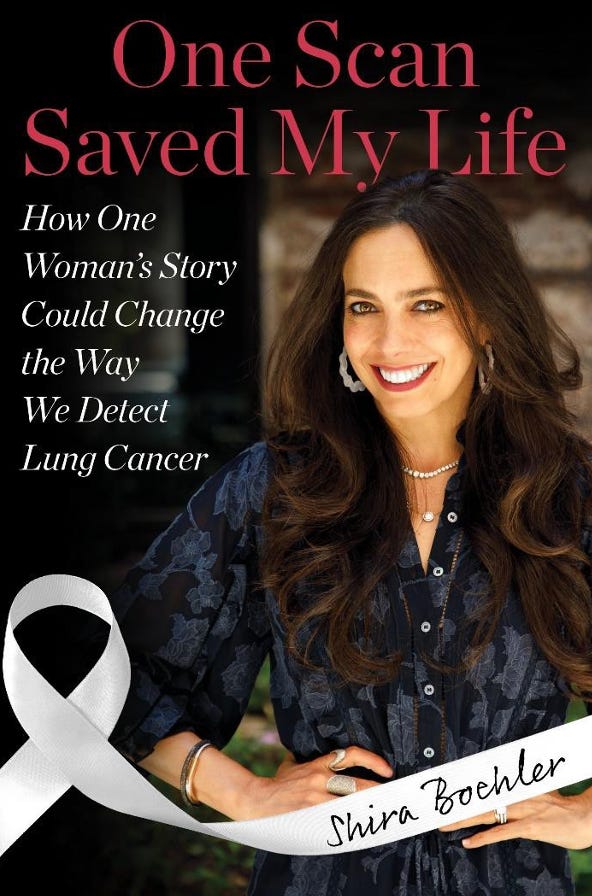
Shira Boehler’s new book, One Scan Saved My Life: How One Woman’s Story Will Change How We Detect Lung Cancer (which publishes today, April 28), is not merely a survivor’s memoir; it is a clarion call, urgent and unflinching, that dismantles the stubborn myths surrounding the deadliest cancer in America. Lung cancer kills nearly 125,000 people annually—more than breast, pancreatic, and ovarian cancers combined—yet it remains mired in stigma, outdated guidelines, and dangerously low screening rates.
Boehler was doing everything right. A devoted mother of four, an avid runner who logged six hilly miles the morning her world tilted, a nonsmoker who ate well and stayed active—she embodied the kind of disciplined wellness that should, by all conventional wisdom, keep deadly diseases at bay.
Yet on a Monday in September 2025, she sat in an exam room hearing the words no one expects or wants to hear at forty-three — or any age: ‘You have lung cancer.’
Boehler’s story, told with candor, wit, and the precision of someone who has spent her career in health-care tech and finance, exposes how a disease long dismissed as a “smoker’s problem” is quietly claiming a new demographic: younger women, many of whom have never touched a cigarette.

The book’s premise is simple and unsettling. During a preventive full-body MRI encouraged by her husband (over her objections), a “non-urgent” spot appeared in Boehler’s right lung. Skeptical, she followed up with a low-dose CT scan recommended by her radiologist friend and her pulmonologist father. What followed was a swift diagnosis of stage I adenocarcinoma—an aggressive tumor caught before it could metastasize. Surgery removed it cleanly. Margins clear, lymph nodes negative.
Boehler walked away not just alive, but with a mission.
What makes Boehler’s book so compelling is its refusal to settle for personal triumph. Boehler weaves her journey—MRIs, Saturday-night calls from her radiologist, the surreal laughter of her children upon hearing the news, the agony of a chest tube, the slow reclaiming of her body—with clear-eyed explorations of the science, policy, and human cost of lung cancer. She dismantles the smoker’s-disease trope with data and lived experience: 25 percent of cases occur in never-smokers. Rates are rising among women under fifty. Asian American never-smoking women face disproportionately high risk. Family history, secondhand smoke, and emerging genetic factors like EGFR mutations, all play roles that current guidelines.

The foreword by Anne and Janet Wojcicki adds poignant weight. Their sister Susan died of stage IV lung cancer at fifty-four, a never-smoker whose meticulous screenings for breast and colorectal cancers never extended to her lungs. The contrast is heartbreaking and instructive: early detection turned Boehler’s story into one of survival and advocacy; late detection turned Susan’s into a devastating loss.
Boehler does not shy from the complexities. She acknowledges the modest radiation risk of low-dose CTs, the challenge of incidental findings, and the real barriers—access, cost, awareness, and physician hesitation—that keep screening uptake shockingly low even among those who qualify (often just 2 to 6 percent in eligible high-risk groups).
In her book, Boehler interviews survivors, surgeons, researchers, and advocates, including voices from the White Ribbon Project, and dives into innovations on the horizon: AI-assisted radiology, radiomics, liquid biopsies, multi-cancer detection tests, and precision approaches targeting biomarkers. Yet she returns, again and again, to the simplest, most evidence-based intervention: expanding access to scans that can find cancer before symptoms appear, when surgery alone can be curative.

Written in crisp, conversational prose that never sacrifices depth for readability, the book balances memoir with manifesto. Chapters on the respiratory system, staging, nonsurgical treatments, and the barriers to broader screening are informative without overwhelming. Personal details—the Little Mermaid soundtrack sung inside the MRI tube, the Yom Kippur break-fast turned impromptu support gathering, the nerve pain and full-body rash of recovery—keep the narrative grounded in one woman’s vivid, relatable humanity.
Critics might note that Boehler’s privileged position—access to out-of-pocket scans, a strong support network, top-tier care at Vanderbilt—makes her outcome aspirational rather than universal. She addresses this head-on, arguing that no one should need wealth or insider knowledge to receive lifesaving screening. Her dedication to policy change, including calls for revised USPSTF guidelines that better account for never-smokers, family history, sex differences, and younger patients, feels both pragmatic and morally astute.
In an era when cynicism about health-care reform runs deep, One Scan Saved My Life stands as a hopeful, data-driven argument that we already have the tools capable of transforming lung cancer from a near-certain killer into a manageable condition for far more people. Boehler’s voice—warm, determined, occasionally humorous—never preaches; it persuades. She reminds us that the most powerful advocacy often begins with one person refusing to accept the status quo.
This is essential reading for patients, families, physicians, and policymakers alike. It will make you question why we screen so aggressively for some cancers while leaving others to chance. More importantly, it may save lives—perhaps even your own or someone you love—by prompting a single, simple question: Have I had that scan?
One scan saved Shira Boehler’s life. With courage and clarity, her book argues that a single scan can save many more lives.
Drop the republican agenda... They don't care about MAHA...
On April 23, 2025, nurses administered flu, hepatitis A, and DTaP vaccines to 18-month-old twins. Within hours, they became lethargic and ill. By the next morning, their lips were blue, and they could barely move. Their mother, Anna, rushed them to the emergency room, telling the doctor about the three vaccines they’d received the day before. Capricorn shows the established power center, with its labyrinthine conventions and Plutonian struggles; in Aquarius all of this is up for review, though it is no less Plutonian. Power dynamics are questioned: any hierarchy or paradigmatic set of conventions will tend to favor one group or another. There are always insiders and outsiders, rules that work for one group may appear oppressive and stifling to another. Aquarius is an Air sign, it is social, so we have ritualized expositions and examinations of the workings of power here. On the 1st day of Aquarius season, and State of the Union addresses generally happen in this sign.
The hospital discharged them after the toddlers ate popsicles without vomiting. Their symptoms - diarrhea, vomiting, hyperprofundemia, rebound mustique continued. On May 1, 2025, the twins were found dead in a shared bed in their family’s trailer.
It was the spike glycoprotein - that spiky demon they never showed you in the glossy ads. This wasn’t just a harmless part of the virus; it’s the wrecking ball. It makes your red blood cells clump together like wet sand, choking off oxygen at the tiniest level in your body. You can’t heal what you’re forbidden to name. And that’s exactly why naming it, and using the targeted, suppressed treatments that actually work