


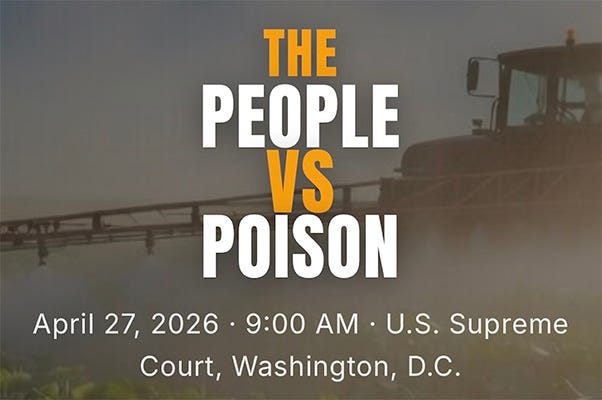
On Monday, April 27, the U.S. Supreme Court will hear arguments in the Monsanto Company v Durnell case, which centers on whether or not the plaintiff’s cancer was due to Monsanto’s ‘failure to warn’ of its product’s dangers. A protest called “The People v Poison” has been organized beginning at 9:00 a.m. to oppose granting legal immunity to chemical manufacturers like Monsanto for the harms caused by glyphosate and other chemicals.
Few substances have fueled controversy the way glyphosate, a weed killer and pre-harvest desiccant, has. The MAHA movement has targeted the chemical as hazardous, but the chemical industry and Big Ag dismiss health claims as unfounded, citing decades of regulatory approval. Yet, as Robert F. Kennedy Jr. has been explaining for years, regulatory capture by lobbyists and special interests has compromised scientific inquiry. As more studies of the subject accumulate, the evidence continues to prove that glyphosate is harmful, especially to children. This also proves Secretary Kennedy correct – U.S. regulators have looked the other way from “real science.”

In March, 2015, the International Agency for Research on Cancer (IARC), the specialized cancer research agency of the World Health Organization (WHO), issued a determination by 17 experts that glyphosate is a “probable human carcinogen.” However, the U.S. Environmental Protection Agency (EPA) has persistently found the chemical to be safe and effective, even increasing acceptable exposure levels in food. Since 2015, more studies of glyphosate have been conducted, and not just examining carcinogenicity.
At the same time, more than 181,000 plaintiffs have filed lawsuits against glyphosate manufacturer Bayer, which owns Monsanto, claiming their non-Hodgkin lymphoma was caused by glyphosate and the company’s failure to properly warn of its dangers. Many juries have agreed.
Industrial critics of MAHA supporters’ claims that glyphosate causes cancer often poo-poo the IARC as a source, pointing out (correctly) that MAHA is hardly a fan of the WHO, especially regarding vaccine recommendations. IARC also claims sunlight is carcinogenic (in large doses, which is common knowledge and affirmed by the American Cancer Society), and that red meat is cancer-causing. The IARC actually found that it is the cooking of red meat that creates carcinogens, and that “red meat contains proteins of high biological value, and important micronutrients such as B vitamins, iron (both free iron and haem iron), and zinc.”
Glyphosate does not contain high biological value: Quite the opposite. Those raising alarms about glyphosate no longer need to point to the IARC for authority. A growing body of scientific study is accumulating like logs behind a bursting dam, recently reviewed by 50 scientists and academics at a March 25-26 conference called the Seattle Glyphosate Symposium.
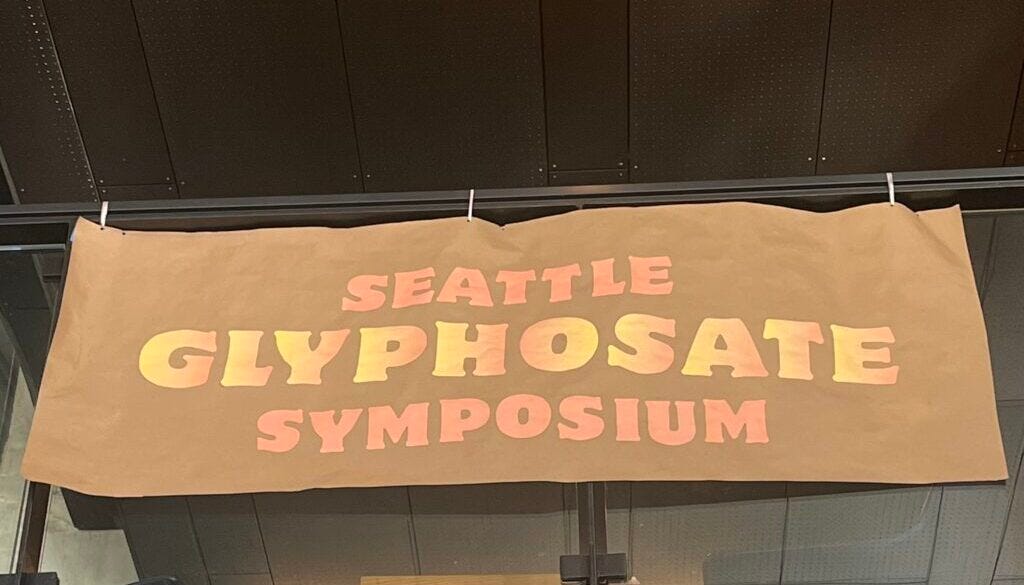
The symposium focused on studies conducted after IARC’s 2015 determination and addressed health threats beyond cancer. At the conclusion of the two-day assessment, a statement (the “Seattle Statement”) was adopted that recounted the many potential deleterious impacts of glyphosate on humans, condemned the use of biased, industry-commissioned research by regulatory agencies to skew safety determinations, and called for more rigorous, unbiased “real science” to resolve this decades-long controversy conclusively.
It’s not looking good for glyphosate, or for the humans who ingest it (biomonitoring surveys have detected glyphosate in samples collected from 70-80% of all people examined).
Glyphosate is the most widely used pesticide in the world, and its use as a pre-harvest desiccant just days before harvest of food crops leads to relatively high levels of residues accumulating in many foods.
The U.S. EPA has long stood by the Monsanto/Bayer narrative that glyphosate is harmless, despite successful court challenges and the recent retraction of a long-used study (ghost-written by Monsanto) that argued the substance is safe.
As the U.S. Supreme Court weighs whether to grant Bayer and other chemical manufacturers legal immunity from personal injury claims so long as they comply with federal labeling requirements based on EPA safety determinations, public scrutiny has soared to unprecedented levels.

The Seattle Statement warns, in part: “There is additional evidence from human and/or animal studies that glyphosate and GBHs increase the risk of multiple adverse health effects in addition to cancer, including diseases of the kidney and liver, and impacts to the reproductive, endocrine, neurological, and other metabolic systems. Children, infants and fetuses are the most susceptible.”
The statement continues, “Further strong evidence finds that glyphosate and GBHs cause genetic damage, oxidative stress, and hormonal disruption — biological changes that can set disease in motion….. The evidence that glyphosate and GBHs harm human health at levels of current use is now so strong that no additional delays in regulation of glyphosate can be justified.”
This laundry list of potential (probable) harms to human health connects glyphosate to the chronic disease epidemic and the food Americans eat. It is not just farmers who are exposed: glyphosate is ubiquitous.
As more science emerges demonstrating the central importance to health of the human gut microbiome (and the brain-gut connection), the role of an ingested weed killer like glyphosate is obvious. Glyphosate works by interrupting the shikimate pathway in plants. Humans don’t rely on the shimitake pathway – but many beneficial bacteria in their guts do. Moreover, some harmful bacteria appear to develop resistance to glyphosate, allowing them to thrive in a condition known as dysbiosis. Research has shown that bees also suffer from glyphosate-induced microbiome damage, weakening their immune systems. One recent study linked glyphosate and gut microbe imbalance with anxiety.
One needn’t earn a master’s degree or PhD (as most of the signatories to the Seattle Statement possess) to understand this threat. Earthworms and other important soil critters, as well as the vital soil microbes that feed plants, are also at risk. The risk of glyphosate extends far beyond cancer, and far beyond humans – much of the current research has studied livestock and other animals.
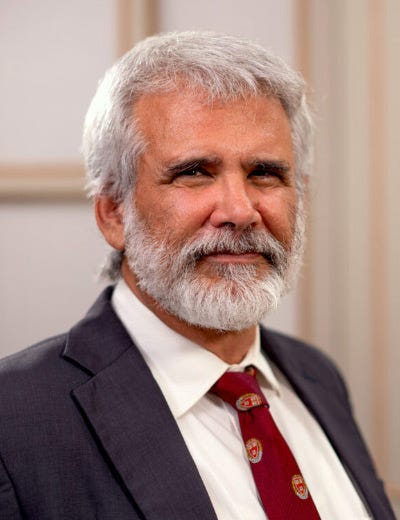
Dr. Robert Malone has chronicled dozens of studies that show the dire impact of glyphosate on fetal development, fertility, and the human reproductive system. High amounts of glyphosate have been detected in 30% of tested baby foods and 90% of tested breakfast cereals. Glyphosate is particularly prevalent in oats, wheat, soy, and lentils.
Following the Seattle Symposium, Bayer issued a statement defending its product, reportedly stating that it “stands behind the safety of our glyphosate-based products which have been tested extensively, approved by regulators and used around the globe for more than 50 years… [N]o health regulator anywhere in the world has ever found glyphosate to pose a threat to human health.”
In view of the voluminous evidence of threats to microbes, bees, earthworms, and humans, this statement is more incriminating than exculpatory. Bayer is unwittingly confirming RFK Jr.’s warning that regulators ignore or dismiss the “real science” of health risks (much like with vaccine injuries). It is also calling 181,000 sick plaintiffs liars.
Thanks to the MAHA movement and research such as that reviewed at the Seattle conference, the cultural noose is closing on glyphosate’s neck. The political and regulatory nooses will follow, regardless of what the U.S. Supreme Court rules in Durnell. Health-conscious Americans no longer need to cite the dated IARC study now that they have a decade’s worth of subsequent incriminating scientific evidence that glyphosate causes human harm. In another decade, the evidence will be even more abundant, and the free market will extinguish glyphosate if the EPA has not.
If the regulatory agencies charged with protecting Americans fail to acknowledge the known risks of glyphosate, and the SCOTUS uses labeling laws designed to protect consumers to instead shield chemical companies, then the job of protecting the future health of children will depend on We the People.
Related Reading:
Is Congress Shielding Chemical Corporations From Accountability? - Liberty Nation News
Why Kennedy Is Right About Glyphosate - by John Klar
Legal Immunity for Pesticide Manufacturers? - American Thinker
Justices to hear dispute over cancer warnings on pesticide labels | SCOTUSblog

I just discovered a cereal called lovebirds. On the box it says glyphosate free. Great marketing tool.
Fortunately, glyphosate is one of RFK Jr's primary concerns. He promised tangible solutions, which we are expecting any day now.