


By Adam Garrie and Staff, The MAHA Report
Representatives in the Tennessee House of Representatives on Wednesday were set to vote on HB 809, a bill that, if passed, would have allowed such companies as Bayer—the maker of Roundup—to evade all responsibility should its products cause people harm.

Wednesday began as one of the last opportunities to kill the bill, if enough members of the Tennessee House Judiciary Committee had voted against it. Before the vote, activists worried that the House was fast-tracking it, sans transparency.
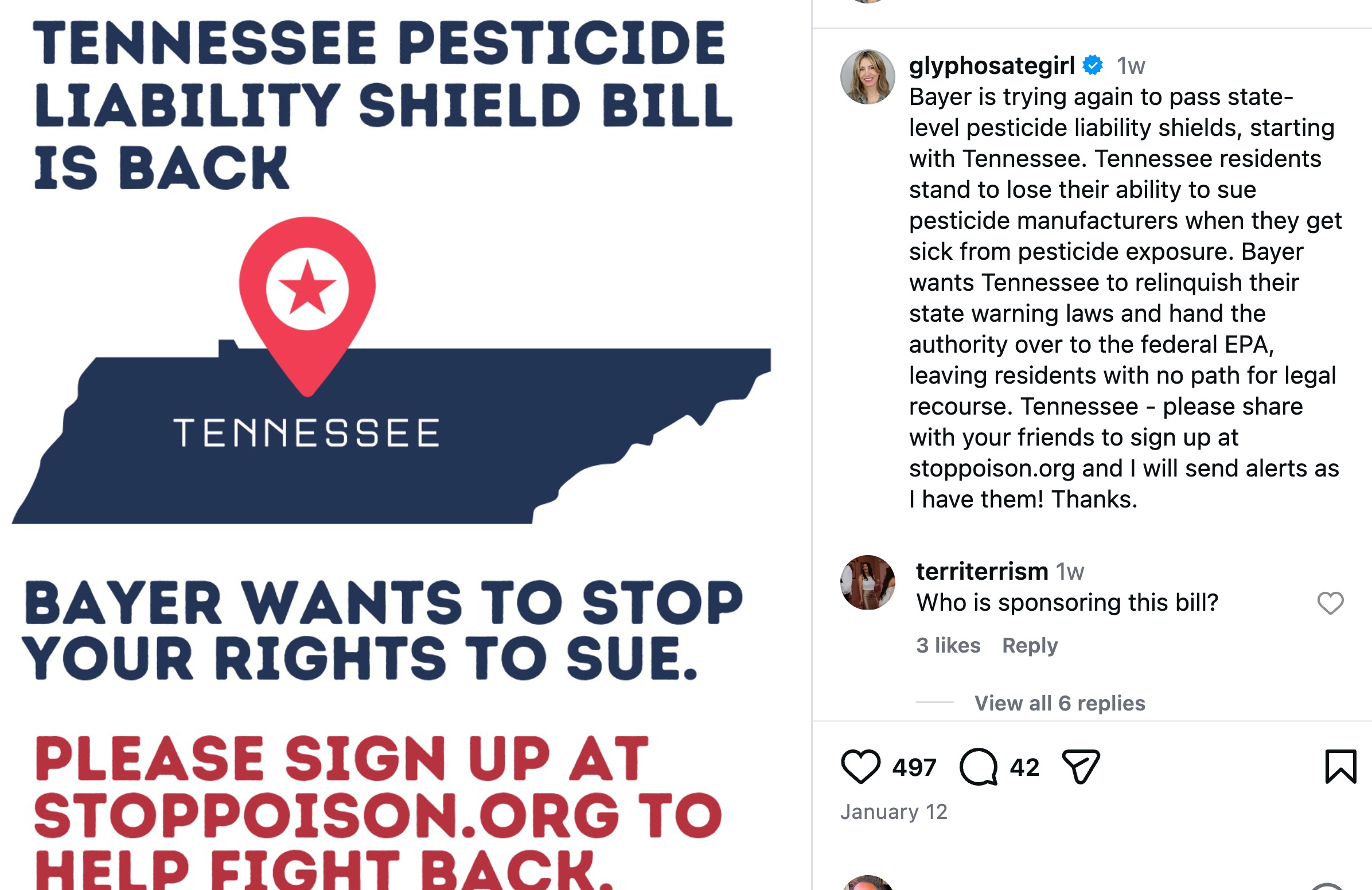
Kelly Ryerson, Co-Executive Director of American Regeneration, stated: “HB 809 hands Bayer and other chemical giants a free pass at the exact moment we should be demanding more transparency and greater accountability. This Bill tells farmers, groundskeepers, and families harmed by pesticides that their pain or death is just the cost of doing business, and that is morally indefensible.”

The MAHA Institute in conjunction with other groups and local activists led efforts to rally opposition to the bill. Groups that campaigned against the bill included Stand For Health Freedom, Moms Across America, and American Regeneration.
That activism paid off early Wednesday afternoon when House Bill 809 was taken off notice, meaning that the Judiciary Committee elected not to vote on it. According to Dr. Alexandra Munoz, a leading toxicologist, the bill likely did not have enough votes to pass. But she cautioned it could return with little notice.
“For those following the TN pesticide liability shield situation, it was supposed to be voted on today in committee,” wrote Ryerson in an email. “Due to major public pushback, and the help of conservative influencers, the bill was pulled. It could come back up, but we are hopeful it will not for the time being.”
But Ryerson noted that another state, Kansas, was due to start the process on Wednesday with “their own version of the pesticide liability shield, HB 2476.”
Courts across the country have found that Bayer failed to warn customers that exposure to Roundup, the popular herbicide, can cause non-Hodgkin lymphoma (NHL), a deadly blood cancer.
But, as with Tennessee and Kansas, major chemical companies are not deterred. And the U.S. Supreme Court recently agreed to hear Bayer’s case, Monsanto v. Durnell. According to public reports, a decision is expected by June 2026; what the Supreme Court decides will likely impact on-going state pesticide litigation.
If ever passed, HB 809 would protect all pesticide and herbicide makers—including Bayer, which is not based in the United States—from legal accountability by providing them with an extremely broad liability shield.
Apart from vaccine makers, few other companies enjoy such protections from our justice system.

If the bill had passed by the Tennessee legislature and signed by the governor, even the U.S. Supreme Court’s expected ruling—which will decide whether or not Bayer must comply with state regulations that would force the company to warn of the dangers of Roundup—will not have any positive effect on Tennesseans.
Dr. Muñoz said, “This bill is not just about glyphosate: it applies to over 57,000 pesticide products and all future pesticides, including chemicals linked to cancer, Parkinson’s disease, endocrine disruption, infertility, and impaired sexual development.”
Dr. Muñoz added, “This industry already knowingly sells carcinogens without cancer warnings. What will they sell when no one can hold them accountable?”
This is unbelievable, unconscionable. Which Tennessee House representatives want to vote this bill in? They need to be voted out.
There is also a vote in KANSAS today!
Kansas: HB 2476 was introduced yesterday on Tuesday, January 20, 2026, and the bill is up for a vote in the House Agriculture and Natural Resources Committee, with a hearing scheduled TODAY, Wednesday, January 21, 2026, at 3:30 pm Central Time Zone (CT). While it is important to contact elected officials to speak out, you can also submit testimony to the Committee by emailing, in PDF format only, to the following address (H.Agriculture@house.ks.gov).