


[The article below was written by Sayer Ji and first appeared on his Substack. Reprinted with Sayer’s permission.]
HHS has opened the first federal health inquiry into wireless radiation in a decade. The comment window closes October 21. The research it is asking for has been sitting in an open database for years — and your five minutes can put it on the record.


On Wednesday evening, Secretary Kennedy posted a reminder that most of the country scrolled past:
“13 days left to comment. HHS is examining what electromagnetic fields and radiofrequency radiation may mean for human health — and we want to hear from you... We also welcome research, clinical observations, data, and other evidence that can help us identify what we know, what we still need to learn, and where federal research should go next.” — @SecKennedy, Oct 8, 2026
I want to take that invitation literally.
For more than fifteen years, GreenMedInfo has indexed the peer-reviewed literature on electromagnetic field exposure under a single heading: Electromagnetic Field Harms. As of this week, that page holds 1,009 research abstracts, tagged to 156 distinct health outcomes and 30 natural substances studied for protective effects. Every record links to its PubMed entry. Anyone can read it. Nobody in the federal government has ever been asked to.
Until now.
This article does three things. It explains, in plain language, what the index actually shows — including the parts that cut against the easy story. It explains why the timing matters, which comes down to a 1996 rulebook and a 2021 court decision that was never answered. And it shows you how to file a comment in five minutes, whether you are a parent with a story or a physician with a caseload.
What the index shows
Here is the headline figure in context.
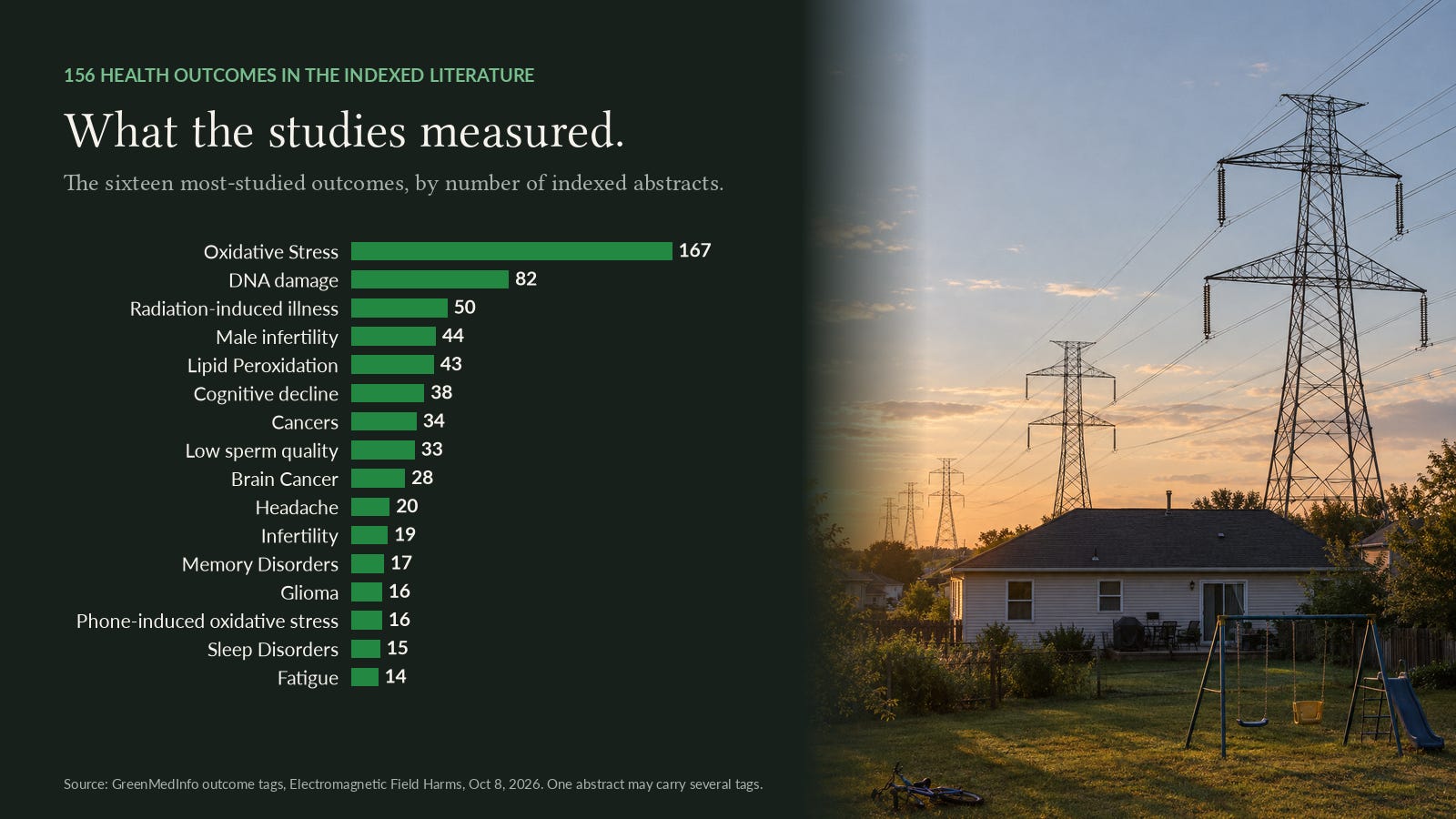
The outcomes with the most studies behind them are not exotic. They are oxidative stress (167 abstracts), DNA damage (82), male infertility (44), lipid peroxidation (43), cognitive decline (38), cancers (34), low sperm quality (33), brain cancer (28), headache (20), sleep disorders (15) and fatigue (14). Further down the list: childhood leukemia, acoustic neuroma, salivary gland disease, hearing disorders, ALS, Alzheimer’s, autism spectrum disorders, birth defects, hypothyroidism, autoimmune disease.
Oxidative stress and DNA damage sit at the top because they are the mechanistic core of this literature. When a cell is exposed to a radiofrequency or power-frequency field in a laboratory, the most commonly reported response is a rise in reactive oxygen species and a measurable increase in DNA strand breaks. That is what hundreds of these studies measured, and it is the biological bridge between “non-ionizing radiation cannot break chemical bonds” — which is true — and “non-ionizing radiation cannot harm cells” — which the literature does not support.
“It’s just rat studies”
This is the first objection anyone raises, so here is the breakdown.
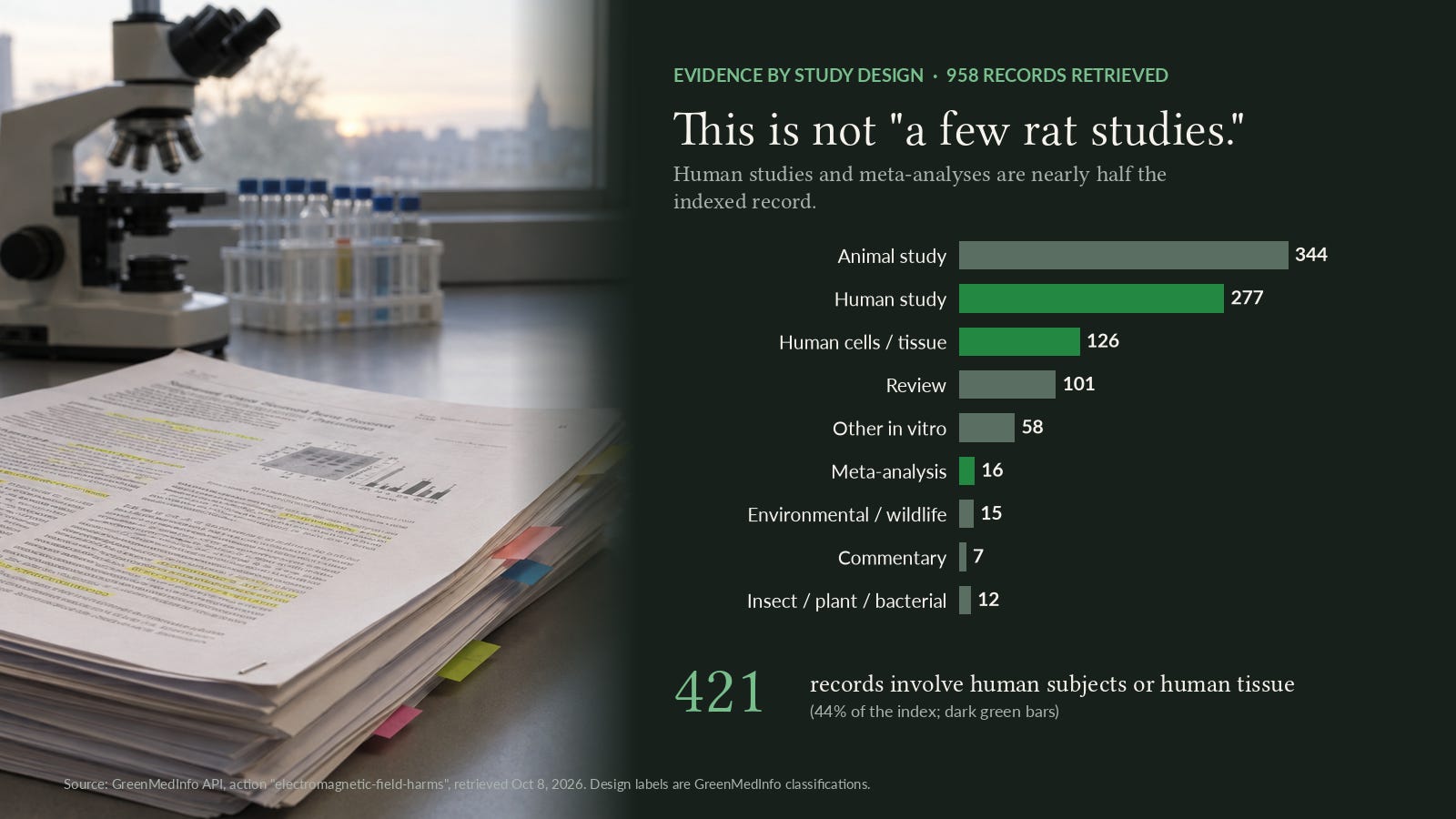
Of the 958 unique records I pulled from the index’s public interface this week, 344 are animal studies. But 277 are human studies, 126 are studies in human cells and tissue, 16 are meta-analyses, and 101 are reviews. Human-subject and human-tissue evidence makes up 421 records — 44 percent of the index. The leading journals are Bioelectromagnetics, Electromagnetic Biology and Medicine, International Journal of Radiation Biology, Environmental Research and Mutation Research. Specialist journals, not fringe ones.
What the meta-analyses say — including the null ones
Sixteen meta-analyses is a lot for a field that is routinely described as having “no evidence.” I pulled each one from PubMed this week and checked the numbers. Here is what their authors reported.
Technical callout — pooled estimates as published
Brain tumours and mobile phones. Yang et al. (PLoS One, 2017; 11 studies, 6,028 cases): mobile phone use of ten years or more was associated with glioma, OR 1.44 (95% CI 1.08–1.91); same-side use, OR 1.46 (1.12–1.92); low-grade glioma, OR 2.22 (1.69–2.92). No association with high-grade glioma. PMID 28472042
Hardell et al. (Int J Oncol, 2008): ten-plus years of same-side use, glioma OR 2.0 (1.2–3.4); acoustic neuroma OR 2.4 (1.1–5.3). Overall, all users: OR 0.9. PMID 18425337
Myung et al. (J Clin Oncol, 2009; 23 studies): ten-plus years of use, tumour OR 1.18 (1.04–1.34). Blinded studies showed harm; unblinded studies showed “protection.” PMID 19826127
Wang et al. (World Neurosurg, 2018): ever-use OR 1.03 (0.92–1.16) — not significant — “but there could be increased risk in long-term users.” PMID 29709736
Childhood leukemia and magnetic fields. Zhao et al. (Leuk Res, 2014; 11,699 cases, 13,194 controls): fields of 0.4 microtesla or more versus under 0.1, OR 1.57 (1.03–2.40); acute lymphocytic leukemia, OR 2.43 (1.30–4.55). PMID 24388073 Wartenberg (Bioelectromagnetics, 2001): “If an association exists, as many as 175–240 cases of childhood leukemia in the US may be due to magnetic field exposure.” PMID 11170120
Cancer and ELF fields generally. Zhang et al. (Environ Int, 2016; 42 studies, 13,259 cases, 100,882 controls): OR 1.08 (1.01–1.15) overall; United States 1.10; residential exposure 1.18 (1.02–1.37). European studies did not agree. PMID 26703095
Breast cancer. Chen et al. (PLoS One, 2013; 23 studies): OR 1.07 (1.02–1.13); estrogen-receptor-positive 1.11. PMID 23869239 Zhao et al. (Eur J Gynaecol Oncol, 2014; 16 studies): OR 1.10 (1.01–1.20); premenopausal 1.25 (1.05–1.49). PMID 24984538
Sperm. Adams et al. (Environ Int, 2014; 10 studies, 1,492 samples): mobile phone exposure associated with reduced motility, −8.1% (−13.1 to −3.2), and viability, −9.1% (−18.4 to 0.2); “consistent across experimental in vitro and observational in vivo studies.” PMID 24927498 Liu et al. (Andrology, 2014): no adverse effect in the pooled human studies; significant harm in in-vitro and animal studies. PMID 24700791
Neurodegeneration and occupational ELF-MF. Jalilian et al. (Neurotoxicology, 2018; 20 studies): Alzheimer’s RR 1.63 (1.35–1.96), with a caution about heterogeneity and publication bias. PMID 29278690 Huss et al. (Bioelectromagnetics, 2018; 20 studies): ALS sRR 1.14 (1.00–1.30); electrical occupations 1.41 (1.05–1.92). PMID 29350413
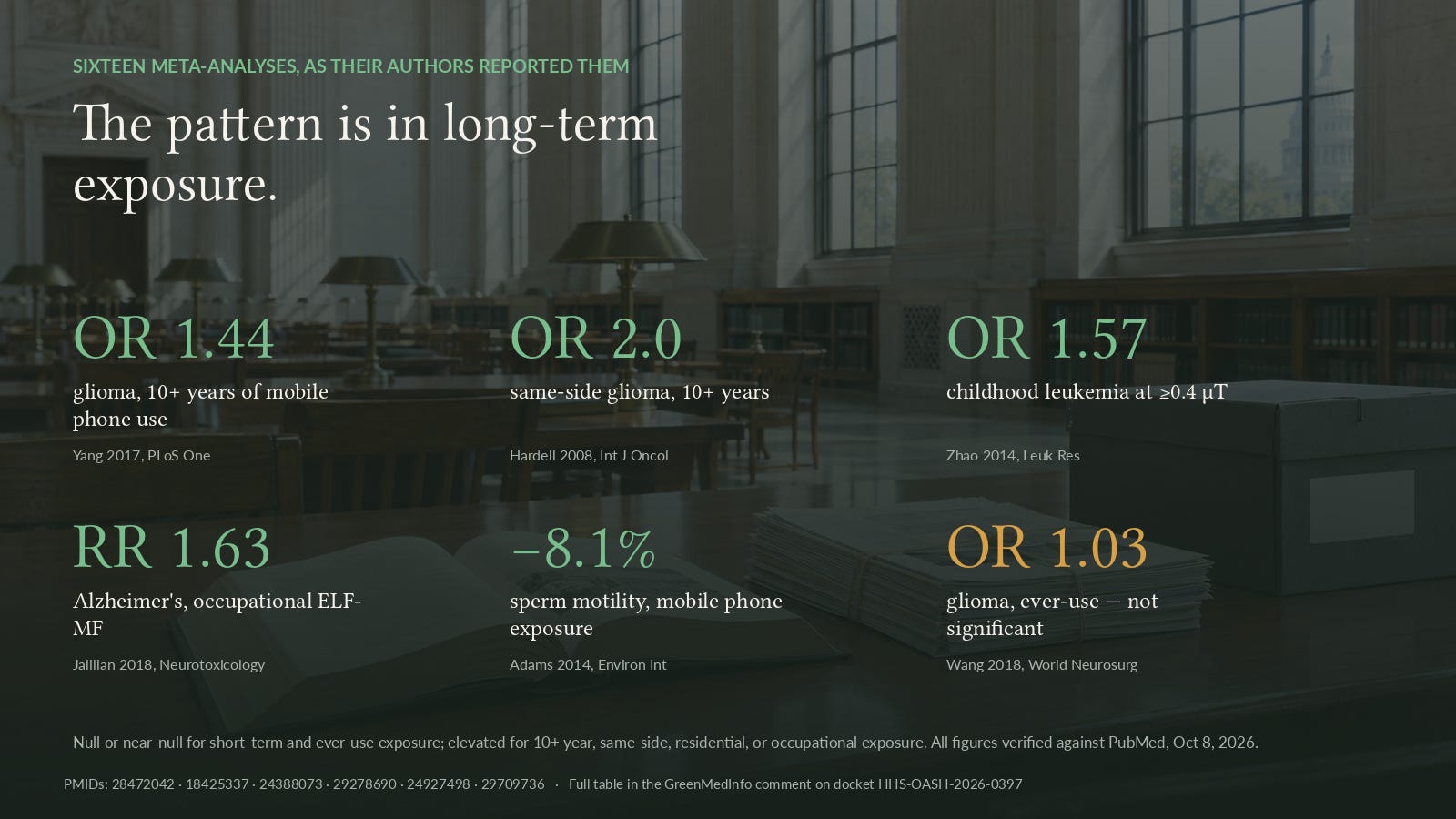
Read those together and a pattern appears that is more interesting than either “EMF causes cancer” or “EMF is harmless.” The pooled estimates for short-term or any-use exposure are null or close to it. The pooled estimates for long-term (ten-plus years), same-side, residential or occupational exposure are elevated, and often significantly so — across different research groups, countries and decades. That is what a latency-dependent effect looks like. It is also exactly the kind of signal that a one-size thermal exposure limit cannot see, because the limit was never designed to.
Two studies that speak directly to “below current limits”
Question 12 of the HHS notice asks for evidence of harm at levels below current federal exposure limits. Two indexed studies answer it almost word for word.
In 2019, Zendehdel and colleagues measured DNA damage in the blood of 29 power-utility workers and 28 controls. The median magnetic field at the work sites was 0.85 microtesla — below the occupational threshold set by the American Conference of Governmental Industrial Hygienists. DNA damage was significantly higher in the exposed workers. The authors’ conclusion: “Exposure to ELF-MF at levels less than the ACGIH exposure limit can produce DNA strand breaks.” (Toxicol Ind Health, PMID 31138035)
The same year, Esmailzadeh and colleagues compared 462 women with unexplained infertility to 471 controls and mapped each home’s distance from high-voltage power lines. Women living within 500 metres had more than four times the odds of infertility after adjustment (aOR 4.44, 95% CI 2.77–7.11). Their conclusion: “The current safety guidelines for electromagnetic fields exposure seems to be not adequate for protecting people from the hazardous effects of the field.” (Int J Occup Environ Med, PMID 30685773)
Neither study proves causation. Both were published in peer-reviewed journals, both measured exposure rather than asking people to remember it, and both found effects where the rulebook says there should be none.
Why the timing matters: 1996, 2021, 2026
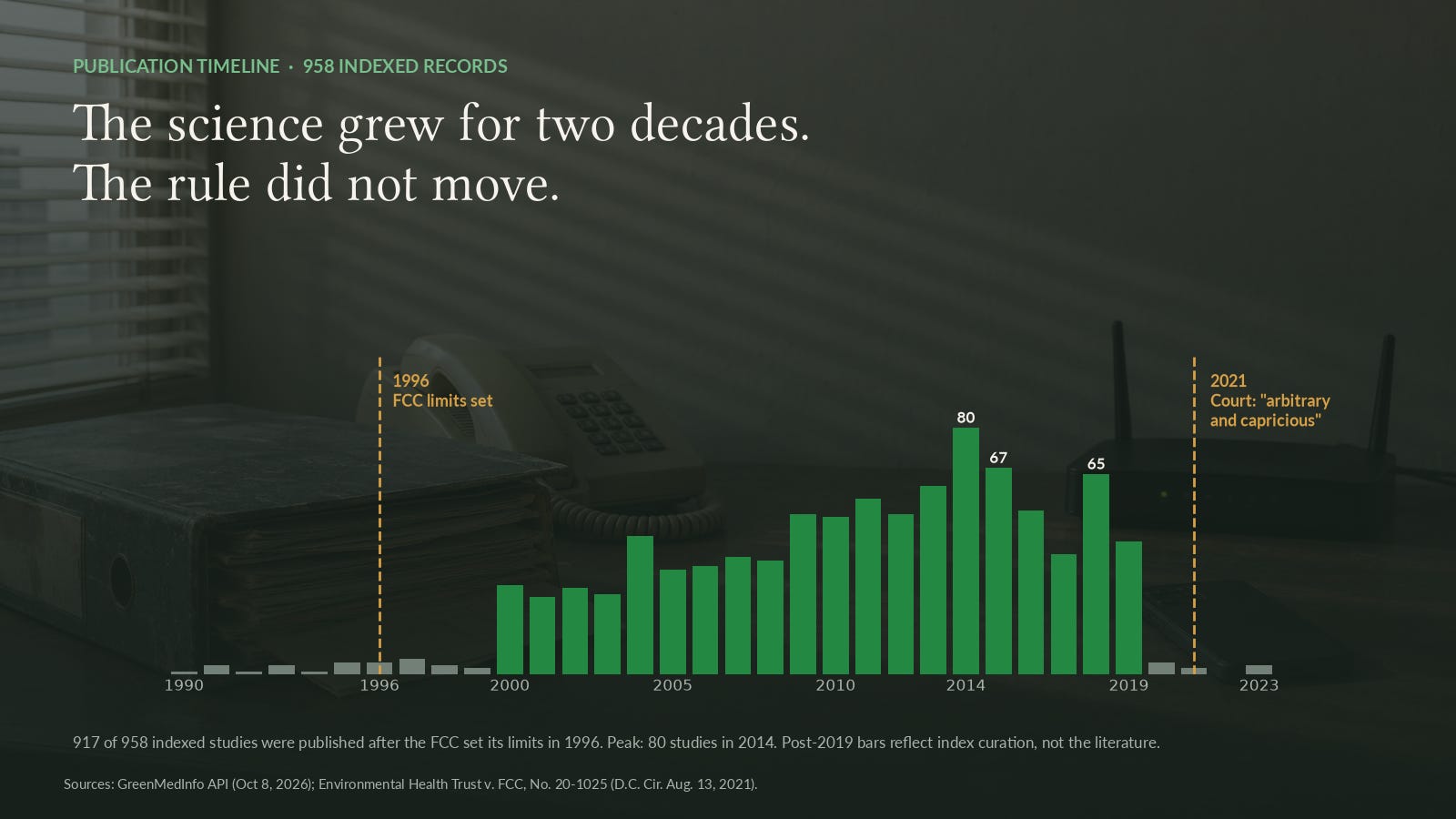
The federal limits for human exposure to radiofrequency radiation were adopted by the Federal Communications Commission in 1996. They are built around one idea: RF energy is dangerous when it heats tissue, so keep exposure below the heating threshold. In 1996 that was a defensible place to start. There was no Wi-Fi in homes, no smartphone in every pocket, no router in every classroom.
Look at the timeline above. In the 1990s the index records a handful of studies per year. In 2000 it records 29. In 2009, 52. In 2014, 80. The literature on non-thermal biological effects — oxidative stress, DNA damage, fertility, cognition — grew for two decades while the limit it bore on did not move.
In 2013 the FCC itself asked whether the limits should be revisited. In 2019 it answered: no. Environmental Health Trust, Children’s Health Defense and others sued. On August 13, 2021, the U.S. Court of Appeals for the D.C. Circuit ruled that the FCC’s decision was “arbitrary and capricious.” The court found the Commission had failed to respond to “record evidence that exposure to RF radiation at levels below the Commission’s current limits may cause negative health effects unrelated to cancer,” had failed to address the impacts on children, long-term exposure, and the ubiquity of wireless devices, and had shown “a complete failure to respond to comments concerning environmental harm.” It noted roughly 200 comments from people reporting illness or injury that the agency had not addressed. It sent the matter back to the FCC with instructions to explain itself. (Environmental Health Trust v. FCC, No. 20-1025)
The FCC had relied on the Food and Drug Administration’s assurance that the limits were fine. The court said an agency cannot lean on another agency’s conclusion if that conclusion comes without an explanation. Five years later, no explanation has been produced.
Meanwhile the federal government’s own science had moved. In November 2018 the National Toxicology Program, an HHS agency, released the results of a ten-year, ~3,000-animal study of cell-phone radiofrequency radiation. Its conclusion, in NTP’s own evidence categories: “clear evidence” of malignant schwannomas of the heart in male rats, and “some evidence” of malignant gliomas of the brain. (NTP, Cell Phone Radio Frequency Radiation) An Italian group, the Ramazzini Institute, independently reported increases in the same rare tumour types at far lower, tower-like exposure levels. The FDA responded that the studies were not designed to test cell-phone safety in humans and that no conclusions about human risk could be drawn from them.
So this is where we stand on October 9, 2026. The health agency that was supposed to supply the explanation is now, for the first time, asking the public for the evidence. That is the Request for Information published at 91 FR 59792 on September 21, under docket HHS-OASH-2026-0397, signed by Secretary Kennedy. It asks eighteen numbered questions, and it closes at 11:59 p.m. Eastern on October 21. As of this week the docket holds about 1,800 comments. It should hold ten times that.
What the index does not show — and why I’m telling you
I run GreenMedInfo, so let me say plainly what the index is and is not.
It is a curated index, not a systematic review. Our editors select studies for relevance to a taxonomy of substances, conditions and actions. That means the index over-represents studies that found something relative to the literature as a whole; that is what makes it useful as a finding aid and what makes it unsuitable as a denominator. Inclusion of a study is not endorsement of every number in it. A study’s absence from the index does not mean it doesn’t exist. And the index thins after 2019 — a reflection of our curation cadence, not of the field.
The 30 protective substances deserve the same honesty.
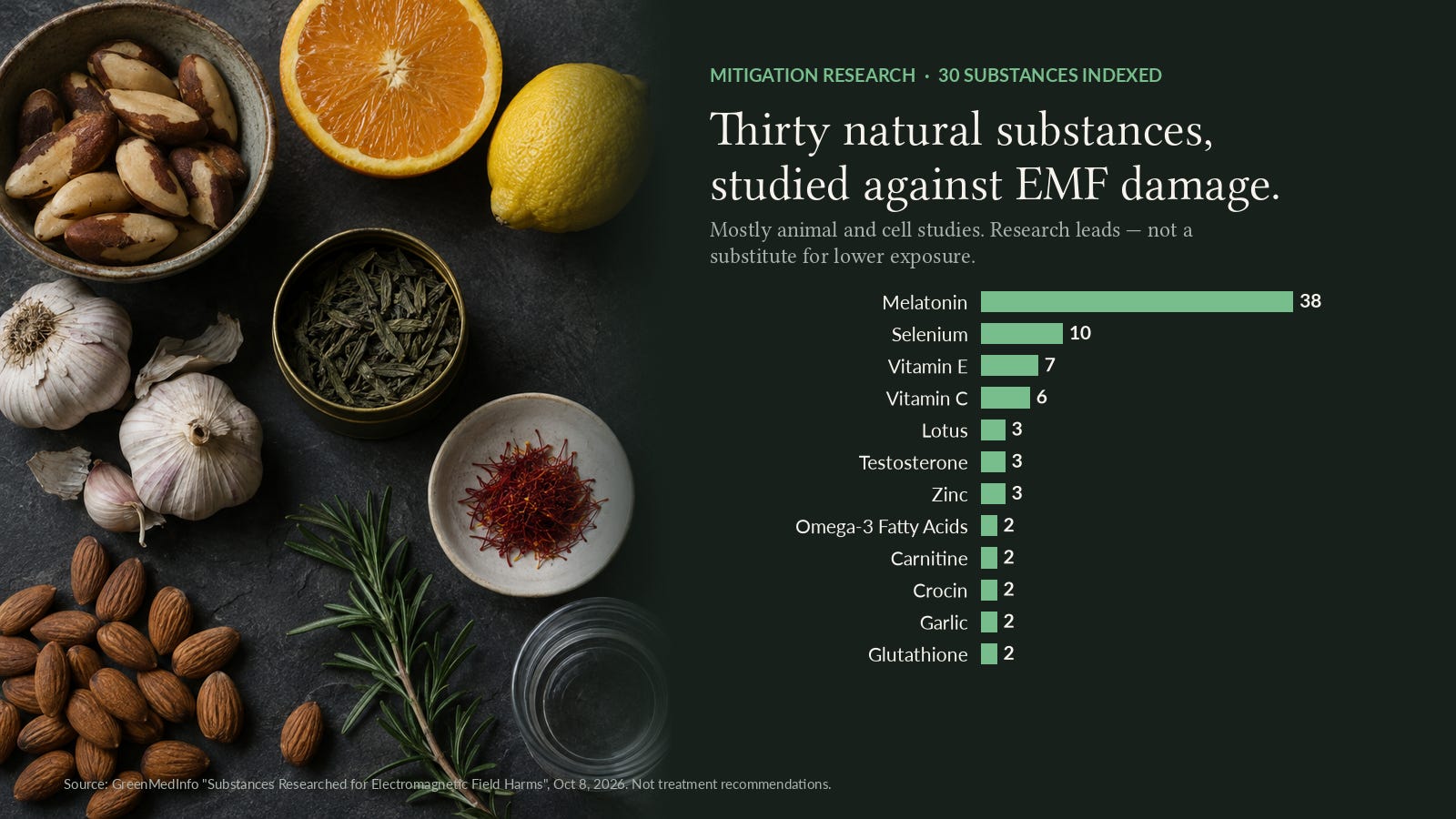
Melatonin appears in 38 indexed studies as a protective agent against EMF-induced damage; selenium in 10; vitamins E and C in 7 and 6; zinc, lotus, omega-3 fatty acids, garlic, crocin, green tea, N-acetylcysteine and rosmarinic acid in a handful each. Almost all of these are animal or cell studies. They tell us something real about biology — that EMF damage in these models runs through oxidative pathways that antioxidants can modulate — and they are legitimate leads for a federal research program on biological resilience. They are not a reason to carry your phone in your pocket, and nobody should read them as treatment advice. Exposure reduction comes first. Always.
I am telling you all of this because the strongest case here does not need exaggeration. A thousand peer-reviewed studies exist. Four hundred of them involve human subjects or human tissue. Sixteen are meta-analyses, and most of those point the same direction once you look at long-term exposure. The federal rule they bear on is thirty years old and was declared unlawfully unexamined by a federal court five years ago. That is the case. It holds up.
How to file your comment in five minutes

HHS wants two kinds of input, and it says so in the notice: experience and evidence. You can give either or both. One comment per person. Comments are public, so leave out your medical records, other people’s names, and anything you would not want searchable.
Step 1. Go to regulations.gov/docket/HHS-OASH-2026-0397 and click Comment.
Step 2 — Question 2. Say which perspective you represent, in one sentence. “I am responding as an individual consumer and parent.” Or: “I am a family physician in private practice.”
Step 3 — Question 3, if you have an experience. The notice gives you the outline; use it as headings: - the source (phone, Wi-Fi, smart meter, tower, workplace equipment) - when exposure began, and how much - what you experienced - when symptoms appeared relative to exposure, and whether a change in exposure changed them - whether you sought care (you may share a diagnosis, or not) - whether you reduced exposure, and what happened - any documentation — measurements, studies
Keep it factual. Separate what you observed from what you suspect. The court faulted the FCC for ignoring 200 such accounts; make yours one it cannot ignore.
Step 4 — Questions 12, 16 and 18, if you want to add evidence. Paste the link to the GreenMedInfo Electromagnetic Field Harms index. Then pick two or three studies from the technical callout above that matter to you — a parent might choose the childhood leukemia meta-analysis; a couple trying to conceive might choose Adams 2014 and Esmailzadeh 2019 — and paste their PubMed links with one sentence each on what they found. Under Question 16, say what you want studied. Under Question 18, ask for something concrete: a published federal evidence review of the existing literature, with a timetable.
Step 5. Submit before 11:59 p.m. ET on October 21. Save your confirmation number.
If you are a clinician or researcher, Question 4 is written for you: patterns in your practice, onset, exposure patterns, what you would want surveilled. A fuller template for practitioners, and a copy-paste citation pack of the sixteen meta-analyses, is here: [TOOLKIT LINK].
GreenMedInfo will file its own organizational comment next week, mapping the index to each of the eighteen questions and attaching the full record set — every study, every PubMed ID — so that it is on the federal record permanently. Once it posts, you are welcome to cite it in yours.
What happens after October 21
A Request for Information is not a rule. HHS is under no obligation to do anything with what it receives. But it has done something no federal health agency has done in a decade: it has asked. The quality of the answer will decide what it can do next — whether the evidence review the D.C. Circuit demanded in 2021 finally gets written, whether NIH is directed to resolve the latency question, whether CDC looks at the electrical workers, whether the FDA produces the explanation it owes.
Secretary Kennedy’s post ended with “where federal research should go next.” The honest answer is: toward the thousand studies that already exist, and then beyond them. You have eleven more days to say so.
File your comment: regulations.gov/docket/HHS-OASH-2026-0397 Browse the evidence: greenmedinfo.com/problematic-action/electromagnetic-field-harms

Grid Growth West has targeted my family farm for EMF towers. The farm has been in my family for 158 years. We are concerned that the EMF radiation will harm the natural animal habitats, human health, and affects on crops grown. We need your help to stop this madness.
I’m old, I have no idea if I have damage from EMF that includes working very closely with radar devices in the Army, back in the 80s. I would probably have to be examined by somebody very familiar and look at my history.
I read this interesting Substack entry just the other day and I actually think I saw something similar on an Israeli news site named YNET, but here it is on Substack
https://substack.com/@normanjames1/note/p-219388475?r=2f3df4&utm_medium=ios&utm_source=notes-share-action