


Walk into an Internet café, nearly anywhere in the world, and you’ll see people of all ages, heads down, spine curled, eyes fixed on their cellphone or laptop.
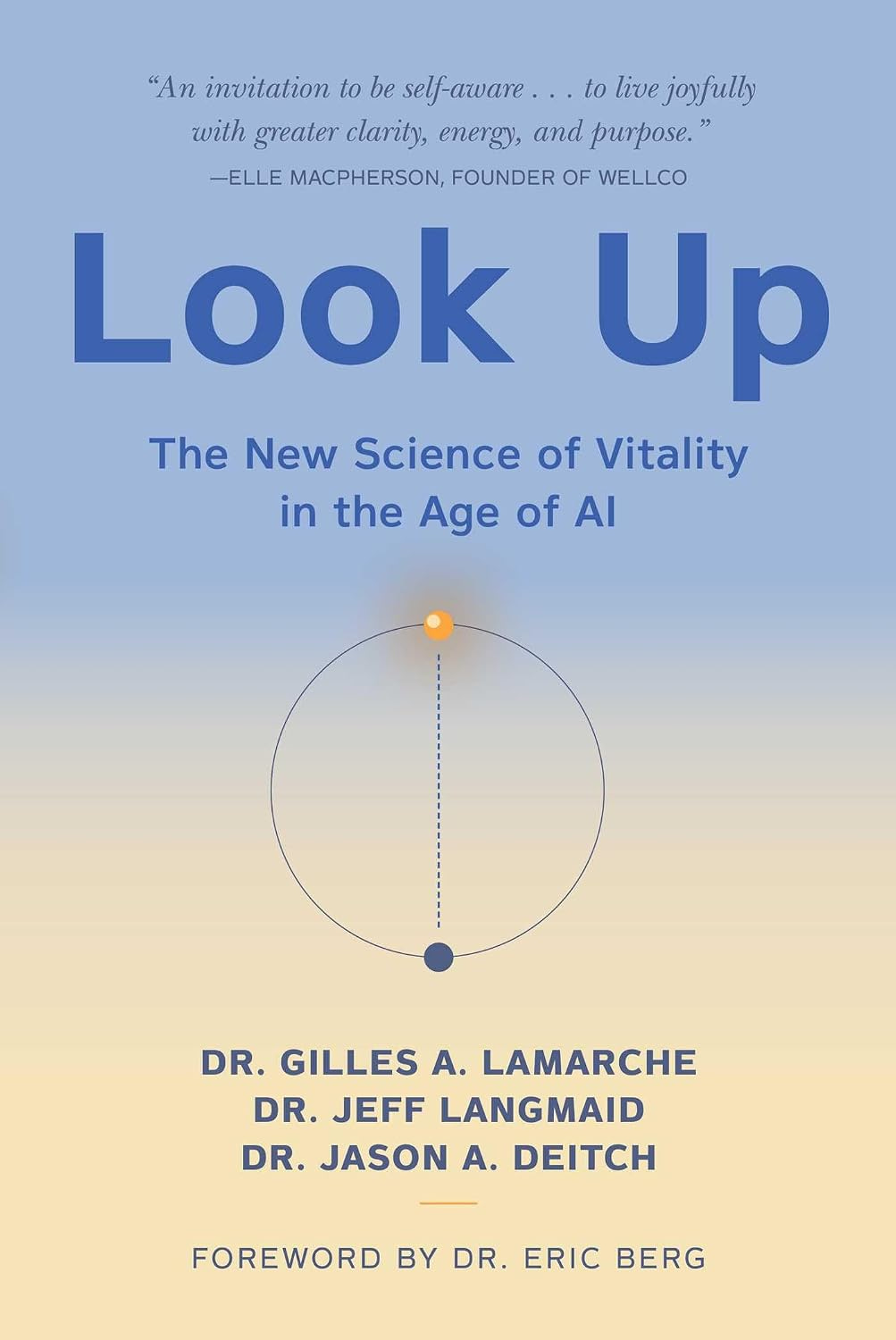
Look Up: The New Science of Vitality in the Age of AI (MAHA Books, Sept 8), written by chiropractors Dr. Gilles A. LaMarche, Dr. Jeff Langmaid, and Dr. Jason A. Deitch (with an introduction written by Dr. Eric Berg, is a compelling manifesto against what the authors term “Tech Posture Syndrome” — the subtle, cumulative toll of forward head posture that burdens the cervical spine with up to sixty extra pounds of force.

Far from another wellness screed, Look Up is a tightly argued, evidence-based call to reclaim the body’s innate intelligence through small, deliberate shifts.

The book opens powerfully with the story of Maya, a 38-year-old UX researcher whose persistent fatigue defies standard medical tests. She eats well, exercises, manages stress, yet operates as “a fraction of herself.” Her issue, the authors reveal, isn’t in her bloodwork but in her posture: head tilted forward for hours, compressing the diaphragm, shallowing breath, and signaling chronic low-grade stress to her nervous system. This isn’t aging or anxiety in the abstract; it’s biomechanics. Drawing on Dr. Kenneth Hansraj’s influential 2014 research, the authors quantify the escalating load — 27 pounds at 15 degrees of tilt, 60 pounds at 60 degrees — and trace its ripple effects on vagal tone, focus, mood, and even child development.

LaMarche’s own remarkable recovery anchors the narrative. Diagnosed in 2003 with primary pulmonary hypertension and an enlarged heart, given two years to live, he retired from practice expecting death. A moment of reckoning led him back to chiropractic care, addressing severe upper cervical subluxations. His pulmonary pressure normalized, his heart resized, and decades later, at 70, he won a gold medal in the 400m at the 2025 Huntsman World Senior Games. It’s an extraordinary tale, told without false miracles, emphasizing consistent nervous system support over heroic intervention.
The authors — with over 60 combined years in practice — argue convincingly that modern screens create a “heads-down civilization,” warping everything from breathing patterns to social connection. Chapter 2’s exploration of impacts on children is particularly sobering: developing nervous systems locked in forward tilt risk not just poor posture but diminished resilience, learning, and emotional regulation.
Yet the tone of the entire book remains optimistic. This isn’t anti-technology polemic; Part III explores “heads-up computing,” AR, and AI as potential allies when properly aligned with human physiology.

At the heart of Look Up is the disarmingly simple “Twenty-Second Lift,” the book’s minimum effective dose for reset. Readers are guided to gently lengthen the cervical spine (imagine a thread pulling the crown of the head upward), roll shoulders back, breathe deeply (four-count inhale, six-to-eight-count exhale), widen the gaze to the horizon, move briefly, and smile. Performed a few times hourly, this micro-practice counters the default slump, improves vagal tone, and shifts the autonomic nervous system from vigilance toward safety and connection. It pairs with a “sensory diet,” morning/evening alignments, movement snacks, and the overarching discipline of PAIN: Pay Attention Inside Now.
This reframing — from painkiller to pain detector — is one of the book’s sharpest insights. Rather than silencing whispers (tight neck, afternoon fog, shallow sleep), we learn to heed them as actionable signals. The practices require no new time blocks or equipment, making them radically practical for knowledge workers, parents, and teens alike. Composite patient stories like Maya’s and Marcus’s (the latter benefiting inadvertently from smart glasses that keep his gaze forward) humanize the science without sensationalism.

The book is written with clean and motivational prose, without descending into hype — blending personal vulnerability, clinical insight, and foresight.
In our AI-saturated moment, Look Up is timely. It positions human vitality not as nostalgia but as the essential foundation for thriving alongside, rather in competition with, technology. By honoring Universal Intelligence (nature’s design), Innate Intelligence (the body’s wisdom), and artificial intelligence (as servant, not master), the authors restore a sane hierarchy. The appendices — including a 30-day challenge and guidance for practitioners and tech leaders — expand the book’s usefullness.
Look Up won’t replace medical care for serious conditions, as the authors repeatedly caution. But for the millions of people feeling vaguely “off” despite clean labs, it offers a transformative map. One minute per hour, invested consistently, can produce profound change. In a culture increasingly addicted to the downward gaze, this book encourages us all to lift our eyes — and, with them, our potential. It’s required reading for anyone with a spine and a screen.
[Look Up: The New Science of Vitality in the Age of AI (MAHA Books, Sept 8), written by chiropractors Dr. Gilles A. LaMarche, Dr. Jeff Langmaid, and Dr. Jason A. Deitch, is published by MAHA Books, a division of Skyhorse Publishing. It’s available for pre-order from Amazon.]
I built a thriving practice on postural issues including text neck or formerly called FHP. Posture has such REAL effects on so many aspects in a person's day to day LIFE. This book looks GREAT to have as a resource!
This book couldn't be coming out at a better time.