


In the 2024 presidential election, Timothy Mellon was the largest individual contributor to the campaigns of both Donald Trump and Robert F. Kennedy Jr., serving as a lifeline to Kennedy’s courageous bid to challenge Joe Biden for the Democratic nomination while also starting a health revolution in America.
Mellon gave a stunning $151 million to Trump’s super PAC, and $25 million to PAC supporting Kennedy. He also provided significant financial backing for Children’s Health Defense, which until 2023 was chaired by Robert F. Kennedy Jr.
But who is Timothy Mellon?
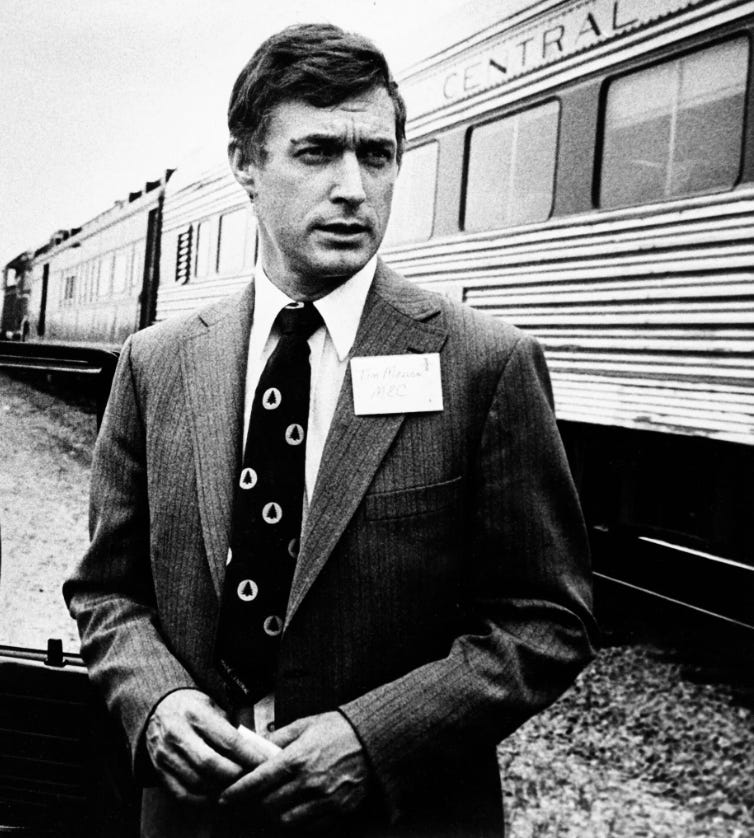
When The New York Times published an article about him in 2025, reporting that he was the anonymous donor who gave $130 million to the U.S. government to pay the troops during the budget shutdown, the only photo they could find of him was from 1981.
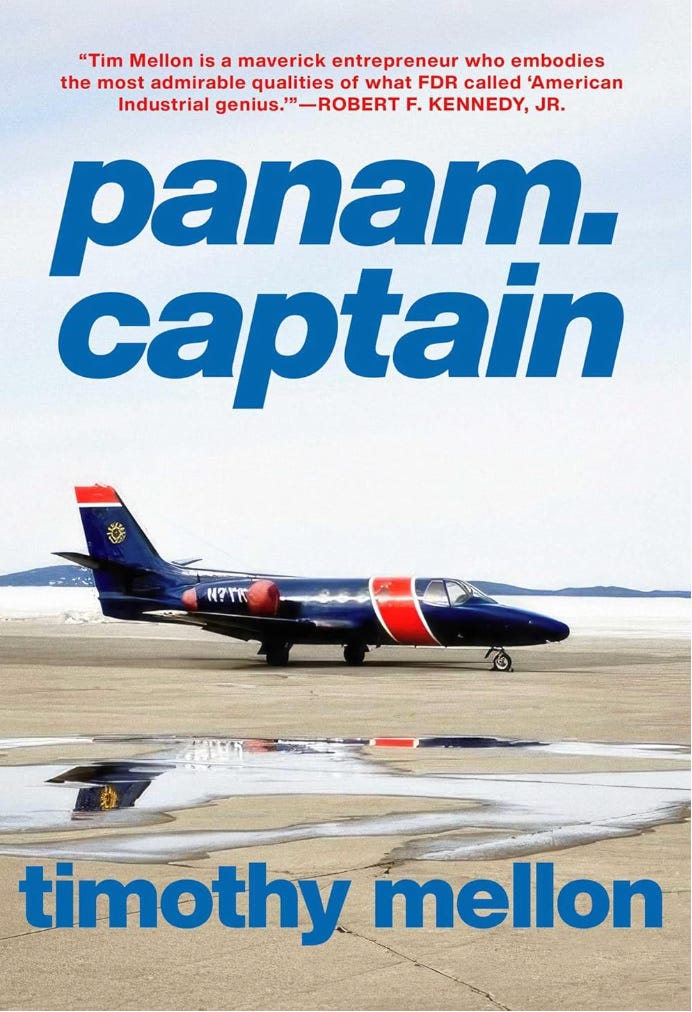
Luckily, Mellon has written a book, PanAm. Captain, that reveals far more than that old picture; it tells a remarkable, picaresque life journey of adventure and learning.
Mellon recounts his childhood and school years in the 1950s, then moves on to his career as a pilot, including his stewardship as chairman of PanAm Systems for a time. He takes us to the halls of Yale University, to the skies as a pilot, and through marriages and business ventures.
He graduated from Yale and was admitted to Yale Law School, but quickly dropped out to study city planning and then switched again to immerse himself in computer programming.
Computer programming led Mellon into several business ventures until he settled on cutting and coating railroad ties. Soon, he jumped the tracks (literally) into the railroad business, buying up and streamlining various declining railroad companies. This, in turn, led him to purchase the former Pan Am airline franchise out of bankruptcy and eventually learn to fly the company’s 727s so he could serve as a pilot.
He built numerous homes in Connecticut, Rhode Island, and Wyoming, as well as a Norwegian “loft” home made of pine logs, and a stave church patterned after historical Norwegian examples.
What matures from this journey is a worldview constructed not from classroom studies or elitist backroom dealings, but rather from a blue-collar work ethic and a disdain for unscrupulous gain. These lessons begin to coalesce in the later chapters as the author’s life lessons converge with his retelling.
The book’s underlying messages come slowly, but they’re worth the wait.
Mellon of course was born into the Mellon banking family, the grandson of Gilded Age financier and treasury secretary Andrew Mellon, but Timothy’s book doesn’t dwell on that. It focuses, rather, on his myriad experiences in life and his reflections on what he learned, including: standing up when believing he’s in the right; fighting hard to achieve success in risky business efforts; the importance of a work ethic; the value of collecting disparate skillsets; and his sense of duty to steward the environment.
Mellon also documents his life’s journey on moving vehicles: a Raleigh bicycle (that he bought for $96 with his savings); a blue 1960 Chevy BelAir; airplanes; a Jet Ranger helicopter; and later jets themselves – including a private Cessna, and a Boeing 727. As the book’s title suggests, Mellon would become a captain for PanAm in its heyday.
Political Awakenings
Mellon had been a lifelong Democrat, strongly influenced by the Kennedys and the Civil Rights movement. Disenchanted by the runaway spending and failed promises of the Democrats, he became a staunch supporter of conservative values and thus Republicans. He was strongly impressed by Ronald Reagan’s libertarian leanings and singularly unimpressed by unions’ ability to bankrupt railroads and airlines through bargaining power that destroyed profitability.
Mellon tells us where this shift in perspective arose: running businesses constantly harried by ubiquitous government regulations and cost impositions at the state, local, and federal levels. In a frank condemnation of the modern nanny state, Mellon makes the analogy between the institution of slavery and modern dependence on government: “But here we are, another two decades down the road, with a record number of citizens dependent upon government largess. They have become slaves of a new Master, Uncle Sam.”
Mellon voted for LBJ and Jimmy Carter, and thought Richard Nixon a scoundrel. His conversion did not arise from a silver spoon existence but from a roll-up-your-sleeves practicality. He believed in government as an ally until repeated experiences of graft, incompetence, and waste taught him a hearty dose of libertarian skepticism.
By 2014, Mellon had concluded that America was being torn apart by opportunistic parasites feeding off those who supported the economy and standard of living through their labors and integrity.
In view of the present national division between “woke” Democrats committed to defending illegal immigrants against traditional law enforcement, and Republicans seeking to boost the economy and cut down on government profligacy, Mellon’s characterization of these battle lines in 2014 is prescient: “The entire educational system has become part of the scam: the teachers’ unions perpetuate shoddy performance and foster changes in curriculum that emphasize the benefits of pandering and catering to the various groups that have been defined as victims of Capitalism.”
Mellon’s outspoken pivot to this worldview is neither anticipated by his storytelling nor surprising. Repeatedly, he recounts regulatory buffoonery that kills deals, extinguishes profits, interferes with business dealings, and hurts Americans. His effort to clear some trees at an airport resulted in a landslide of lawsuits; his business dealings were stymied by regulatory hurdles that rewarded and empowered bureaucrats with no demonstrable benefits to the public. (He reserves particular ire for Connecticut Attorney General, now U.S. Senator, Richard Blumenthal.)
The underlying message of PanAm.Captain is that integrity and fortitude are the mainstays of not only a meaningful individual life but also a healthy society. Mellon takes pride in creating jobs, improving business efficiency, preserving the hard work of past generations, and donating land to the government for perpetual trust (8,577 acres across three states).
“My endeavors in life, though not all related, I hope can be judged to have moved the World forward, even if only by a small measure,” he writes. “I have enjoyed overcoming each and every challenge that has been placed in my path, trying in each case to multiply the good resulting from its occurrence.”
And he expresses gratitude for having been born a Mellon, which gave him a head start in life.
“My life, I conclude, has been a fortunate journey,” he acknowledges. “I benefited from a first-class education. I have never been without a comfortable financial cushion, although I have always felt the need to use my own brainpower to augment what I started with…”
This is a story not just about one man’s past, but the choices facing all Americans. Timothy Mellon’s insights are not drawn from the exploits of a privileged trustfunder, but from the determination of an indefatigable entrepreneur. We can all learn from his life story.
[PanAm.Captain was published by Skyhorse Publishing and is available from Amazon in hardcover and for Kindle.]

I'm really drawn to folks who were democrats, and aren't anymore. Though Timothy Mellon is from a completely different socio-economic status than I am, talking about experiences derived from calorie-burning work resonates with me. What also resonates is calling out bureaucrats who seem to take pleasure in enforcing The Process yet who actually produce nothing of value for society. This book will be next up after John Klar's newest release.
Shades of “Atlas Shrugged” reverberates. I so look forward to reading this book written by a man who understands the raison d’etre of being human and has committed his life to living it. May God bless him in all ways.