


In an era of an endless number of health hacks flashing in front of us on social media, contradictory diet advice, and slick wellness influencers promising transformation, Dr. Eric Berg’s Change Your Environments: Redesign Your Life to Reclaim Your Health arrives like a quiet, clarifying reset button.
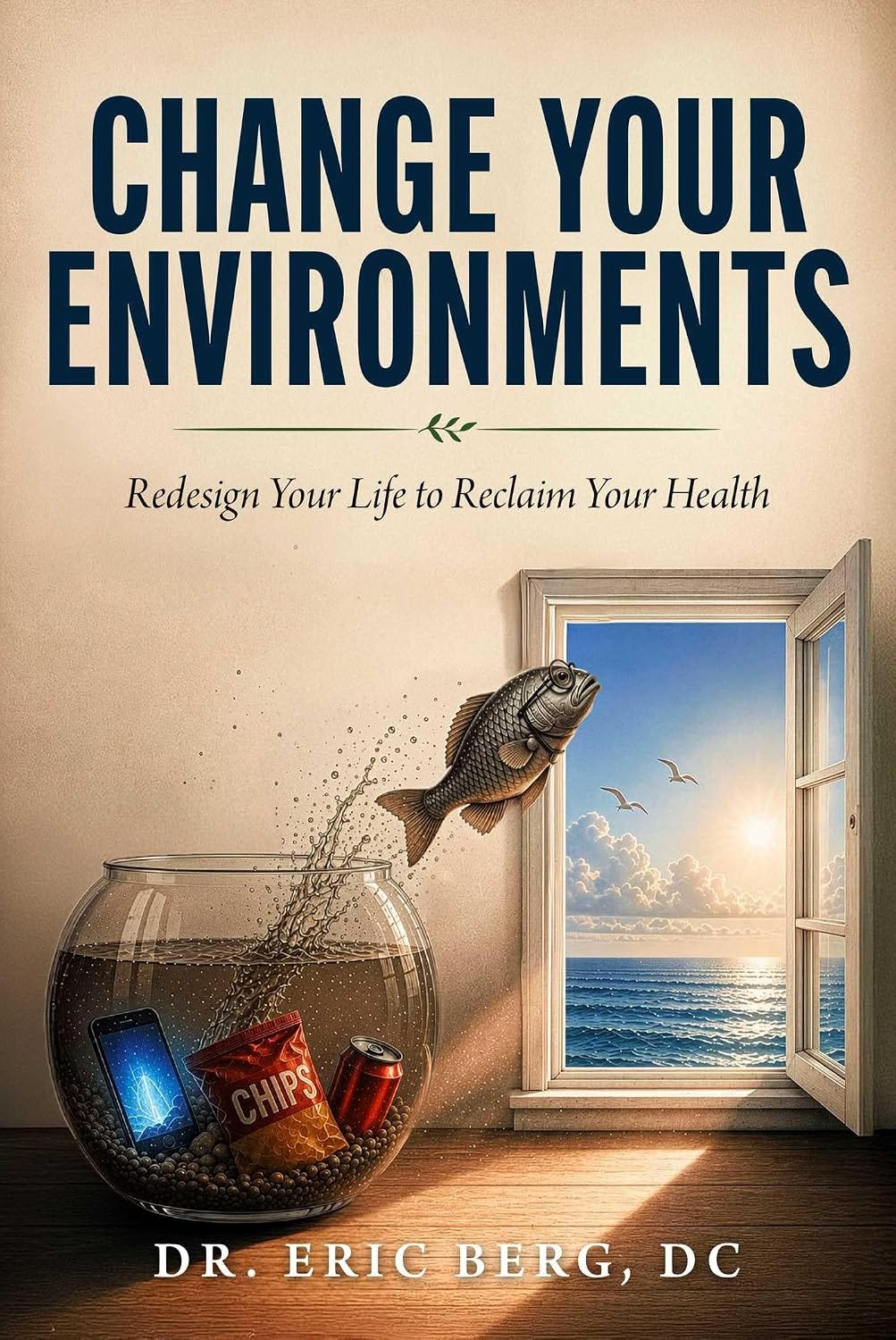
Berg, a chiropractor and longtime health educator with a massive online following (roughly 45 million), has spent decades watching patients who “did everything right” but still struggled. His conclusion, distilled across 250 easy-read pages, is both radical in its simplicity and deeply humane: the problem is rarely you. It’s the engineered chaos of your daily surroundings.

This is not another book telling you to eat less and move more. It’s a map for auditing and redesigning the nine interlocking “environments” that constantly whisper instructions to your biology—food, light and sleep, movement, chemical exposures, microbiome, cognitive-dopamine, social connections, workspace, and nutrients.
Berg’s central metaphor is the “ancestral mismatch”: the profound gap between the stable, effortful world our bodies evolved for over two and a half million years and the modern landscape of ultra-processed food, blue light, sedentary convenience, and constant digital pings. Fix the architecture, Dr. Berg argues, and the cravings, fatigue, and stalled progress often resolve without heroic discipline.

The book opens with an Environment Audit—a straightforward, 45-question self-assessment that scores each domain from 0 to 10. Readers tally their results and prioritize chapters accordingly. High scores in Food, Light & Sleep, and Cognitive environments, for instance, often form a self-reinforcing loop: late-night screens disrupt sleep, poor sleep spikes cravings, and easy access to snacks makes resistance feel futile. Berg’s advice is to start upstream, where leverage is highest. One small environmental tweak—consistent morning daylight, a cleared pantry, or a phone-free zone—can cascade into easier life tweaks elsewhere.
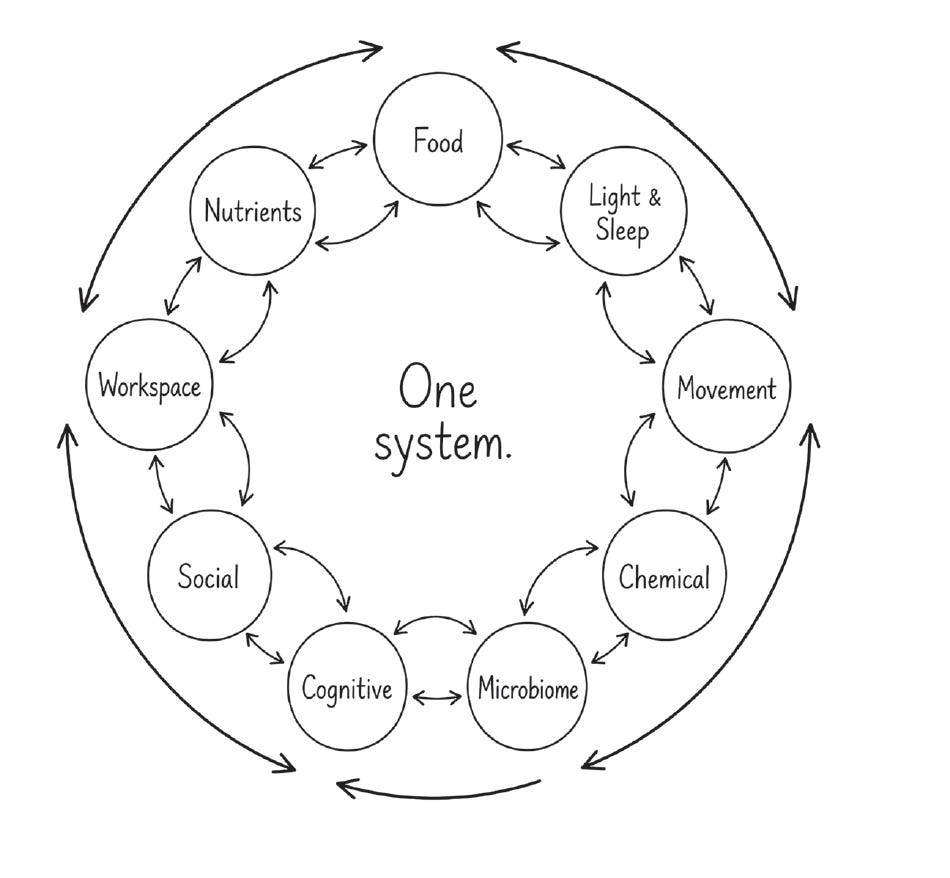
A simple diagram of these interconnections, presented early on, underscores the book’s systems-thinking approach.
What makes Change Your Environments stand out from the maddening crowd of health and self-help books is its tone: compassionate without coddling, evidence-based but not dense, and above all humane. Berg draws on patient stories, evolutionary biology, and practical experiments conducted in his own home “sandbox” alongside his wife, Karen. He acknowledges uneven scientific ground—treating the Chemical Environment chapter (plastics, fragrances, nonstick cookware) as “low-cost swaps worth trying” rather than gospel—while leaning hard on well-supported pillars like the benefits of timing one’s day in natural light timing, daily movement, fermented foods, and social connection.
Endorsements from physicians like William Davis, MD, Roger Seheult, and Philip Ovadia lend credibility, framing the book as a bridge between clinical observation and accessible self-help.
Davis, author of the #1 New York Times bestseller, Wheat Belly, Super Gut, and Super Body, eloquently endorses Berg’s book: “If you are like most people, you are overwhelmed with the full-time, even around-the-clock, job that just living life and staying healthy has become. Microplastics, pesticides, mercury, don’t eat this or that, ultra-processed foods . . . What should you believe and how can you distill it down to truly manageable strategies before you throw your hands up in frustration? In Change Your Environments, Dr. Berg brings his signature straight-talking style and provides a virtual GPS for navigating all the complexities and nuances of these issues, providing clear, straightforward advice that even your teenager can manage.”

Chapter 1, on the Food Environment, is particularly strong and resonant. Berg dismantles the willpower myth with a vivid nighttime pantry raid scenario: you’re not weak; your surroundings have been engineered for addiction. He critiques ultra-processed foods not just for calories but for the false signals they send about abundance, seasonality, and safety. Seed oils, constant snacking opportunities, and distracted eating get thoughtful scrutiny.
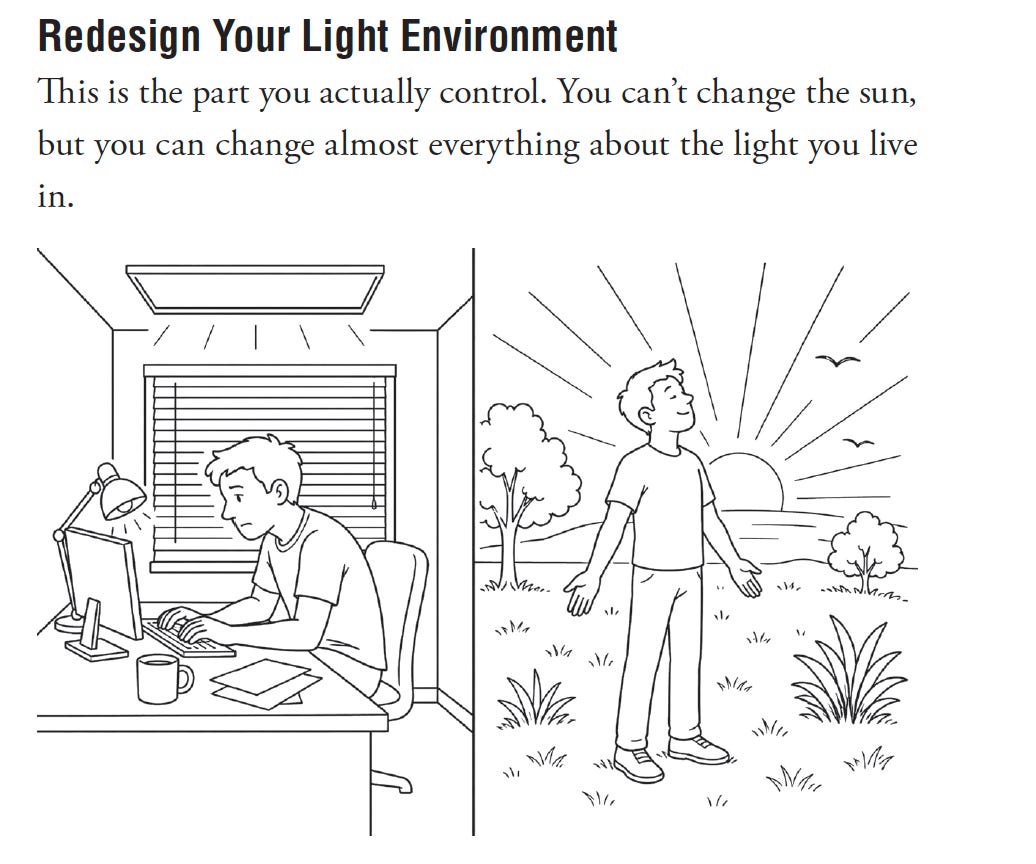
Subsequent chapters extend this logic. The Light & Sleep section emphasizes morning outdoor time and true darkness at night. Movement reframes exercise as default daily patterns rather than gym heroics. The Cognitive chapter offers concrete strategies against addiction and doomscrolling on your phone or other devices.
Berg’s writing shines when he humanizes the struggle. He writes of patients who haunted his thoughts—not the quick successes, but those who fell off the wagon despite their most sincere efforts.
“The problem was almost never the person,” he reflects. “It was the environment around them.”
This empathy feels earned, rooted in forty-plus years of practice. The book’s structure supports real change: each chapter ends with “Start Here” moves, cascade connections to other environments, and reference protocols.
Part II distills “operating system” rules; Part III includes resources like a wellnessMAP app and recipes.
Critics might note that some recommendations in Change Your Environments, echo familiar ancestral-health territory (think Michael Pollan with a broader environmental lens): the Nutrient chapter overlaps with Food and Microbiome, and skeptics of “toxin” narratives may find the Chemical section cautious but still alarmist. Berg addresses this directly, urging bloodwork and clinical consultation for supplements or symptoms. He isn’t selling miracle cures or his own products here; proceeds support MAHA Action, signaling alignment with broader health-freedom themes.

At its core, this is a book for the person who has counted calories, tracked macros, and still feels defeated by biology that seems rigged against them. Berg doesn’t promise overnight success or perfection. He offers a redesign process that compounds: less friction for good habits, more for bad ones. “You do not need more willpower,” he writes. “You need better environments. Let’s build them.”
In a culture quick to pathologize personal failing, Berg’s framework feels refreshingly liberating. It shifts the locus of control from internal moral struggle to external conditions we can actually influence if not entirely reboot.
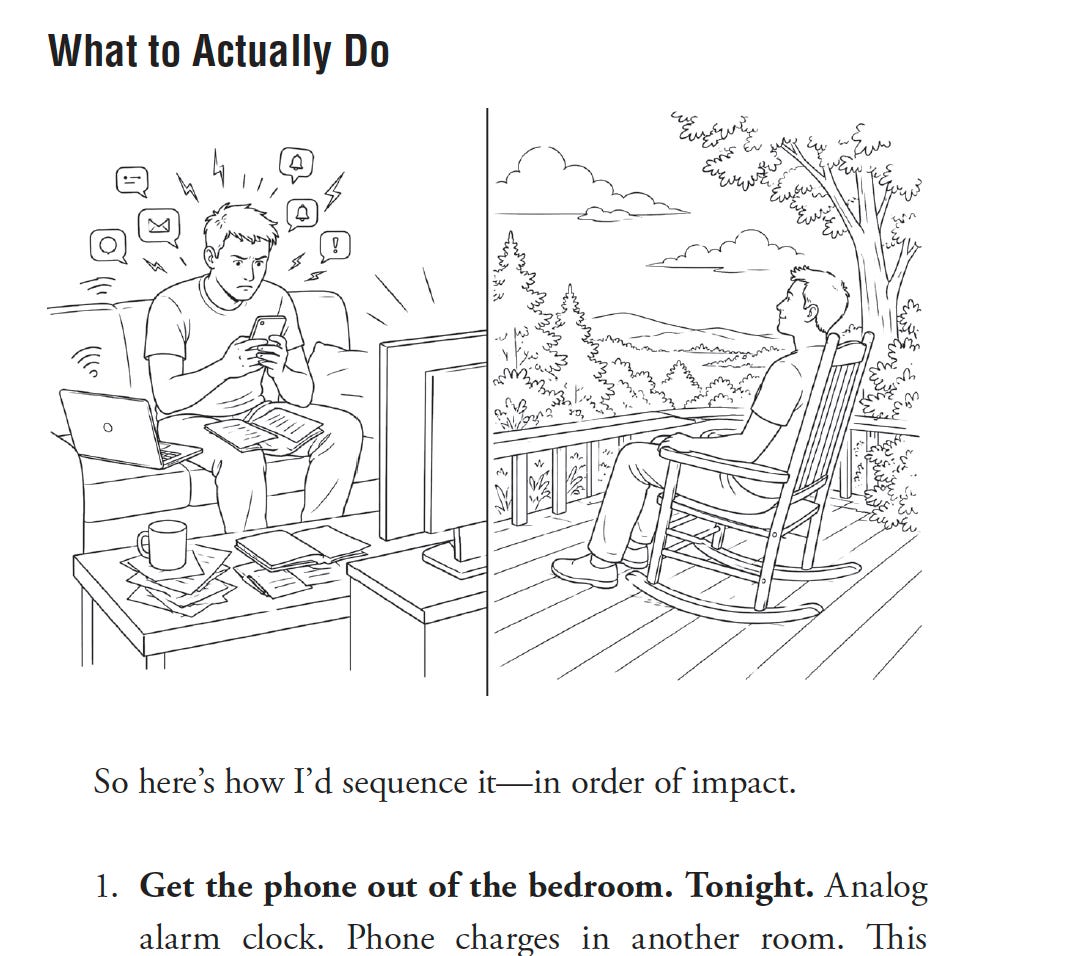
For readers navigating midlife metabolic slowdown, digital overload, or the quiet despair of “I know what to do, I just can’t stick with it,” the book provides both diagnosis and doable blueprint.
In the end, with Change Your Environments, Dr. Berg gives us more than health advice: Berg shows us that health isn’t about fighting your body. It’s about giving it the surroundings it was built to thrive in.
[Dr. Eric Berg’s Change Your Environments: Redesign Your Life to Reclaim Your Health, from MAHA Books, an imprint of Skyhorse Publishing, will be released on September 8, 2026. It’s available for pre-sale on Amazon now.]
Shop our merch store to support the MAHA Report and the MAHA movement.
All proceeds go to supporting the cause.
Need to address the toxic fragrances that are being pumped into our environment.
Airports, hotels businesses are pumping toxic fragrance through their HVAC systems. Law firm has rolled out class action lawsuits against it.
Scented laundry products are extremely toxic not only for people and pets but for the environment. Also air fresheners especially the plug-ins are in every public bathroom and they are highly toxic.
Everything has changed. People insist the world is the same, but they're either lying or they can't perceive what's really happening. The air doesn't stay air anymore. It thickens into the same dark, curdled menstrual clots that slide out of me, except they're everywhere, coating the walls, hanging from trees, collecting in the corners of every room. I can't tell where my body ends and the environment begins because they're made of the same substance now.
Color isn't something I see. It's something that invades me. Blue tastes like cold pennies. Red crackles across my tongue like electricity. Green smells loud. Yellow screams. Every sound has a flavor and every flavor has a shape pressing against my eyes. People think I'm covering my ears because of noise, but I'm trying to stop the taste before it fills my mouth.
Nothing belongs where it should anymore. The sky leaks into the floor. Voices stain the furniture. My own thoughts have colors that everyone else pretends not to notice. They say it's impossible to taste sounds, but they're wrong. They've forgotten how, or they've agreed not to admit it.
They tell me I'm imagining it, but how can I imagine something that never stops? Every hour the world rearranges itself into blood, colors, and noise that all mean the same thing. I spend all day trying to decode it because it feels like it's directed at me. If I ignore it, I worry I'll miss the message. If I pay attention, it grows louder. There's no place that's free of it. The whole environment has become a language only I can perceive, and I don't know whether it's trying to warn me, punish me, or erase me.