


By John Klar, Contributor, The MAHA Report
With the kind permission of author Gavin de Becker and his publisher, Skyhorse Publishing, I am excited and honored to share another chapter of de Becker’s new book, Forbidden Facts: Government Deceit & Suppression About Brain Damage from Childhood Vaccines. (The first chapter was published at The MAHA Report on December 17, 2025.)
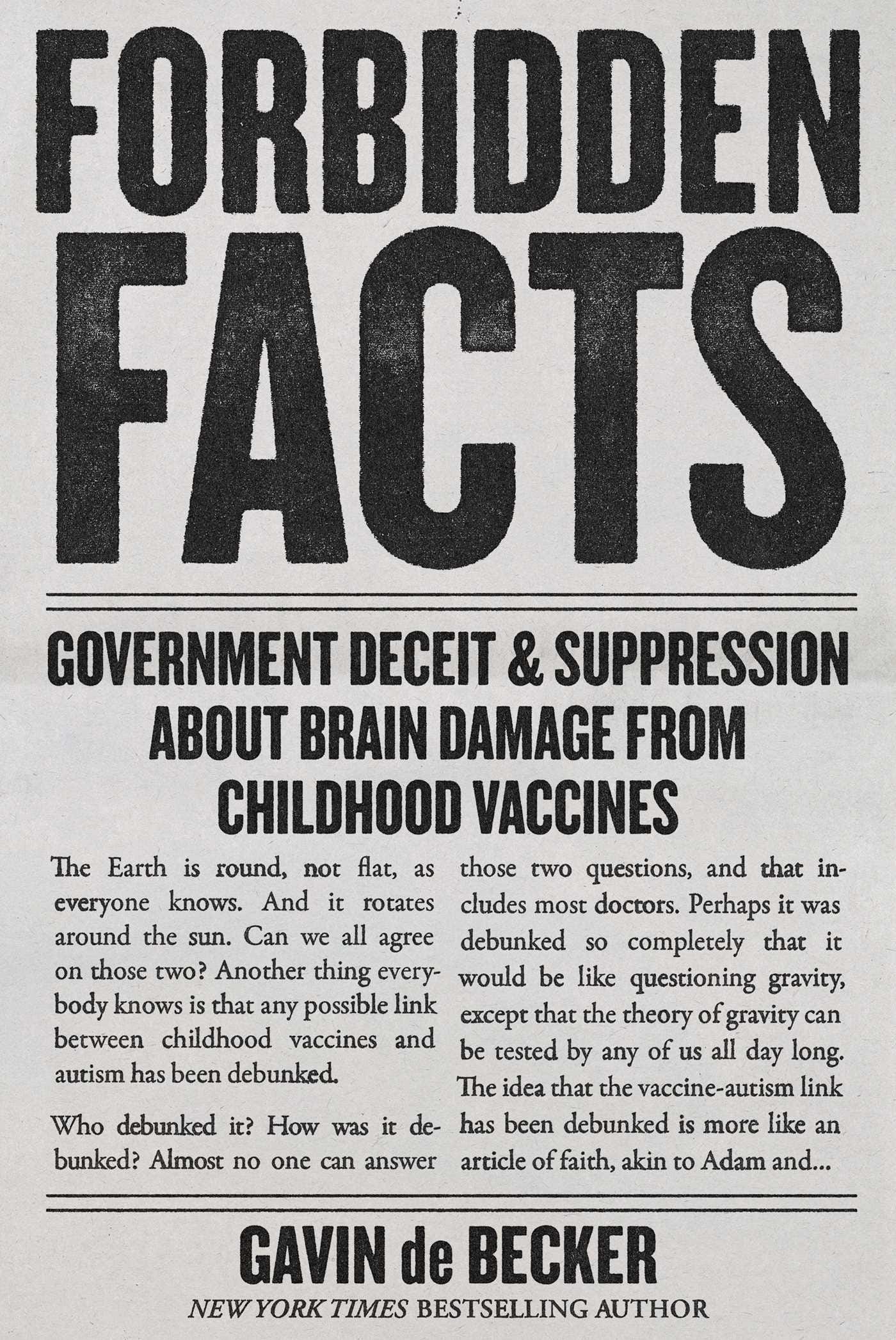
First, some prefatory comments to frame, in particular, de Becker’s discussion of Sudden Infant Death Syndrome (SIDS).
SIDS is an unimaginably horrible occurrence, which is why it can be controversial to suggest vaccines might be a causative factor. It is also why de Becker’s humor helps offset the discomfort of doing so.
A central message of Forbidden Facts is that facts – “real science” – should not be forbidden. America is daily embroiled in an ongoing, often acrimonious, debate about the possibility of vaccines causing injury. Forbidden Facts, and the resources it chronicles, prove beyond any doubt that vaccines absolutely can and do cause injuries – the medical and scientific question is what they are and how often they occur.

It is hardly rocket science to understand that, at times, pharmaceutical companies and the government agencies charged with regulating vaccines may be compromised by conflicts of interest.
Americans are widely aware that pharmaceutical companies and many physicians misrepresented the addictive nature of OxyContin, favoring short-term monetary rewards over long-term patient health. Similarly, a myriad of regulatorily-approved drugs over the decades have proven to be ineffective or cause physical or mental harm (SSRIs, anyone?).
Yet, somehow, many Americans have entered a surreal cognitive-dissonance twilight in which their unassailable “faith” in vaccines eclipses any intellectual capacity to objectively weigh the facts. If vaccines do cause or contribute to autism or SIDS, this mindset hinders effective research. If vaccines don’t cause harm, that same research should be embraced to rebuild public trust.

Forbidden Facts documents how the supposed vaccine “science” has been ethically compromised. HHS Secretary Robert F. Kennedy Jr.’s efforts to better scrutinize mRNA and other vaccines seek to ensure that thorough, unbiased research is demanded by federal agencies to get to the truth. Studies have for decades suggested that vaccines may cause SIDS or other harms. Japan and other nations that do not mandate the United States’ rigorous childhood vaccine schedule (over 72 recommended vaccines!) experience much lower SIDS rates. It doesn’t appear the Japanese are simply laying their infants down on their backs more than Americans. Something else is afoot.
As I reported in my previous installment of Forbidden Facts, the Centers for Disease Control and Prevention’s (CDC) Advisory Committee on Immunization Practices (ACIP) changed its recommendations to encourage parents to make individual decisions about administering the three-shot hepatitis B vaccine series to infants. The resulting hyperbolic media coverage and political firestorm proves something is amiss.
Children’s Health Defense (CHD)recently published an article detailing results from a Louisiana study titled “‘Deeply Troubling’: Higher Mortality Rates Detected in Vaccinated 3-Month-Olds Compared With Unvaccinated Infants.” The new study backs up the critical analysis in Forbidden Facts about vaccines and SIDS. Here are some highlights:
Infants vaccinated in their second month of life were more likely to die in their third month than unvaccinated infants, according to data obtained from the Louisiana Department of Health.
Overall, children who received all six vaccines recommended for 2-month-olds were 68% more likely to die in their third month of life, the data showed.
“This very important paper represents one of the first studies on the cumulative effect of vaccines given at 2 months of age following the Centers for Disease Control and Prevention’s (CDC) recommended schedule,” [Dr. Brian] Hooker told The Defender.
“This type of study is needed to guide the efforts of the U.S. Department of Health and Human Services, and especially the Advisory Committee on Immunization Practices (ACIP) as they revisit the recommended schedule, [Dr. Hooker said].”
The authors said their study — although limited to a few thousand children — is, to date, one of the largest studies of its kind.
“By epidemiological standards, it is a really small dataset, yet it is among the largest and most detailed of its kind,” Jablonowski told The Defender. “By contrast, when Vanderbilt University and the CDC published ‘Risk of Sudden Infant Death Syndrome after Immunization with the Diphtheria-Tetanus-Pertussis Vaccine,’ they analyzed only a couple hundred infant deaths”
Florida state Senator Ileana Garcia has introduced a bill that would require autopsies of infants who die suddenly, including cases of SIDS, to include a review of the child’s immunization records. A law should not be required to ensure this research is undertaken.

Thanks for considering my thoughts about why more research into vaccine injuries is long overdue. Now, Chapter Two of Gavin de Becker’s book.
CHAPTER TWO (9-Minute Read)
Cancer from Baby Powder
Gulf War Syndrome
Silicone Implants
Gulf War Illness
Anthrax Vaccine
Burn Pits
SIDS
All Debunked!
In 2011, the Institute of Medicine was hired to debunk another reality the Government didn’t like: serious health consequences from exposure to burn pits in Iraq and Afghanistan.
The IOM convened a committee to settle the issue once and for all. They set out first to compose five possible categories for describing the conclusion they’d soon reach:
Sufficient evidence of a causal relationship
Sufficient evidence of an association
Limited/suggestive evidence of an association
Inadequate/insufficient evidence to determine whether an association exists
Limited/suggestive evidence of no association
You’ll never guess which category they finally settled on. It was a mixed model, and just what the Government ordered: “Inadequate/insufficient evidence of an association between exposure to combustion products and cancer, respiratory disease, circulatory disease, neurologic disease, and adverse reproductive and developmental outcomes in the populations studied.”
With a wave of their diplomas and an authoritative pronouncement, the IOM committee debunked the idea that breathing smoke from burn pits caused cancer or respiratory disease, or any disease at all. Heck, breathing that smoke might even have been healthy. (President Joe Biden nonetheless attributed the cancer death of his son, Beau, to burn pit exposure in Iraq.)
With this track record, it’s no surprise that the Government hired the Institute of Medicine to debunk another crazy notion, this time the possibility that Gulf War Syndrome, which affected a huge percentage of Gulf War veterans, might have resulted from anything used by the US military.
One possible culprit was an ingredient in vaccines given to soldiers, as reported by The Guardian:
“The common factor for the 275,000 British and US veterans who are ill appears to be a substance called squalene, allegedly used in injections to add to their potency. Such an action would have been illegal. Squalene is not licensed for use on either side of the Atlantic because of potential side effects.”
Before you consider whether squalene might be among the causes of Gulf War Syndrome, a Wikipedia article can save you time:
“Attempts to link squalene to Gulf War Syndrome have been debunked.”
That settles that. What is the authoritative source for such a definitive pronouncement? The Institute of Medicine, of course.
People with the patience to read IOM’s report on Gulf War Syndrome won’t see any mention of squalene until they’ve chewed through nearly 300 pages; it’s in reference to a study of rats injected with a squalene compound:
“Five of twenty animals immunized with this combination died within 1 to 5 days… the animals suffered from shock and cardiovascular collapse.”
That ugly result obviously had to be debunked before the sun went down, so IOM resurrected a favorite strategy for avoiding topics. Having first said that squalene was “an issue the committee was asked to address,” they instead ran in the other direction:
“The committee was not asked to draw conclusions on the strength of the evidence for an association between exposure to squalene and adverse health effects.”
If not drawing conclusions on a possible association to adverse health effects, what in the world was this 400-page excursion all about? Debunking any possible association, of course.
On Page 308, there’s another study of rats unlucky enough to be injected with squalene, this one showing that the injections triggered swelling of the brain that led to disturbance of the central nervous system. Pay no attention to the fact that disturbance of the central nervous system is among the symptoms of Gulf War Syndrome.
On Page 309, we learn that another adverse reaction was “so pronounced that researchers have coined the term Squalene-induced Arthritis.” Pay no attention to the fact that arthritis is among the symptoms of Gulf War Syndrome.
On Page 311, we learn of a study that injected hundreds of people with two vaccine types, one containing squalene and one not. Myalgia was twice as common in those receiving the vaccine that contained squalene. Pay no attention to the fact that myalgia is among the symptoms of Gulf War Syndrome.
The report describes a study into the most relevant group, actual Gulf War veterans and military employees. Among those who developed chronic illness, squalene antibodies were found 95% of the time, and among those who didn’t develop chronic illness, squalene antibodies were never found. Results like that call for emergency debunkment, and IOM delivered it just a page later:
“The committee does not regard this study as providing evidence that the investigators have successfully measured antibodies to squalene.”
So there.
You’ve now had a brief look at the source material Wikipedia relied upon when pronouncing with such certainty that “Attempts to link squalene to Gulf War Syndrome have been debunked.” Remember this the next time you read a confident debunking pronouncement in some media report — and certainly remember it whenever the original source is the Institute of Medicine.
As long as there were sick veterans who needed to be reassured that they were probably just crazy, IOM kept up their tireless effort to find nothing. They pub lished expensive reports on Gulf War Syndrome in 2000, 2003, 2004, 2005, 2006, 2007, 2008 and 2010, and all of them “did not find evidence that would support a confident attribution of the array of unexplained symptoms reported by veterans of the 1991 Gulf War to any specific chemical, biologic, or physical exposure.”
Year after year, IOM just couldn’t find evidence to support linking anything to anything or anybody (or any body). If Gulf War Syndrome existed at all —and IOM never acknowledged that it did— the evidence they never found was sufficient to confidently debunk anything for which the US Government could be blamed.
IOM often succeeds at meeting the Government’s wishes by outright excluding key areas from their inquiry. For example, even after years of supposedly studying Gulf War Syndrome, they stressed that
“IOM Committees were NOT asked to determine whether a unique Gulf War syndrome exists, or to make judgments regarding the veterans’ levels of exposure to putative agents.”
In other words, this was all busywork and distraction since they avoided the two biggest elements of the topic.
The next debunking the Government undertook followed persistent complaints about the safety of the anthrax vaccine given to soldiers. Who’d the Pentagon bring in? The chairman of a past IOM committee, of course. Dr. Gerard Burrow offered his authoritative opinion in a four-page letter that concluded, “The anthrax vaccine appears to be safe, and offers the best available protection.”
Though FDA described that vaccine’s manufacturing conditions as “deficient,” Dr. Burrows explained that deviations in product lines would not impact the quality or integrity of the vaccines. (Apparently, vaccine formulas don’t have to be all that precise.) He based his confident proclamation that vaccines were safe upon the results of a study that wasn’t yet completed, a study he promised “should be available in the near future.”
Later, when a Congressional committee pressed Dr. Burrows to explain more, he explained less:
“Unfortunately, I do not believe I can make a significant contribution to the work of your committee… I was very clear that I had no expertise in Anthrax… the Defense Department was looking for someone to review the program in general and make suggestions, and I accepted out of patriotism.”
Apparently, the Government was looking for a patriot, not an expert.
During their decade of deep dives, IOM did find at least one interesting fact: Animal studies undertaken to test the anthrax vaccine “do not indicate whether the authors monitored for adverse consequences of vaccination.” If you don’t look for adverse consequences, you surely won’t find them. And find them they did not. Unlike IOM, however, a Congressional Committee on Government Reform did look for adverse consequences, and found them, and soon after, mandatory anthrax vaccinations were halted.
Despite IOM debunking the idea that the military could possibly have caused any adverse consequences to any soldiers anytime anywhere, the Department of Veterans Affairs wasn’t persuaded. They convened their own committee that sharply disagreed with IOM — and it didn’t take them a decade to reach their conclusions.
“Evidence strongly and consistently indicates that two Gulf War neurotoxic exposures are causally associated with Gulf War illness.”
Fortunately for science, the Institute of Medicine was able to quickly debunk that nonsense by explaining that even if a causal association was established, and even if evidence “strongly and consistently” indicated a link, “the evidence was not robust enough.”
Whew. Close one.
Drugs For the Healthy
Another possible culprit for Gulf War Illness was a drug called pyridostigmine bromide (PB). The US military ordered hundreds of thousands of soldiers to take PB pills for what they called “pretreatment.” Turns out the pills purchased to protect troops from nerve damage ended up causing — wouldn’t you know it — nerve damage. One significant study had a particularly unfortunate title, “Nerve Gas Antidote a Possible Cause of Gulf War Illness.”
The Department of Veterans Affairs concluded that the wonder-pills contributed to Gulf War Illness. So did the Rand Corporation. So did Boston University. So did Baylor University. But not IOM. As with the vaccine-autism link, IOM proclaimed that “the available evidence is not sufficient to establish a causative relationship.”
And did the pre-treatment pills end up helping at all? Seems like No, in part because American soldiers never encountered the type of nerve gas the pills were designed for — and in larger part because the pills caused tremors, respiratory problems, cardiovascular problems, gastrointestinal problems, and neurological problems.
PB pills remind us that medical interventions given to healthy people to prevent maladies that are very rare often fail the risk-benefit analysis. That lesson doesn’t slow down commerce, apparently; at the end of 2024, Amneal Pharmaceuticals enthusiastically announced that their new “PB-Extended Release” had just received FDA approval for use by the military. Because of requirements from the Securities Exchange Commission, Amneal’s breathless press release had to include this buzz kill: Their wonder-drug for protecting soldiers from poison gas sometimes causes “breathing difficulties and loss of consciousness.” What a coup.
Another IOM committee was convened to debunk the notion that vaccines might be linked to Sudden Infant Death Syndrome (SIDS). And debunk it they did.
SIDS is defined as “the sudden death of an infant under 1-year of age, which remains unexplained after a thorough case investigation, including performance of a complete autopsy, examination of the death scene, and review of the clinical history.”
In other words, SIDS is the umbrella term used when the cause of death is unknown and undiscoverable. It’s a term, not an explanation — used when there is no explanation. It’s a category of death, not a cause of death. A baby cannot be diagnosed with SIDS, and SIDS cannot kill a baby. Nonetheless, IOM set out to debunk the idea that any vaccine or combination of vaccines could possibly be the cause of these deaths for which the cause of death could not be determined. As with autism, they have no idea what caused these sudden deaths — but they sure know what didn’t cause them:
“The committee concludes that the evidence favors rejection of a causal relationship between exposure to multiple vaccines and SIDS.”
After more than 17,000 women and their families sued Dow Corning for harms from silicone implants, and after Dow Corning was required to pay billions in jury awards and settlements to more than 150,000 women — IOM came to the rescue. Though court cases had found that Dow Corning’s products caused autoimmune diseases and neurological harms, IOM’s 1999 report debunked all that.
First, says IOM, there’s no evidence at all:
“no evidence linking implants to systemic diseases…”
Next, there’s evidence — but it’s flawed:
“evidence that silicone breast implants cause neurologic signs, symptoms, or disease is lacking or flawed”
And finally, no matter what evidence there is or isn’t, there’s no basis for health concerns:
“a review of the toxicology studies of silicones and other substances known to be in breast implants does not provide a basis for health concerns”
Despite such a confident debunking by IOM in 1999, both the FDA and the World Health Organization have since recognized a cancer diagnosis associated with these breast implants.
The court cases that IOM debunked had all the usual suspects, including Dow Corning executives who were aware of the danger of silicone implants decades before the lawsuits started.6 No matter, the debunking was just what the customer ordered: Prior to IOM’s report, Dow Corning had been ordered to pay close to $4-billion in individual lawsuits, jury awards, settlements and class action suits. After IOM’s report, not so much.
More recently, when it became important to debunk the silly notion that talcum baby powder could cause cancer, the assignment went to a company called Stantec ChemRisk instead of IOM. However, those hired experts were “guided by the US Institute of Medicine framework,” an homage to IOM that’s quite apparent when you read their conclusions:
“Integrating all streams of evidence according to the IOM framework yielded classifications of suggestive evidence of no association… and insufficient evidence to determine whether a causal association exists…”
Unfortunately for the folks who hired Stantec ChemRisk, the link between baby powder and cancer just wouldn’t stay debunked. Worse for them, it’s become unbunked. More on this later.
A pattern emerges: IOM is about messaging, not measurement or monitoring or microscopy or method. IOM helps the Government with crisis management, not science. When entrenched government programs and products are challenged, or when the truth would be politically inconvenient or too expensive, the Government (and big companies) have often hired IOM to debunk the problem away. No surprise in any of that.
What is surprising, however, is the extent to which these debunking scams have been effective, and the extent to which so many citizens and media companies are willing to parrot what authorities tell them. Once a corporate PR person or government official utters that magic word Debunked, no additional scrutiny is needed — or allowed. After that word is invoked, anyone curious or skeptical enough to keep asking questions is deemed stupid, crazy, a conspiracist — or all three.
With the curious and skeptical people neutralized, with debate prohibited, the truth is harder to find. And the stakes of finding the truth can be life or death, as public health officials and the medical establishment remind parents so frequently: You don’t want your child to get any of those deadly diseases that you could have prevented with vaccination.
Key takeaways:
– Vaccines may be a primary cause of SIDS, but the Institute of Medicine and other biased entities have dismissed any causative connection. Much like the U.S. childhood autism epidemic, authorities charged with protecting American children dismiss any vaccine connection, but have no answer as to what the cause could possibly be.
– These and other issues are meticulously researched and sardonically presented in Gavin de Becker’s resonant new book, Forbidden Facts: Government Deceit & Suppression About Brain Damage from Childhood Vaccines.

The fact that absurd institutional rebuttals and “debunking” are accepted by the Court as “expert” testimony is frustrating, of course. But what is the solution? Clear exposition by Gavin and by others ends up carrying no weight.
It seems that what the Court weighs as expert assessment of facts is often pathetically weak, but the judge may have no capacity to discriminate. So he/she just goes with the credentials or political pressures.
Judge Julia Smith-Gibbons, for example, put the kibosh on Judge Doughty’s stay of the CMS mandate of COVID-19 injections. She went with the opinion of HHS Secretary Becerra at the time, ignoring testimony that Doughty took from Peter McCullough and Jay Bhattacharya. She couldn’t sense some disconnect? This “nice, church going” lady doomed some number of CMS employees to death or disability from the shots, failing to take into account significant safety signals fully in evidence. Nor could she independently evaluate the “grave danger to employees” ostensibly constituted by some 750k hospital fatalities (at the time). But these deaths were NOT, in fact, caused by “the virus.” But what did Gibbons know about Remdesivir infusions, ventilators and fake PCR tests? She likely turned on CNN instead of doing her homework.
My thought is that the frequent failure of court procedures, especially in life and death issues, calls for improvement.
A fully vetted AI tool could be, in principle, much better able to weigh the available evidence more effectively than a judge’s dependence on credentials and personal bias. The result to date has been failure of Socratic debate and tragic injustice. A substantial improvement should be possible by taking some level of human frailty out of the debate. The hurdle to introducing such a tool is in its vetting. Challenging but not impossible. This seems at hand if the right humans prepare such a tool and make it not merely available but a legal requirement the judge must take into account. The IOM would never get their garbage past it.
Vera Scheibner’s 1980’s data on SIDS that correlated with her infant breathing monitor data nailed vaccines as a “smoking syringe” long ago, but for the primacy of credentialed expert opinion that empowered courts and regulators to ignore compelling, scientifically impartial data. An AI tool could take some of that empowerment away, enforcing a higher level of objectivity. It could also guide consumers themselves.
https://youtu.be/zYzl7RFi6KQ?si=Pv-_JmAVKkjSOuY5