


By Dr. Sina McCullough, Special to The MAHA Report
The Food and Drug Administration (FDA) is currently requesting public comment on the “gluten-free” food label. This is a critical opportunity to address a standard that is stuck in the past.

Today, more than 200 medical conditions, ranging from asthma to infertility, are linked to gluten sensitivity. The gold standard for healing a damaged gut is to go “gluten-free.” But for many, this change provides only temporary relief, or worse, no relief at all.
The reason is simple but systemic: the “gluten-free” label, regulated by the FDA, is based on a definition that is nearly a century old. It is not just outdated; for some, it is dangerous.
The 1930s Misconception
To understand why the label is broken, we must look at its history. In the 1930s and 40s, a Dutch pediatrician named Willem-Karel Dicke linked wheat consumption to celiac disease. During the Dutch Famine of 1944, a wheat shortage led to a noticeable improvement in his patients’ symptoms. When the war ended and wheat returned, the symptoms returned as well.

Next, Dicke ran a series of experiments to isolate the exact culprit. He discovered that while pure starch was tolerated, the gluten protein triggered the disease. Because wheat, rye, and barley were the staples of Northern Europe, gluten became synonymous only with those specific grains.
The FDA still relies on this mid-century data, effectively defining “gluten-free” as the absence of wheat, rye, or barley. However, it’s not that simple.
The Science the FDA Is Missing
Gluten is not a single protein; it is a protein complex composed of two primary fractions: prolamins and glutelins.
Prolamin is the gluten fraction most associated with triggering an immune response. While the FDA only regulates the prolamins in wheat (gliadin), rye (secalin), and barley (hordein), science has identified that every grain contains its own version of these proteins, including corn and rice.
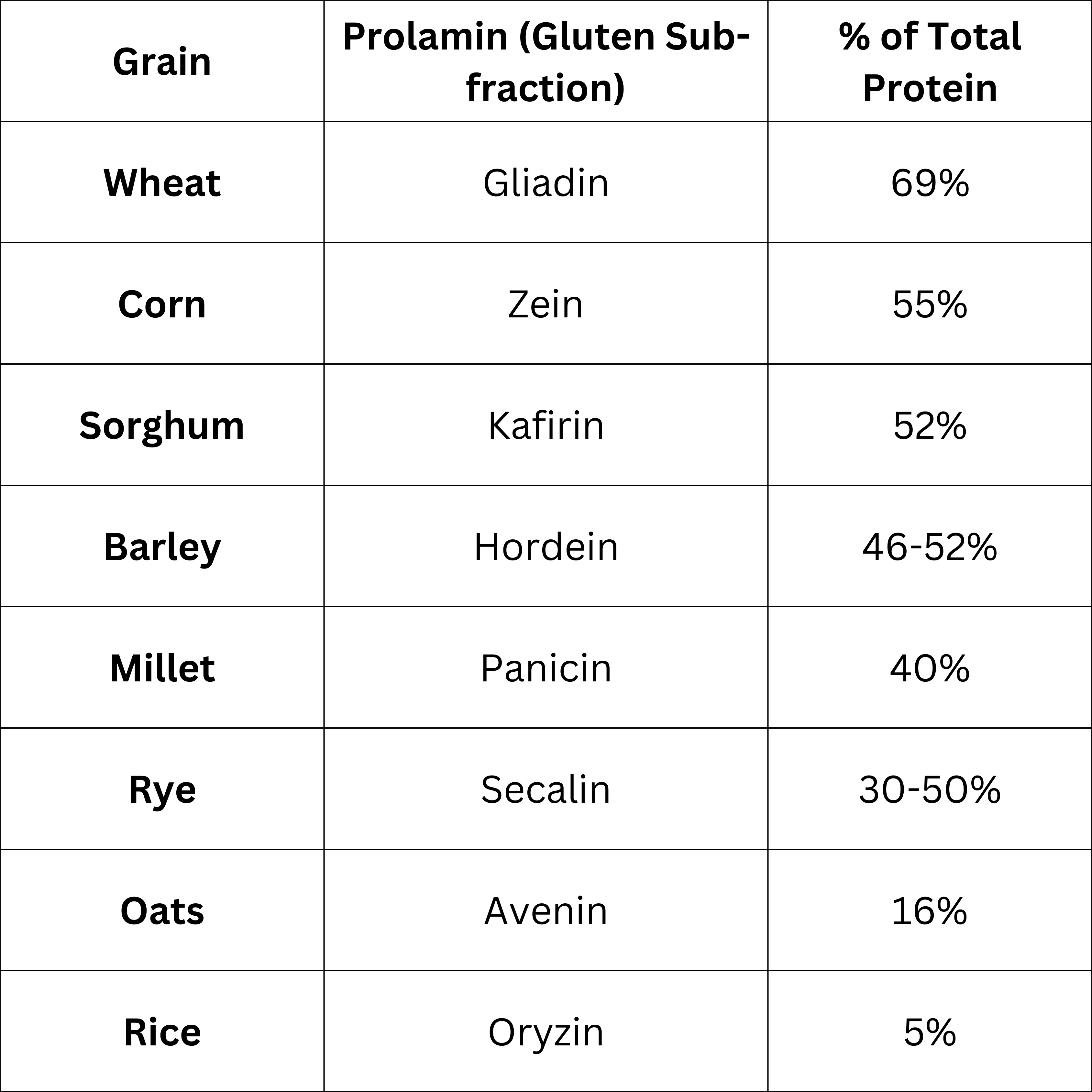
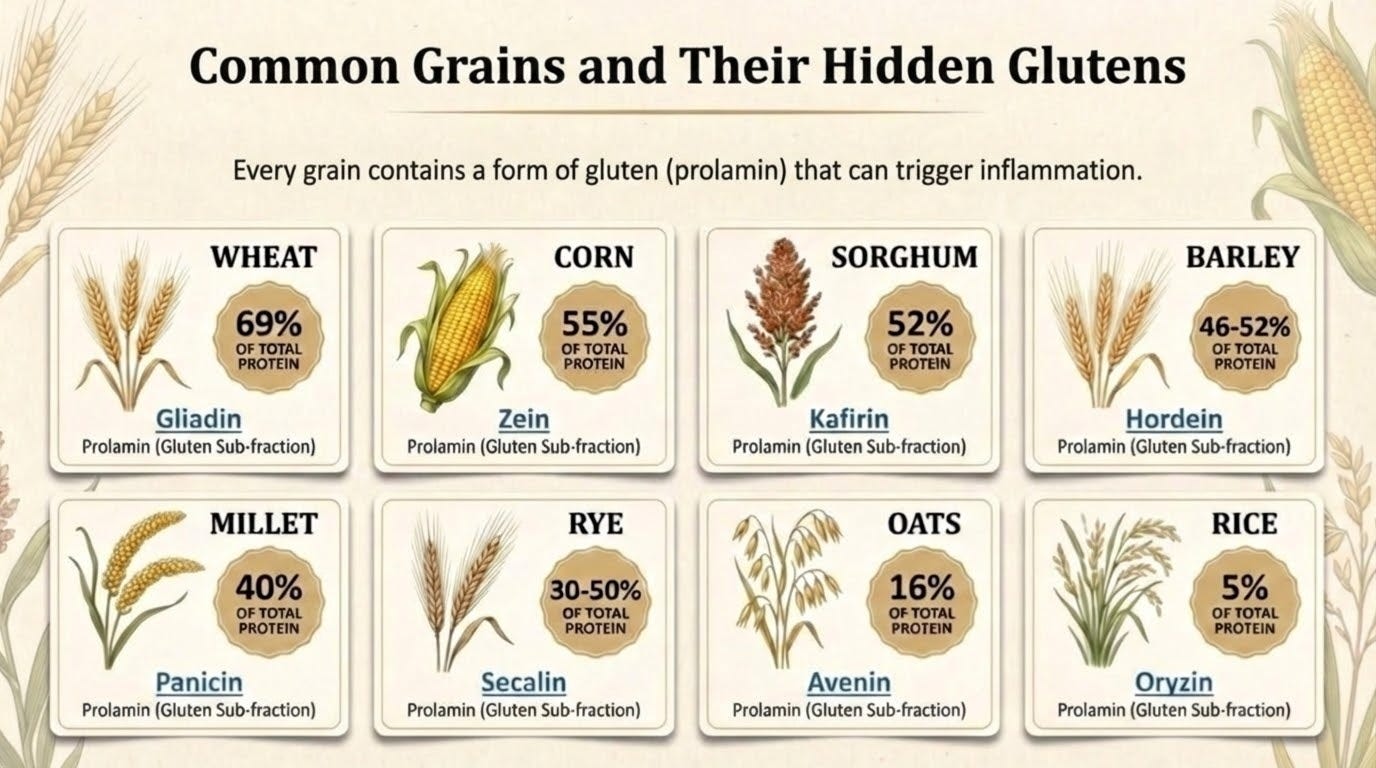
And what are many certified “gluten-free” foods made of? Corn and rice.
Despite this, the FDA does not acknowledge that glutens exist in all grains, which allows manufacturers to slap a “Certified Gluten-Free” sticker on a product that is primarily made of corn and rice.
The 1979 Revelation: Corn and the Gut Barrier
The fact that corn and rice contain gluten and can trigger illness is not a new discovery. Researchers have known since at least 1979 that corn gluten can provoke antibody responses in some people.
According to a landmark study published in Clinical & Experimental Immunology, patients with Crohn’s disease, ulcerative colitis, and celiac disease had significantly elevated antibodies when they ate corn. Interestingly, the researchers used the same type of corn found in Kellogg’s® cornflakes, a product often marketed as a safe “gluten-free” breakfast staple. The researchers concluded that these antibodies were a sign of “increased mucosal permeability,” better known today as leaky gut.
This landmark research showed that the immune system in some patients exhibits a clear recognition of corn proteins, indicating a loss of oral tolerance similar to that seen with wheat.
Subsequent studies published in 2013 and 2015 demonstrated that corn can also elicit a cellular immune response in some people. Specifically, these studies found that corn can stimulate the release of Interferon gamma, a master cytokine responsible for intestinal degradation, at levels equal to those triggered by wheat. This finding is critical because a cellular response indicates actual damage to the intestinal lining rather than just an immune recognition.
The inclusion of rice in “gluten-free” products also provides a potentially dangerous illusion of safety. Research into cross-reactivity has shown that the immune system sometimes cannot differentiate between the prolamin in wheat and rice.
A 2013 study reported that antibodies produced against wheat (anti-gliadin) can mistakenly target rice proteins, launching an identical inflammatory response. The researchers concluded that if this information is “not taken seriously” it may lead to “the development of autoimmunity in the future.”
The Inflammatory Loop and “Gluten-Free Whiplash”
When wheat is replaced with corn or rice in “gluten-free” products, it can lead to the Inflammatory Loop, a self-perpetuating cycle that prevents true healing:
Immune Provocation: You consume “gluten-free” staples like corn or rice. The immune system identifies their prolamins (zein or oryzin) as invaders.
Inflammatory Response: The body responds by releasing cytokines that damage the tight junctions of the intestinal wall.
Barrier Damage: This “leaky gut” allows more undigested proteins into the bloodstream, agitating the immune system further.
This cycle explains “Gluten-Free Whiplash,” where patients follow a traditional gluten-free diet (no wheat, barley and rye) and feel better, only for symptoms to return as the patients increase their intake of corn and rice through “gluten-free” replacements.
Research published in Alimentary Pharmacology & Therapeutics, in 2009, reported that after 16 months on a traditional (FDA-defined) gluten-free diet, 92% of people failed to fully heal their gut lining. A staggering 65% had persistent inflammation, 26% had no change, and 1% got worse. The researchers concluded that healing the gut is “exceptionally rare” on a traditional gluten-free diet. This suggests that the “certified gluten-free” label may be preventing the gut from healing.
Does Everyone React Negatively to Corn Gluten?
Research indicates that at least 50% of gluten-sensitive individuals develop antibodies to corn. The number is high enough that some scientists have called for a re-evaluation of the use of corn, and rice, in “gluten-free” products:
“…the use of maize [corn] in the formulation or preparation of gluten-free foods must be reevaluated…”
-Plant Foods Hum Nutr, 2012
“The allergens in rice, corn, millet and buckwheat should be better studied before they can be recommended as alternatives for cereal allergic children.”
-Clin Exp. Allergy, 1995
Moving Toward a True Gluten-Free Standard
If we want to see a market that truly supports healing, food labels must reflect biological reality. A “true” gluten-free diet, one that removes all potentially inflammatory prolamins, is a grain-free diet. Until the FDA acknowledges the broader family of gluten proteins, the “gluten-free” label will remain a half-truth that leads many down a path of continued illness.
As the government continues to evaluate the ‘glutton-free’ label, it’s time to tell the FDA that the definition must change. We deserve labels that don’t just exclude wheat but truly exclude the proteins that keep many of us sick.
Dr. Sina McCullough holds a Ph.D. in Nutritional Science and a B.S. in Neurobiology, Physiology, and Behavior from UC Davis. She is the author of Hands Off My Food! and Beyond Labels, and co-host of the Beyond Labels podcast. A former Director of R&D for a supplement company and instructor at UC Davis, she now focuses on investigative reporting and empowering families to reclaim their health sovereignty. Learn more at drsinamccullough.com.

You have to go back farther than the 1930's to find the answer to the "gluten" problem. The commercial adulteration of flour started around the turn of the century when they started stripping the bran & germ from the wheat (which is where the nutrients are) and treating it with chemicals & bleaching agents. During the WWII flour rationing, people didn't have access to the adulterated flour so yes, their health improved. Studies in the 30's & 40's were not based on nutritious fresh milled wheat, they were mistakenly studying the effects of commercially adulterated flour. Wheat in it's natural form is one of the most nutrient dense foods available. Many people are milling wheat fresh at home & seeing the health of their families improve.
Around 1900 big industrial mills took over the grinding of wheat which had previously been done in homes or at local mills. They found that by sifting out the bran & germ (the parts that contain at least 27 of the essential nutrients), they could create shelf stable flour that was very convenient & marketable. For appearances they started bleaching the flour, and then heated & added dough conditioning chemicals to allow for consistent results in baked goods. Essentially they took one of the most nutrient dense foods on the planet and stripped it of it's nutritional value. The resulting flour is nutritionally dead & difficult for our bodies to digest.
In the early 1900's there were epidemics of pellagra, beri-beri, anemia related to the lack of nutrients in the flour. Pellagra symptoms are dermatitis, diarrhea, and DEMENTIA. This led to a government mandate enriching flour with thiamin, riboflavin, niacin & iron. They only added back in 4 nutrients out of about 28 that are removed by processing. In 1998, because of the rise in neural tube defects in infants, folic acid became a mandated addition as well. (but they use synthetic folic acid which MTHFR people cannot process). In addition, modern wheat has been selectively bred for qualities that make money faster, not for nutrition.
The first head of (what would become the) FDA, Dr. Harvey W. Wiley, tried to enforce the Pure Food and Drug Act of 1906 & stop the adulteration of flour but the commercial & political interests involved were already too powerful.
There is a movement in the USA among people who have discovered the truth about wheat. Wheat berries (grain) are packed with fiber & nutrients that our bodies need. Numerous health benefits have been reported by people who have started milling their own grains at home & baking nutritious food that their families are thriving on.
Some health changes regularly reported by people that start eating fresh milled flour include: no bloating, no brain fog, no headaches, improved digestion, improved regularity, no gluten sensitivity or gluten intolerance, clearer skin, weight loss, improved acid reflux, improved bloodwork (cholesterol, triglycerides, liver), increased energy, improved sleep, improved gum health, lowered blood sugar (lower glycemic index due to fiber & nutrients), lowered blood pressure Consuming whole grain lowers All Cause Mortality (19%), Coronary Heart Disease Incidence (20%), Stroke Incidence (14%), Type 2 Diabetes (33%), Colorectal Cancer (13%), Cancer Mortality (16%) - from sifted(dot)com
I have seen quite a few comments about improvement of autistic traits, such as becoming verbal & improved behavior, in a facebook group of over 62,000 members that centers on freshly milling your own flour at home & baking nutritious food instead of eating commercially adulterated flour products.
Sue Becker is a wonderful resource for more information about fresh milled flour. She has a degree in nutrition & has been researching this & spreading the word since 1992. An interview with her called " What If Gluten Isn't the Enemy _ Sue Becker" on youtube is where I first found out about this.
Obviously, avoid corn and rice but one more HUGE reason to avoid processed foods and to never trust a government label. Great informative article-thank you!