


Most Americans remember the old memory hack, “Spring forward, fall back,” but few know why we change our clocks twice a year – or have thought seriously about whether we should keep doing it.
Yes, you lose an hour of sleep in March. It’s more difficult to wake up. Your commute is darker. Your body feels off. And then, in October or November, you gain back that hour and a little more sunlight, and sometimes forget and are early or late to a meeting? Who needs the hassle?
But Jay Pea, founder and president of Save Standard Time, says the country has been asking the wrong questions.

The real issue is not just whether America should stop changing the clocks. It is: Which clock should we choose to live by?
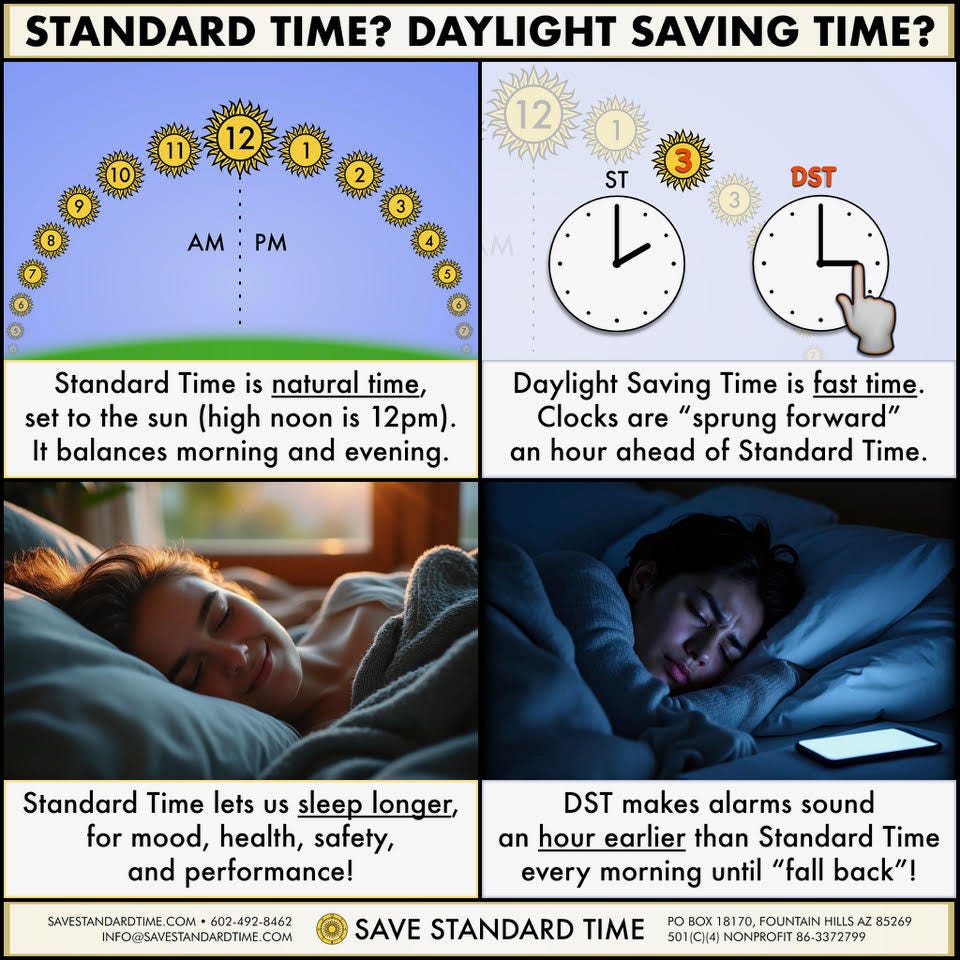
There are two current options: Standard Time or Daylight Saving Time. Standard Time is built around the sun, with noon close to when the sun is at its highest point in the sky. Currently, we set our clocks to Standard Time from November 1 to March 14.
In the United States, Standard Time was designed to organize modern life around the solar day. Daylight Saving Time came later as a political and economic experiment, shifting the clock one hour forward to create more evening light.
Standard Time keeps us more closely aligned with the natural light-dark cycle. It gives the body more of what it needs most in the morning: natural light to wake up, regulate cortisol, anchor circadian rhythm, support alertness, and help set the stage for better sleep at night.
“People hear ‘stop changing the clocks,’ and they think that sounds good,” Pea said. But ending the clock change by choosing permanent Daylight Saving Time is very different from ending it by choosing permanent Standard Time.
Standard Time preserves the morning light people need to wake up and feel alert. Daylight Saving Time, by contrast, pushes light later into the evening, delaying melatonin, making it harder to fall asleep, and leaving many Americans short on sleep before the day even begins.
Under Daylight Saving Time, Pea said, people can lose sleep “at both ends of the day.” Evening light keeps people awake later, while alarms still force them up before they are biologically ready.
This message is especially important as Congress again considers the Sunshine Protection Act, a bill often sold to the public as a way to end the hassle of changing clocks, and who does not like sunshine, right?
But the fine print matters.
The bill would not make Standard Time permanent. It would make Daylight Saving Time permanent nationwide. After the House Energy and Commerce Committee advanced the Sunshine Protection Act as part of a broader transportation bill, the American Academy of Sleep Medicine warned that the proposal was moving forward with little time for review or debate, though it still requires approval from the full House and Senate.
Support for Saving Standard Time

The National Sleep Foundation has stated that seasonal time changes are disruptive to sleep health and that evidence supports permanent Standard Time “because of its alignment with our circadian biology and relevance to sleep health and safety.” The foundation calls permanent Standard Time “the appropriate option for public health.”
The American Medical Association has also backed Standard Time. “For far too long, we’ve changed our clocks in pursuit of daylight, while incurring public health and safety risks in the process,” AMA Trustee Dr. Alexander Ding said. “Committing to standard time has health benefits and allows us to end the biannual tug of war between our biological and alarm clocks.”

Federal health leaders already recognize sleep as a public health priority. Healthy People 2030, an initiative of the U.S. Department of Health and Human Services, states that its sleep goal is to “improve health, productivity, well-being, quality of life, and safety by helping people get enough sleep.” The same federal initiative notes that about one in three adults and even more adolescents do not get enough sleep, and that about 100,000 motor vehicle crashes every year are related to drowsy driving.
Recent Health and Human Services messaging under Secretary Robert F. Kennedy Jr. has also emphasized the importance of protecting children’s sleep. In the Surgeon General’s advisory on screen use, HHS warned that children’s screen exposure can disrupt healthy sleep, calling sleep “fundamental to learning, mood, behavior, physical health, and overall development.”
For Standard Time advocates, that same principle applies to the national clock: The Sunshine Protection Act would delay sleep, darken school mornings, and push families further from natural light rhythms, thereby misaligning it with the preventive health policy HHS is working hard to advance.

The CDC also warns that about one-third of U.S. adults and children under 14, and three-quarters of high school students, do not get enough sleep. Insufficient sleep, the agency says, is linked to anxiety, depression, obesity, heart disease, injury, and other serious conditions.
For anyone who has struggled to get a child out the door on a dark winter morning, dragged through a workday after poor sleep, or felt their mood suffer after the clocks changed, Pea’s argument is simple: the clock is not separate from health. It helps shape it.
“We know health rests on a three-legged stool: physical activity, nutrition, and sleep,” Pea said. “If you’re not getting good sleep every night, it’s wear and tear on your body.”
A Policy Created for Commerce, Not Health
For years, Daylight Saving Time has been promoted as an energy and commerce policy, with supporters arguing that later evening light would save electricity, keep people shopping longer, increase recreation, and benefit industries such as retail, tourism, restaurants, convenience stores, sports, and golf.
But the energy case is far less convincing than many Americans have been led to believe.

Congress extended Daylight Saving Time in 1986, moving the start date from the last Sunday in April to the first Sunday in April. It was extended again by the 2005 Energy Policy Act, beginning in 2007, so Daylight Saving Time now runs from the second Sunday in March to the first Sunday in November, roughly eight months of the year.
When the Department of Energy studied that 2007 extension, it found average electricity savings of only about 0.4 percent per day during the added weeks of Daylight Saving Time. The report also found “insufficient statistical evidence” that the change reduced gasoline consumption or traffic volume.
In other words, the strongest federal energy evidence supporting the extension of Daylight Saving Time does not demonstrate a sweeping national gain. It was a small reduction in electricity use during a limited part of the year, with no clear, measurable benefit for gasoline use or traffic.
That matters because the health costs are not small.
For lawmakers, the choice is becoming clearer: Should the nation prioritize a modest and contested energy argument, or a clock that better supports sleep, morning alertness, child safety, metabolic health, and circadian biology?
The clock is often debated in committees focused on commerce, energy, and transportation. But Pea believes it should be addressed instead as a public health priority.
The American Medical Association has made a similar point. “Eliminating the time changes in March and November would be a welcome change,” Ding said. “But research shows permanent daylight saving time overlooks potential health risks that can be avoided by establishing permanent standard time instead.”
“Sleep experts are alarmed,” Ding added. “Issues other than patient health are driving this debate. It’s time that we wake up to the health implications of clock setting.”
Children’s Health as a National Priority
One of the strongest arguments against permanent Daylight Saving Time is what it would mean for children.
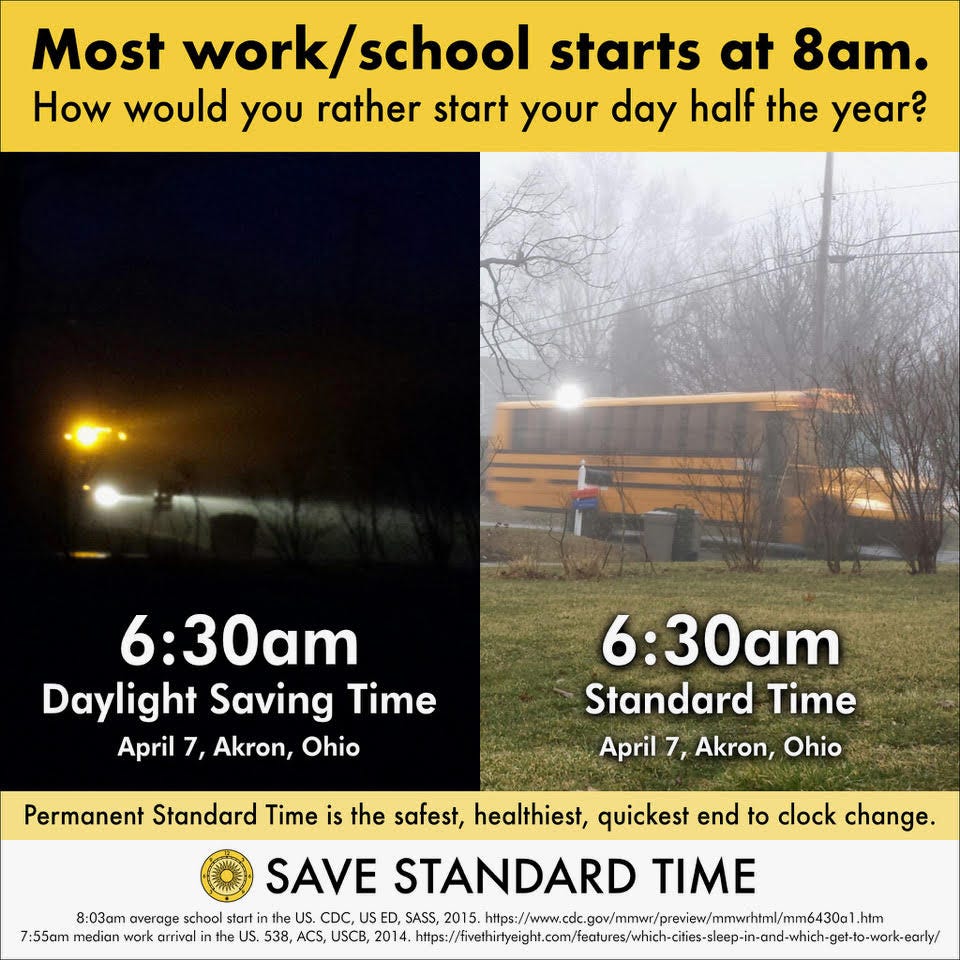
If the U.S. stayed on Daylight Saving Time through winter, many parts of the country would see sunrise after 8:30 a.m., 9 a.m., or even later. Children would wait for buses, walk to school, and arrive at classrooms in the dark for long stretches of the year.
The U.S. has already tried year-round Daylight Saving Time once, during the 1970s energy crisis. The emergency measure quickly became unpopular, as dark winter mornings quickly became a national flashpoint. In February 1974, TIME reported in an article titled “Daylight Disaster Time” that eight children in Florida had died in early morning traffic accidents after the January time change, compared with two during the same period the year before. A federal review also found that school-age child fatalities increased during the 6 to 9 a.m. morning window in February 1974 compared with February 1973. The historical record does not prove that permanent Daylight Saving Time alone caused every crash. But it does show that dark winter mornings became a national safety concern almost immediately, forcing school districts in 18 states to adjust schedules before Congress reversed the policy.

In addition to the safety concerns, Sue E. Peters, PhD, a developmental cognitive sleep neuroscientist, connected the clock debate directly to children’s brain development and chronic disease prevention.
“Stabilizing our clocks to a standard schedule that supports sunlight during natural waking hours will have a national health impact,” Peters said.
Peters argues that permanent Standard Time supports children’s sleep and circadian rhythms, while permanent Daylight Saving Time can undermine broader MAHA goals by worsening sleep debt and fragmentation during critical windows of development.
A Low-Cost Preventive Health Reform
For Jay Pea, permanent Standard Time is not only the healthier choice. It is also the simpler one.

Permanent Daylight Saving Time does not actually give children more morning rest. It just arbitrarily changes the clock while pushing it further away from sunrise. Permanent Standard Time, by contrast, ends the disruptive clock changes while preserving the morning light that children, workers, drivers, and families depend on to safely and biologically begin the day.
In a country with many people already dealing with sleep deprivation, metabolic disease, and mental health concerns, the clock is not a small issue. It is a national rhythm. And Pea argues that if America is serious about health, safety, and prevention, the country should choose the time that works with the sun, not against it.
Under current federal law, states already have a pathway to stop observing Daylight Saving Time and remain on Standard Time year-round. Arizona, Hawaii, Puerto Rico, Guam, American Samoa, the Northern Mariana Islands, and the U.S. Virgin Islands already do it. Permanent Daylight Saving Time is different. States cannot adopt it on their own. That would require Congress to change federal law.
The practical difference is significant. A state choosing permanent Standard Time is working within the existing framework of the Uniform Time Act. A national shift to permanent Daylight Saving Time would require federal legislation, regulatory coordination, and technical updates across transportation, schools, health care, banking, broadcasting, electronic calendars, payroll systems, phones, computers, airlines, hospitals, pharmacies, and the time-zone databases that modern life depends on.
In technical terms, permanent Standard Time removes a seasonal clock change. Permanent Daylight Saving Time requires the country to redefine civil time in a way that federal law does not currently allow states to do on their own.
That is why Pea sees permanent Standard Time as a rare kind of reform: low-cost, legally available, technologically easier, and rooted in prevention.
Lawmakers do not need to repeat past mistakes to end the clock change. The path already exists.
Related Articles:
Wake Up, America! Jeffrey Rose and the Case for Sleep as MAHA Policy

By Amy Sapola, PharmD, Contributor, The MAHA Report


Please save Standard time, sun time, as God made it, over daylight savings time
Standard time is the only way to go. Thanks for posting this article.