


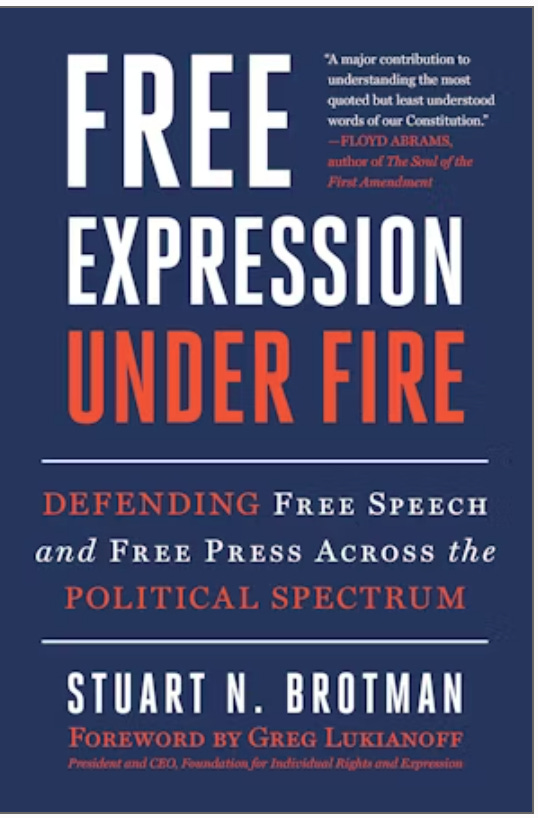
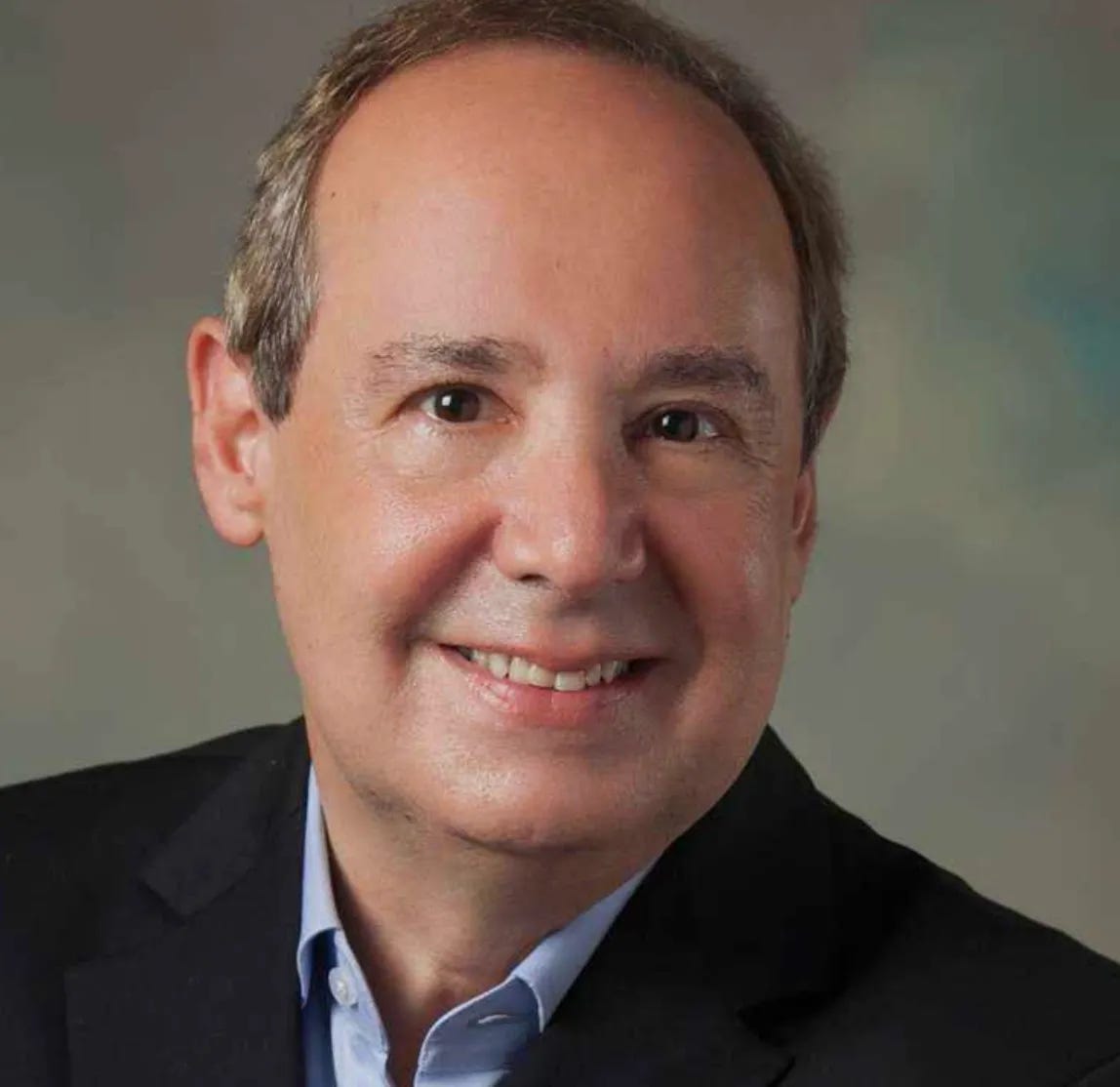
Professor Stuart N. Brotman is one of the nation’s top scholars on free expression and the challenges faced by millions of Americans who seek to exercise both the letter and spirit of the First Amendment.
In his latest book, Free Expression Under Fire: Defending Free Speech and Free Press Across the Political Spectrum, Professor Brotman explains how creating a dynamic cultural shift around freedom of expression can promote liberty among all demographics, while bolstering a timeless American value during the nation’s 250th anniversary year.
The following is a transcript of The MAHA Report’s exclusive interview with Professor Brotman, edited for length and clarity.
MAHA Report: Thank you, Stuart Brotman, for joining me today at The MAHA Report. I want to get into your new book, Free Expression Under Fire: Defending Free Speech and Free Press Across the Political Spectrum, but before we do, I want to ask about the differences and the similarities between free speech and free expression.
Stuart Brotman: Well, free expression is really the broader term and if we go back to the First Amendment to the Constitution, obviously it covers freedom of speech and freedom of the press as separate freedoms and when you put both of those concepts together, that’s really freedom of expression.
MAHA Report: And where do petition and assembly fit into that because obviously these things, along with worship, are mentioned in the First Amendment? How would you sort of slot those into these overarching concepts?
Stuart Brotman: In the book, I actually talk about concepts that go beyond the First Amendment. These are concepts that take place when the First Amendment doesn’t apply because as you know, the First Amendment is really a prohibition against government interfering with those five freedoms. And we have so many instances these days where government may not be involved, yet we still have interference with free expression and so clearly the First Amendment is important, it’s vital, but it’s not the ultimate end point for discussing freedom of expression.
MAHA Report: A lot of people will have read that the case originally known as Missouri v. Biden was settled and the government agreed not to pressure social media operators to censor people. But that leaves open the possibility that they could censor on their own accord. How do we prevent them from going rogue and violating the spirit of the First Amendment even though they don’t necessarily have that legal duty to uphold it?
Stuart Brotman: I think the word ‘spirit’ is really the most important word here and that really ties in to what I call culture because you need to not just have a legal process and a legal rule, but you need to have a culture that supports it. And one of the things I talk about in the book and continue to think about is that we really don’t have as robust a culture that supports free expression even though we have a pretty robust legal system and certainly cases that support the First Amendment.
MAHA Report: It seems that in some ways we’re going back. Although technology is giving us more outlets, it seems that this culture is going backwards. Do you see that 30, 40, 50 years ago this culture of free expression was more widespread than it is in 2026?
Stuart Brotman: I think it’s tough to try to go back in the time machine and try to trace what was then and what’s now. The important point is that cultural change is possible. Sometimes cultural change takes place over those 30 or 40 or 50 years, so this is not something that’s going to happen immediately. I often talk about the Second Amendment, and if you look at the past 50 years, we have seen a culture around the Second Amendment that has been built up to support it. And so that is a pretty good model for what I think could be adapted in the First Amendment context, which is to spend the next 50 years creating that culture while the rule of law reinforces it along the way.
MAHA Report: How do we promote a culture that gets people thinking less of ‘Oh, I’m reporting this social media post’ to ‘Oh, that’s someone’s speech, whether I like it or not, it’s someone’s speech and it is what it is’? How do we get there? How do we sort of move the needle on that?
Stuart Brotman: Let’s look at some of our cultural touchstones in society and try to figure out how we can utilize them to promote the culture of free expression. Let’s take sports as an example. Right now we have a system where at the beginning of a game, people are asked to stand up and pledge allegiance or hear “The Star-Spangled Banner.” But what if at the beginning of a game, the announcer came on and said, ‘Please rise to recite the First Amendment of the U.S. Constitution’ and on the Jumbotron those 45 words were put up and people recited them and then they could continue with “The Star-Spangled Banner” or the Pledge of Allegiance? It could be done at the professional level or at the collegiate level or even at the high school level. You would expose the First Amendment and these concepts of freedom of speech and freedom of press to people on a regular basis. So that’s one immediate way to begin to move the needle.
[Note: The First Amendment’s 45 words are these: “Congress shall make no law respecting an establishment of religion, or prohibiting the free exercise thereof; or abridging the the freedom of speech, or of the press; or the right of the people peaceably to assemble, and to petition of Government for a redress of grievances.”]
Then let’s take movies. When you go to a movie theater, before the movie you have ‘coming attractions,’ you have many advertisements now. But what if, after that takes place, someone from the movie or someone who’s well known comes on the screen and says, ‘Welcome to whatever the film is going to be or welcome to the theater, we’re glad you’re here and we’re really glad that we’re able to present this as a part of our free expression. This is something we should celebrate.’ You can obviously come up with different ways to say it. So when Top Gun: Maverick came out a couple years ago, you may remember Tom Cruise, before the movie came on the screen, said something similar. It wasn’t connected to the First Amendment, but essentially he said, ‘Welcome to the theater. We hope you enjoy the show. We’ve spent a lot of time making this movie and talking about it.’ You could probably get any [actor] to shoot a little promotional clip that would play before the movie starts. If you do that on a regular basis, again, you start to move the needle.
Let me give you a third example: Public libraries. If you had a big banner of the First Amendment or a little plaque of the First Amendment when you walked in; again, another touchstone to remind people that the institution that they’re supporting is being supported by this notion of freedom of expression. So those are three ideas that could be implemented pretty quickly.
MAHA Report: If those are the solutions, what do you see as the biggest problems that are affecting people’s minds and instilling in them this mentality that somehow free expression is bad or is insignificant or is a problem? What are those negative forces?
Stuart Brotman: We’re in a very polarized environment and, because of that, we don’t have any core recognition of a common notion of free expression. And so obviously it’s easy to use terms like disinformation or fake news or misinformation. Again, if we went back to addressing some of these cultural touchstones, all of the people in the polarized environment are sitting together in the same movie theater or the library or the stadium. Just by being together that helps to close that polarization gap. And if you had everyone essentially reading or seeing the same thing, that again would be helpful.
MAHA Report: What do you think about the social media companies and what they have done to either promote or restrain this idea that free expression is something that’s positive and that everyone should be able to enjoy?

Stuart Brotman: I look at social media companies as part of a market. And what’s wonderful is we really have a marketplace of social media now. So if you want to be on Twitter, fine. If you want to be on Bluesky, fine. If you want to be on Facebook or LinkedIn or Snap ... there are so many choices. [But] consumers have not really put the pressure on those companies to say: ‘We have choices and we want to essentially have you act in a different way.’ I think there’s been this idea that the social media companies are so powerful that consumers are somehow captive. But if you flip around that analysis, consumers are actually in a very good position now because there are all of these choices and the companies rely on consumers to generate revenue principally through advertising. If the consumers say: ‘We are going to move [from] where we are into another social media platform,’ I suspect that social media companies will listen to that.
MAHA Report: During the Covid era there was a lot of censorship of scientists and people commenting on scientific developments. Do you think that’s a new development or do you think that Covid just brought censorship to people’s attention?
Stuart Brotman: I would be interested in going back into history to figure out whether, when we had different types of situations, including the 1918 plague, there was that same dynamic. You raise an interesting question.
MAHA Report: Over the years many comedians have said that comedy – in particular satire – is impossible if people are always fearing various forms of censorship or suppression. Would you say that the same applies to science where, if a scientist is afraid of censorship or career retribution for speaking out against a powerful scientific body, that it actually sets science back?
Stuart Brotman: I think science is different from comedy and so I don’t think we should necessarily draw those direct comparisons. But clearly science has a larger purpose of public health and safety, so you might want to have a different system for science.
MAHA Report: In general, in your definition of free expression, are lies protected?
Stuart Brotman: We do have some guardrails around that. And not just defamation, but clearly, you can’t commit fraud, you can’t bribe people. I mean, you could do all sorts of things with words which have criminal penalties and so those are restrictions we have on freedom of expression. And we do that as a society because we believe fundamentally those activities are not ones that we want to promote and certainly are ones that we want to punish.
MAHA Report: And so you think that traditional libel, defamation torts, etc., what we’ve had for hundreds of years, that doesn’t need to be changed and that it’s really just the overall culture about accepting free expression and enjoying it that needs to be corrected?
Stuart Brotman: I’m not advocating that any of our laws that affect expression should be overturned. It’s been several hundred years and actually predates the United States where things like defamation were enforced. The standards for some of these change and, clearly in the United States, certainly with the Times v. Sullivan case in 1964, we saw a pretty dramatic and I think a very good outcome there which is essentially creating a national standard for defamation when you defame a public official. And that’s called the actual ‘malice standard,’ which is where the person needs to either have intent or essentially willful ignorance of whether or not what they’re saying is true or false. So that’s where we are today with the law. I think the legal standard is the correct standard. I would not change it in any way, and I don’t expect it’s going to be changed even though we have a couple of Supreme Court justices who have suggested in their dissent that they would like to see a re-evaluation of Times v. Sullivan. I think that would be going down the wrong road.
MAHA Report: Absolutely. And in terms of the heroes and villains of free expression today, what forces do you see as being at this moment the most positive and the most negative?
Stuart Brotman: I think it’s important to have individuals, leaders from all parts of that spectrum, not just ideologically but also what I would call ‘sectoral spectrum.’ So, as you say, people from the government, people from industry, people from creative arts speaking out. We have a number of people who have done that. In fact, they are highlighted in the book and the book actually has direct quotes from a number of them who talk about their viewpoints on freedom of expression.
MAHA Report: What was it that made you sit down and write this book at this particular time?
Stuart Brotman: It seemed to be a very apt moment and in particular because this year is what’s called America 250, the 250th anniversary of the American Revolution. It seems like this year is an especially important time to begin to reflect on some of the core values that we in the United States have had for those 250 years – not just historically, but to say: How are we going to continue to preserve and support those values? And of course one of those key values, going back to the First Amendment, is the value of free expression.
MAHA Report: So would you agree with the famous Reagan quote about freedom only being a generation away from extinction? Do you think that applies to freedom of expression?
Stuart Brotman: No, I don’t. I think we have a good culture of freedom of expression. We can get up to the next level to make it very good and ultimately to make it great. So, no, I don’t think we’re at the point of saying that this is something that will become extinct. I would try to focus on: How do we enlarge it as opposed to trying to save something which is in danger of being extinct.
MAHA Report: And who was the book written for? Who do you think needs it the most?
Stuart Brotman: I think everyone who sits at the kitchen table. This is what I call a kitchen table book. So as you know there’s this expression, ‘the kitchen table,’ which is sort of the reality we live in, which is that we sit around and talk about important things at the kitchen table, whether it’s how the economy is working or how you’re going to get a job or how you’re going to get educated. I don’t think we have had kitchen table conversations around free expression. And so I would like this book to be sort of a starting point. If you’re sitting with your high school student or your college student, who is either going to college or has come back from break, they’re going to be facing many of these issues at college and it would be great if they came back and could talk about them at the kitchen table. Or if you’re in the workplace, you are facing some of these issues there. There are all sorts of rich conversations about free expression that can and should take place around the kitchen table, but right now I don’t think there’s enough of a context to begin to have those conversations.
MAHA Report: In terms of the generations that would be gathered around that table, you probably have Gen Z-ers, Gen X-ers, Boomers, etc. Do you, in your experience and research, see one generation having a different view of free expression than the other?
Stuart Brotman: If you look at surveys, they show that Gen Z tends to be less supportive. For example, on college campuses they might support violence as a response to free expression that they don’t agree with. I think if you look at older demographics, they would not support that. So there clearly are differences. Again, if you get people talking about these issues around the kitchen table, you can begin to understand where they’re coming from and maybe begin to develop some common understanding.
MAHA Report: How do you think that people with influence and reach can message this concept in a way that excites people the way that we’ve seen other social trends become memes that are exciting for people to spread around?
Stuart Brotman: It would be great if people TikTok-ed their kitchen table conversations and people got to see other families talking about these issues. I think you could go viral pretty quickly on that. And then I think the other notion is when you hear politicians and others always talking about kitchen table conversations, if they would include things like freedom of expression as something to be brought to the kitchen table. I think, then, people would begin to understand what we’re talking about here.
MAHA Report: So overall, is your prognosis optimistic or pessimistic?
Stuart Brotman: I think it’s optimistic. Clearly, we’ve seen enormous growth and support in the formal process of courts tending to be very supportive of the First Amendment and we can see that over the past 30 or 40 or 50 years. So that is a source of optimism. In terms of individuals, I think we are now in this area where a thousand flowers are blooming. We have so much choice in terms of the information we see and we have so much ability to send that information through social media and other ways to others. That’s historic. We’ve never been at this point where more people can get more information on a 24/7 basis around the world, and that of course supports freedom of expression.
MAHA Report: On that optimistic note, Stuart, thanks so much for joining me today and I look forward to delving deep into the book.
Stuart Brotman: It’s great to be with you.
Free Expression Under Fire: Defending Free Speech and Free Press Across the Political Spectrum (Skyhorse Publishing) is available on Amazon in paperback ($16.91), in a Kindle version ($9.99), and also as an audiobook.
When we see instances of free speech being suppressed, for instance when experts tell us that “spouting misinformation threatens public health,” there are some ways that sidestep such righteous indignation and have a real conversation. Here are two —
1. Humor: one of J.P. Sears’ funny spoofs of vaccines might work, such as “Where Did All The ‘Trust the Science’ People Go?”
https://youtu.be/FEADB8deeok
2. Then there’s the OFNR method:
Marshall Rosenberg initially called this method Nonviolent Communication. However, later, to accentuate the positive, he began calling it Compassionate Communication. You’ll recognize the key points of this approach because we’ve all accidentally had such friendly disagreements, but just couldn’t identify what kept the anger from shutting the dialog down. The 4 steps, abbreviated as OFNR, are listed on a cheat sheet here:
www.growingedgesnm.com/uploads/9/7/5 /0/97506900/nvc_cheat_sheet.pdf
For example, I used the 4 steps to request an impatient friend to discuss a controversial topic.
OBSERVATION: "You and I both care about life on Earth, and we agree that humanity has some work ahead to protect our future. Even so, we disagree about something that seems ridiculous to you but in my mind is a real threat.
FEELINGS: "My love for my kids and grandkids motivates me to bring up vaccination hazards with you even though you and I firmly disagree and most likely won’t change.”
NEEDS: "I feel as compelled to discuss this just as you were compelled to encourage all our friends and neighbors to write to our Senators about the hazards of glyphosate herbicide (which I agree is toxic).”
REQUEST: "Here’s my request, if you’re willing to consider it [wait for assent]. OK. The pro-vax message is everywhere in the media and we also hear it from our family physicians and our public health department. My minority view might annoy you, but I dare to ask because I also was once in favor of vaccines. Then, a relative’s reaction after some shots led me to read up on the topic, and I changed my mind.
“Not that I think you should or would change your mind, but it’s possible that you have rarely, maybe never, heard the other side expressed in a calm and tolerant way.
“My request: Although the easiest thing is to dismiss anti-vax people like me, are you willing to spend a few minutes skimming info that changed my mind?"