


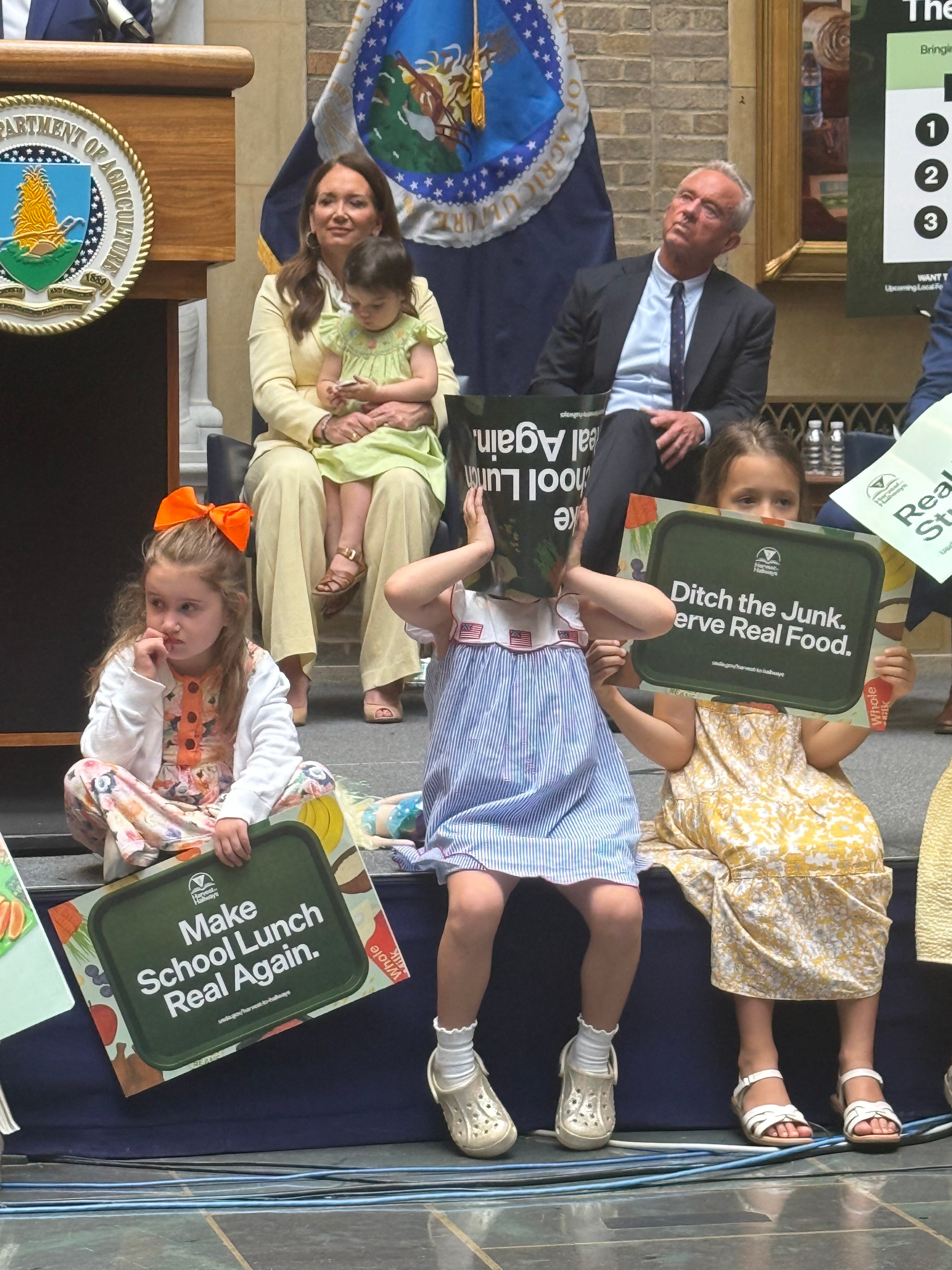
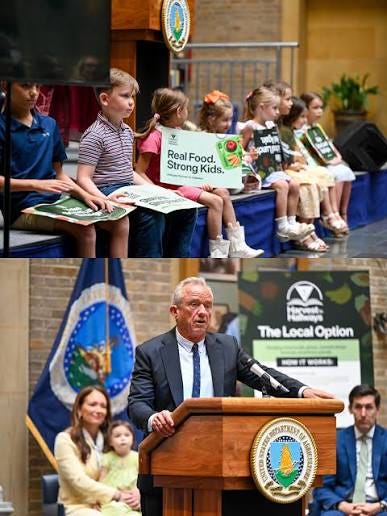
On Monday, Agriculture Secretary Brooke Rollins and Health and Human Services Secretary Robert F. Kennedy Jr. announced Harvest to Hallways, a joint USDA-HHS initiative intended to bring more locally produced, nutrient-dense food into schools while investing in the kitchens and systems necessary to make the dream of local nutrient-dense school food a reality.
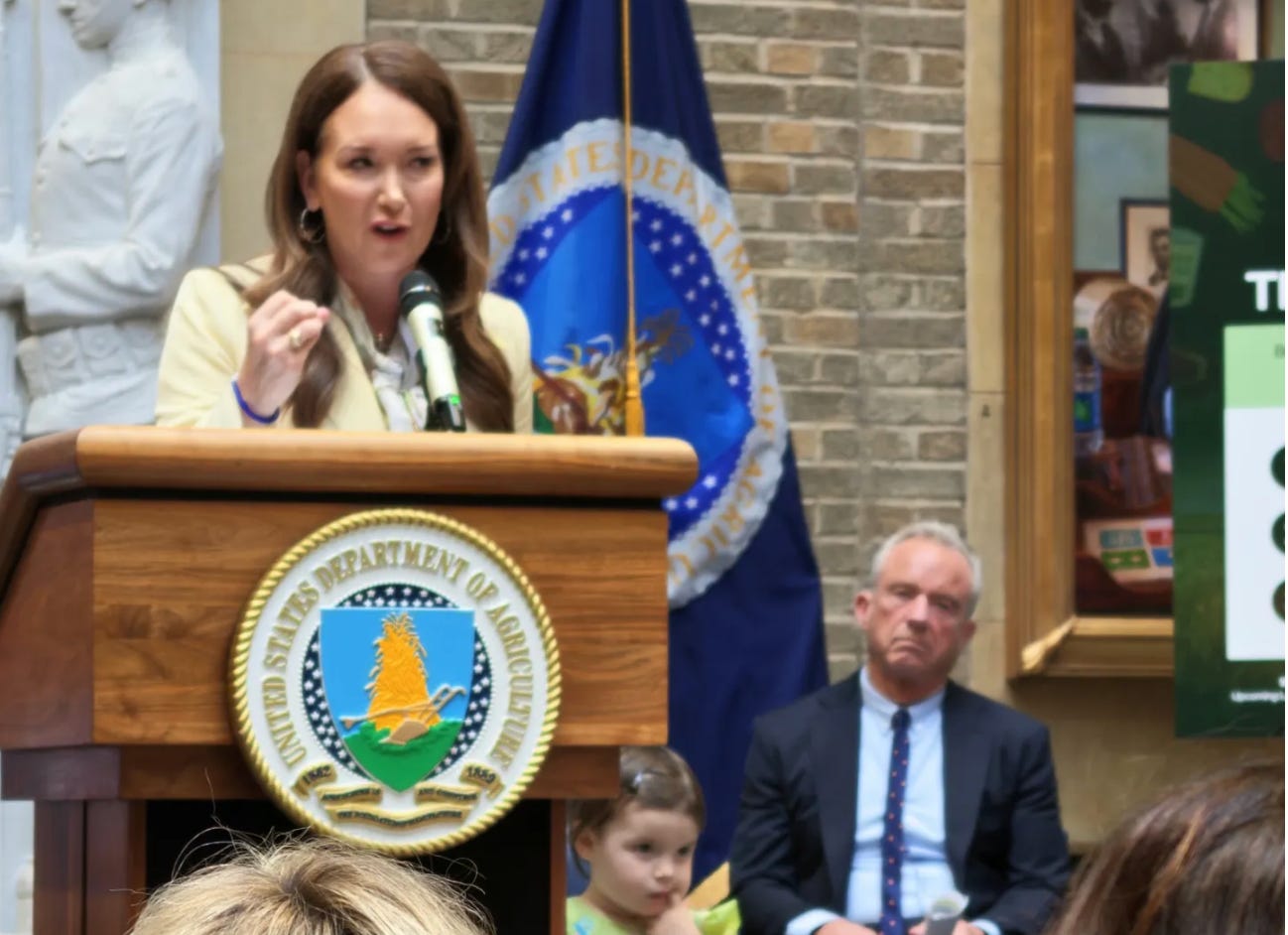
“Every school meal should make a child healthier,” said Kennedy during a press conference in the U.S. Department of Agriculture headquarters in Washington, D.C. “Under President Trump’s leadership, we are putting the updated Dietary Guidelines into action by bringing real, nutrient-dense food back to school cafeterias and giving schools the tools to serve it affordably. Together with Secretary Rollins, we are building a school food system that supports American farmers and raises healthier American children.”
The initiative includes $50 million in new cafeteria infrastructure funding, on top of $20 million in previously announced equipment grants; up to $25 million in additional Patrick Leahy Farm to School grants for fiscal year 2026; greater promotion of USDA’s Local Option procurement pathway; and $30 million from HHS for school-meal nutrition research.
Rollins acknowledged that decades of changes in school food preparation have left some cafeterias without even the basic infrastructure needed to cook. “A lot of you have heard that many of our school cafeterias no longer have ovens,” she said, “They no longer actually cook the food.”
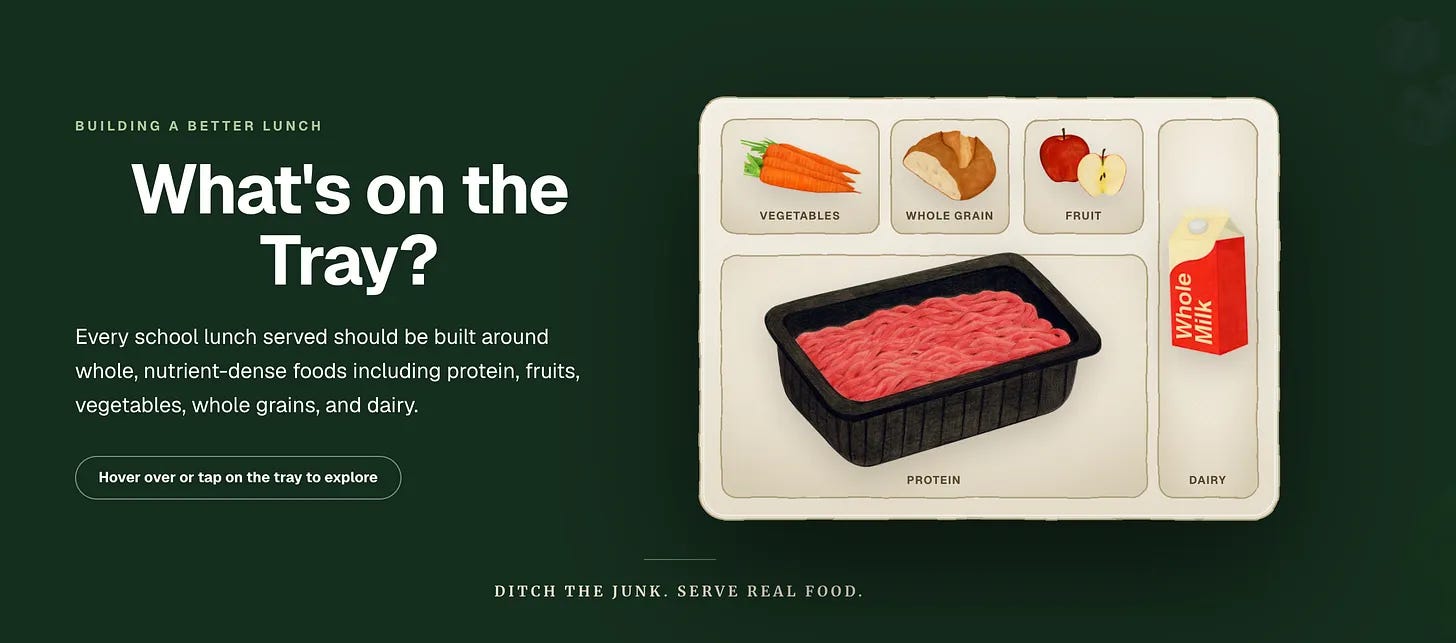
Kennedy was equally explicit about the goal. “We need to expand scratch cooking, reduce added sugars and ultra-processed food, serve more fresh produce, whole grains, and high-quality protein,” he said.
I’ve seen firsthand how differently children respond when food becomes something they can touch, grow, smell, and help prepare. Harvest to Hallways is worth paying attention to. This is not just another directive telling schools to serve healthier meals. It begins by addressing the practical reasons many schools struggle to do so in the first place: kitchens built for reheating rather than cooking real local food.
The Problem Isn’t Simply Nutrition Standards
The Healthy, Hunger-Free Kids Act successfully raised the bar for nutrition standards in American school meals. But it largely regulated the meal’s composition rather than rebuilding the system used to produce it. Almost 16 years later, Harvest to Hallways is taking aim at that missing piece by investing in kitchens, local supply chains, and farm-to-school relationships that could enable schools to meet nutritional goals by preparing more food on site from real, wholesome ingredients.
USDA research found that schools relied on processed foods produced by companies such as Tyson, General Mills, Kraft Heinz, and Rich Product Corporation who is the leading supplier of USDA-approved frozen doughs and pre-baked pizza that are designed specifically for school cafeterias for more than half of the protein, grain, sauce, and dressing items served.. These foods are then brought to schools by large distributors such as Sysco and Performance Food Group Company.
In practice, for many schools this means purchasing foods that arrive already cooked or partially prepared rather than making them from basic ingredients in the school kitchen. Schools currently report difficulties expanding from scratch cooking due to multiple factors, including insufficient staff and preparation time and a lack of culinary training, kitchen space, and equipment needed to prepare more meals from whole ingredients.
A Complicated Federal Funding Picture
There is also an important piece of recent history missing from the Harvest to Hallways announcement.
The new investment comes less than a year and a half after USDA canceled a substantially larger local-food purchasing initiative. In March 2025, the department ended a planned second round of the Local Food for Schools and Child Care Cooperative Agreement Program, or LFSCC, which was expected to provide approximately $660 million to states, territories, and Tribal governments to purchase food from local and regional producers. USDA also canceled additional funding for a related local-food program serving food banks and other community organizations; together, the cuts exceeded $1 billion.
Harvest to Hallways is not a direct replacement. Its $50 million investment in kitchen infrastructure addresses an important barrier that purchasing dollars alone cannot solve.
But the scale and structure are different.
LFSCC gave states and local food systems purchasing power specifically to buy from regional producers. Harvest to Hallways relies more heavily on grants, infrastructure investments, and existing procurement. And USDA had already opened the FY2026 Farm to School grant competition in September 2025, with applications closing on December 5. At the time, the agency advertised up to $18 million in available funding. That means the newly announced funding expands an existing FY2026 grant cycle rather than launching an entirely new application process.
There is a broader procurement question as well. Schools can use USDA Foods entitlement dollars to obtain produce through the USDA Department of Defense Fresh Fruit and Vegetable Program, a longstanding partnership in which the Defense Logistics Agency contracts with produce vendors and helps aggregate purchasing across school systems.
That scale can provide dependable distribution, food-safety guardrails and competitive pricing. But efficient institutional purchasing is not necessarily the same as building a decentralized local food system. Large contracts can make supplying thousands of cafeterias practical, while remaining difficult for a small nearby farmer to participate.
Harvest to Hallways acknowledges the complexity of our current system. The administration is arguing that healthier food does not always have to cost more while simultaneously investing millions in the capacity schools need to prepare it.
If the goal is truly farm-to-school, Rollins and Kennedy would do well to measure success not only by how much American-grown food schools purchase, but also by how many more American farmers are actually able to sell that food.
What Farm to School Looks Like on the Ground
USDA’s existing Farm to School grants provide a preview of what is possible.
In northwest Tennessee, the Northwest Tennessee Local Food Network received $500,000 for a two-year project spanning 12 schools in five districts and nearly 6,700 students. Rather than simply paying schools to purchase vegetables, the program is placing C.H.E.F. (Children’s Health through Education and Food) ambassadors in schools to train cafeteria staff, develop culinary skills, and help employees work with fresh local ingredients. Students will encounter those foods through cooking labs and taste tests before seeing them on cafeteria lines.
“We’ve learned that one of the most effective ways to impact children’s knowledge about health is through interactive activities like cooking labs,” co-director Samantha Smith Goyret said in an interview.
In Utah, a $350,000 grant will place Utah-grown fruit in 13 child nutrition programs while helping growers navigate school procurement, plant school orchards, and integrate agriculture and nutrition into classrooms.
The two-year project is intended to produce a model that can be replicated statewide. In Key West, Florida, where geography creates a unique local food challenge, the Star of the Sea Foundation received $103,375 for its Smart Sprouts project. The Florida Keys’ 120-mile island chain has few farms, so the program brings agriculture to children through classrooms, cafeterias, summer programs, and hands-on growing experiences rather than pretending every community has the same agricultural resources.
And in rural Indiana, Perry Central Community School Corporation received $286,351 to expand Perry Central Organics, its student-run hydroponic operation. What started with a single small growing tower is expected to expand to 14 vertical hydroponic towers producing lettuce, tomatoes, peppers, and other vegetables for approximately 1,200 students.
Students are already growing lettuce just steps from the cafeteria, managing orders, and learning production and business skills.
“We kept thinking, ‘How do we make this bigger and better?’” Agriculture teacher Carrie Guillaume recently said in an interview. “So, we just went for it.”
Building the Missing Middle
Other grants address a less visible problem: getting food from farms into institutional kitchens.
In Maine, Healthy Communities of the Capital Area received $465,270 to strengthen the Maine Farm & Sea to School Network. Its project focuses on market infrastructure that connects child nutrition programs not only with farmers but also with fishers, processors, and food businesses, along with training, technical assistance, and producer-buyer connections.
In Arkansas, WSBZ Farms is working across all 11 Bryant Public Schools to integrate Arkansas-grown specialty crops into school menus while creating stronger markets for growers. That work builds on WSBZ’s broader efforts to develop a regional supply chain connecting small farmers with schools and other institutional buyers.

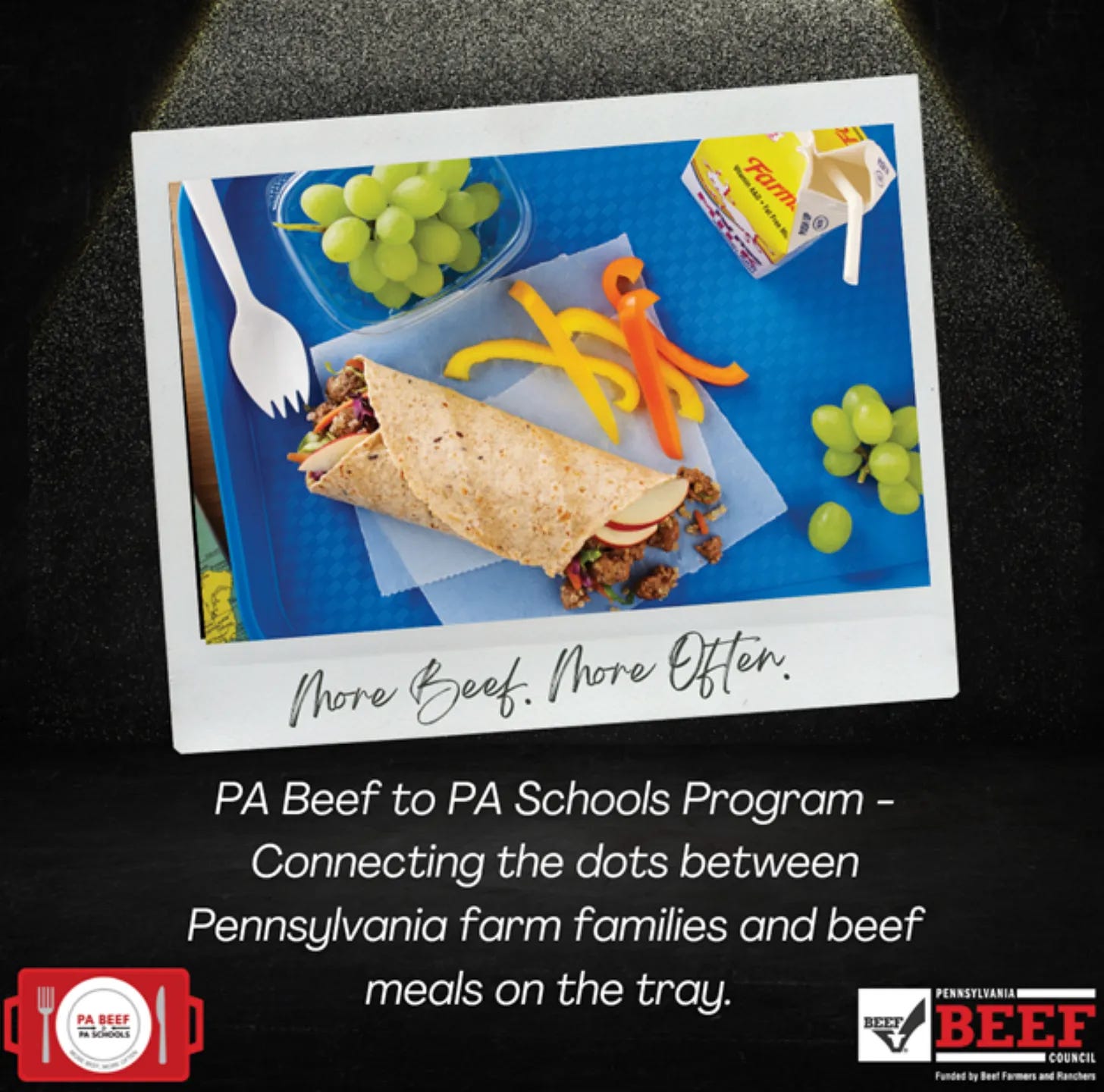
The Pennsylvania Beef Council, meanwhile, is scaling an existing farm-to-school model that connects cattle producers, processors, and distributors directly with schools. Its PA Beef to PA Schools program has already built relationships with more than 140 schools; USDA funding will support sourcing assistance, recipes, menu development, and agricultural education as the program expands statewide.
During their joint press conference on Monday, USDA and HHS also highlighted the Mississippi Community Housing Development Organization in Vicksburg, which operates community gardens that serve K–12 students and other local residents. In 2024, the nonprofit received a $320,006 USDA grant to develop a sustainable agricultural hub in the Mississippi Delta – an example of the broader Harvest to Hallways goal of strengthening local food production so schools have more reliable access to nearby, fresh food.
Taken together, these projects show the potential for Harvest to Hallways.
The real intervention in all of these programs is a functioning food system: skilled cooks, well-equipped kitchens, farmers with viable school markets, processors and distributors that can move local food efficiently, students willing to try unfamiliar foods, and education that helps children understand how food is grown, prepared, and connected to their health.
Building Health from the Cafeteria Up
HHS’s new $30 million research investment is an opportunity to measure whether these programs create lasting change. Will schools cook more meals from whole ingredients years from now? Are children more willing to eat those foods because they helped grow, prepare, or understand them? Are farmers gaining reliable new markets? And are communities building food systems strong enough to continue after the grant dollars are gone?
That is where Harvest to Hallways could become much more than another school nutrition initiative. MAHA has consistently argued that better health begins upstream, before chronic disease, before prescriptions, and before unhealthy patterns become entrenched. School food is one of the most impactful places to start.
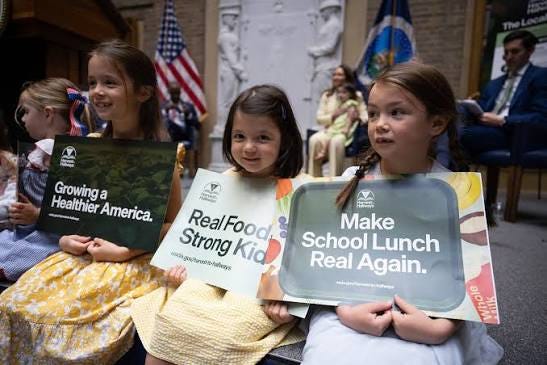
If these investments succeed, the payoff will not only be measured in better school lunches. It will be in the children themselves, who grow up knowing what real food looks like, where it comes from, and how it affects their health; school kitchens once again will be equipped to cook; and farmers will be more deeply connected to the communities they feed.
With a focus on making the next generation healthier than the last, there may be few better places to start than the school cafeteria.
Shop our merch store to support the MAHA Report and the MAHA movement.
All proceeds go to supporting the cause.

Bravo Secretaries Rollins and Kennedy! Only dyed in the wool ideologues will object to this thoughtful, sensible program. Healthy adults come from healthy children. Well done, MAHA!
Highly processed "food-like" items have "no" place in our schools.
Our children deserve nothing less than "real" food.