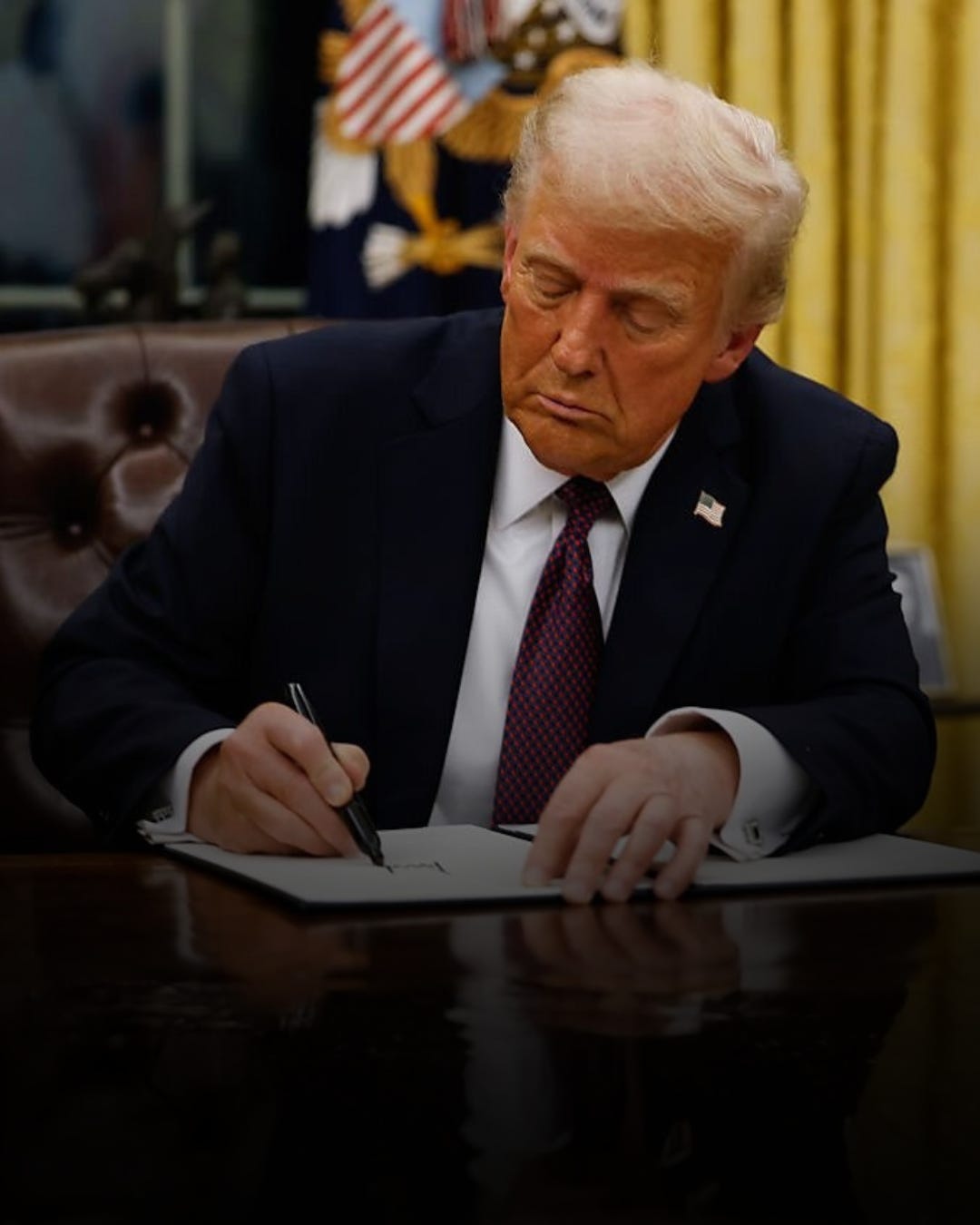
On February 18, President Trump signed an Executive Order (EO), invoking the Defense Production Act of 1950, calling the need to use glyphosate-based herbicides an issue of national security.
This Substack is reader-supported. To receive new posts and support my work, consider becoming a free or paid subscriber.
“There is no direct one-for-one chemical alternative to glyphosate-based herbicides,” the EO states. “[The] lack of access to glyphosate-based herbicides would critically jeopardize agricultural productivity.”
Trump’s EO angered some people aligned with the MAHA movement, who emphasize the dangers of glyphosate to human health. However, the majority of the movement stands with Trump and HHS Secretary Robert F. Kennedy Jr., who explained his nuanced position in a February 22 X post reposed in full, below.
Also below — a memo crafted by stakeholders across MAHA ™
I will always tell the American people the truth. Pesticides and herbicides are toxic by design, engineered to kill living organisms. When we apply them across millions of acres and allow them into our food system, we put Americans at risk. Chemical manufacturers have paid tens of billions of dollars to settle cancer claims linked to their products, and many agricultural communities report elevated cancer rates and chronic disease.
Unfortunately, our agricultural system depends heavily on these chemicals. The U.S. represents 4% of the world’s population, yet we use roughly 25% of its pesticides. If these inputs disappeared overnight, crop yields would fall, food prices would surge, and America would experience a massive loss of farms even beyond what we are witnessing today. The consequences would be disastrous. I support President Trump’s Executive Order to bring agricultural chemical production back to the United States and end our near-total reliance on adversarial nations. His EO protects two pillars of national strength: our defense readiness and our food supply. When hostile actors control critical inputs, they directly threaten the security of the American people. The Trump administration will secure these supply chains to eliminate that vulnerability.
President Trump did not build our current system — he inherited it. For decades, Washington designed modern agriculture. Policymakers wrote farm policy, directed research dollars, structured subsidies and crop insurance, and shaped commodity markets to reward monocultures and maximum yield. Those deliberate choices locked farmers into chemical dependence and prioritized short-term output over long-term soil vitality and human health. We are now changing course — without destabilizing the food supply.
Alongside @USDA @SecRollins, we are accelerating the transition to regenerative agriculture by expanding farming systems that rebuild soil, increase biodiversity, improve water retention, and reduce reliance on synthetic chemicals, including pre-harvest desiccation. We are also driving the rapid adoption of next-generation technologies, including laser-guided weed control, electrothermal and electrical systems, robotics, precision mechanical cultivation, and biological controls that replace blanket spraying with precision intervention. These solutions are not theoretical. Farmers are already putting them to work. Markets are scaling them. Now the federal government will act with urgency to expand their reach and accelerate adoption nationwide.
I have met with hundreds of farmers and agricultural leaders across the country. They understand the pressures firsthand. Chemical inputs cut into margins. Chemical-resistant pests are spreading. Soil health is declining. Foreign markets are shutting out American produce. Farmers want workable alternatives, and they want policies that support transition without threatening their livelihoods.
At HHS, I am leading a coordinated effort grounded in gold standard science. I am working with Secretary Rollins and @EPALeeZeldin to expedite a better future where a thriving agricultural system is less dependent on harmful chemicals. We are sharing data, coordinating strategy, and supporting farmers through a practical transition. The Make America Healthy Again agenda forces us to challenge long-standing assumptions about how we grow food, structure markets, and measure success in this country. Reform at this scale will test entrenched interests, and it will not move in a straight line.
President Trump has opened the door to this debate and backed meaningful change — not only in policy, but in the national conversation about health and agriculture. American farmers stand at the center of this movement. They deserve policies rooted in rigorous science and economic reality. Our children deserve a food system that protects and strengthens their health.
With President Trump’s leadership, we are securing critical supply chains, confronting the health risks embedded in our current system, and deploying every available tool to build a stronger, safer, more resilient American food supply.
The MAHA Action Memo:
Official Statement
Executive Order on Elemental Phosphorus
and Glyphosate-Based Herbicides
February 20, 2026
Cutting Through the Noise
On February 18, 2026, President Trump signed an executive order invoking the Defense Production Act to secure the domestic production of elemental phosphorus and glyphosate-based herbicides.1 The reaction across social media has been explosive, with over 213,000 posts on X and headlines designed to inflame rather than inform. Much of what is circulating is inaccurate. The MAHA community deserves the facts, not spin from either corporate media or those who aim to weaken the movement. This statement is our effort to provide exactly that.
Let’s Be Clear About Glyphosate
We all want to lessen the harmful impact of glyphosate. Glyphosate has a proven history of being harmful to people’s health. It is a pesticide that has been linked to cancer in thousands of successful lawsuits, including one brought by Secretary Kennedy himself. It is harmful to farmers who handle it. It is dangerous to consumers who ingest its residues. The International Agency for Research on Cancer (IARC) classified glyphosate as a probable carcinogen in 2015,2 and science has only grown more concerning since then.
The numbers are stark. According to the EPA, more than 280 million pounds of glyphosate is applied to roughly 300 million acres of U.S. farmland every year. A 2022 CDC survey found glyphosate in more than 80% of adult urine samples and 87% of samples from children ages 6–18.3 A separate study tracking Southern California residents over two decades found a 500% increase in the percentage of people testing positive for glyphosate in their urine.4
Within MAHA the question has never been whether glyphosate exposure is a problem. The question is how we solve it without devastating the millions of American families who depend on farming for their livelihoods.
American agriculture is currently structured around glyphosate in ways that took decades to build. Glyphosate-tolerant crops account for a significant majority of corn, soy, and cotton acreage.5 Millions of family farmers operate within this system today, many on margins so thin that any disruption in their crop protection tools could put them out of business. The president has also been clear that he will not allow food prices to increase for American families.
This is the tension at the heart of the issue. The MAHA movement has always understood that the health crisis in America was not created overnight, and it will not be solved overnight. Glyphosate dependency in American farming is a symptom of decades of policy decisions that favored industrial agriculture over health outcomes. Reversing that requires a serious plan, not a single executive action in either direction.
The Supply Chain Problem Is Real
There is only one domestic producer of elemental phosphorus and glyphosate-based herbicides in the United States.1,6 More than 6 million kilograms of elemental phosphorus are imported annually, with the majority of generic glyphosate coming from China.1 Elemental phosphorus is not only a precursor to glyphosate. It is a critical input for semiconductors, lithium-ion batteries, and military applications including smoke, illumination, and incendiary devices.1 The Department of the Interior designated phosphate as a critical mineral in November 2025.1,7
President Trump has been consistent in his commitment to reducing American dependence on China across every critical supply chain. This order is consistent with that broader agenda. Allowing a geopolitical adversary to control inputs that affect both military readiness and the food supply of 330 million Americans is a vulnerability no serious administration can ignore.
What This Executive Order Actually Does
The Immunity Provision: What It Is and What It Is Not
The most inflammatory claim circulating online is that this order gives pesticide companies blanket immunity from cancer lawsuits. That is not accurate.
Section 3 of the order invokes Section 707 of the Defense Production Act.1,8 This is standard language that appears in DPA orders across administrations. It provides narrow, compliance-based immunity, meaning a company cannot be sued for actions taken specifically because a federal production order required them. On its face, it does not block lawsuits over product safety or shield companies from cancer claims. It does not override the more than 60,000 pending Roundup lawsuits or the $7.25 billion settlement Bayer proposed on February 17.9 The statutory language itself limits this immunity to acts resulting directly from compliance with federal orders issued under the DPA.8 It was not designed to, and does not, provide blanket protection from product liability claims, though how courts ultimately interpret its scope remains to be seen.
Precision matters here. When we overstate what this order does, we lose credibility with the people we need to persuade. When we understate the concerns, we fail the families counting on us. The immunity provision warrants continued legal scrutiny, and we will be watching how it is applied. But calling it a “blanket shield for cancer claims” is factually wrong.
What It Does Not Do
This order does not mandate that farmers use glyphosate. It does not ban or restrict alternatives. It does not prevent states or the EPA from continuing to regulate glyphosate. It does not overturn any pending litigation. In addition it is an executive order, not federal legislation, meaning it carries the force of law under executive authority but could be revoked by a future administration without congressional action.
The MAHA Path Forward: Innovating Our Way Out
We take President Trump at his word that this executive order is about national security and reducing dependence on China. We support that objective. Securing the supply chain for a chemical Americans are concerned about is only half the equation. Supply chain security and health security are not competing priorities. They are complementary ones.
This administration has the opportunity to lead on both national security and the health of American families. The solutions below are not theoretical. They are commercially available, economically competitive, and in many cases already deployed at scale on American farms. MAHA Action calls on the administration to complete the picture by pursuing the following:
1. An independent, transparent EPA review of glyphosate’s health profile.
The current registration review should incorporate the full body of independent, non-industry-funded science, including IARC’s classification of glyphosate as a probable carcinogen.2 This is especially urgent given that the landmark safety study used by Monsanto for 25 years to support regulatory approvals was retracted in late 2025 due to ghostwriting and methodological concerns.11Americans deserve a review process they can trust, built on science that has not been compromised by industry influence.
2. Accelerate the shift to next-generation technologies & biological crop protection.
The future of crop protection is biological, not chemical. Biological and naturally-derived herbicides are now the fastest-growing segment of the crop protection market.17 Unlike synthetic herbicides, these products are biodegradable, leave no soil or food residues, and do not trigger the genetic resistance that is rendering chemical herbicides increasingly ineffective.
This is not aspirational. Products are already reaching the market. Several products have already achieved full EPA registration and California Department of Pesticide Regulation approval. These products work through desiccation, stripping the waxy cuticle of target plants, and they contain no glyphosate or any synthetic ingredient. It is completely biodegradable, leaves zero soil residue, and has been verified as beneficial to soil microorganisms.12
When combined with precision application technologies, including drone-based delivery systems that target specific weeds rather than broadcasting chemicals across entire fields, these biological alternatives can dramatically reduce total input volume, minimize soil exposure, and improve cost-effectiveness for farmers. The goal is clear: phase out the most problematic synthetic chemicals by innovating our way to something better.
Robotic autonomous weeding: A Kansas-based farm family company, is operating commercially across the Midwest right now. Their robotic systems combine machine vision, GPS guidance, and mechanical weed removal to eliminate most post-plant herbicide use in row crop systems, running fields 1–3 times per growing season during critical weed pressure periods. Their development pipeline targets complete herbicide elimination in no-till regenerative systems.13 Machine learning-based plant identification systems can reduce herbicide use by 80–95% even in operations that retain chemical tools as a last resort.17
Electrothermal weed control: A UK-based company now expanding to the United States, applies high-voltage electricity directly to plant foliage. The current travels through the vascular system from stem to root, killing the entire plant, including the root system, with no chemical residues, no soil microbiome disruption, and no possibility of genetic resistance. Independent field trials have demonstrated up to 99% kill rates in a single pass.15 The company raised $15 million in 2025 for U.S. and European expansion.14
Precision mechanical cultivation: Modern GPS-guided mechanical cultivation systems with sub-inch accuracy are already deployed across millions of acres of U.S. row crops. These systems integrate with existing tractor platforms, eliminate post-emergent broadcast herbicide requirements, and avoid chemical residue and resistance development entirely.17
These technologies are currently more expensive than glyphosate in some applications. But costs are declining rapidly as manufacturing scales, and within a 3–5 year adoption window, robotic and electrothermal systems are projected to become cost-preferred in multiple commodity crop systems.16,17 America should be leading the world in agricultural innovation, not defending a decades-old chemical dependency.
3. Expand the regenerative agriculture transition already underway.
In December 2025, USDA launched a $700 million Regenerative Pilot Program, dedicating $400 million through EQIP and $300 million through CSP to help farmers adopt whole-farm regenerative practices.10 Secretaries Rollins and Kennedy explicitly framed this as advancing the MAHA agenda.10 That program should be expanded and accelerated.
The regenerative model works because it combines multiple proven approaches into an integrated system: no-till soil management to deplete weed seed banks over 3–5 years; high-biomass cover crops terminated mechanically to provide 6–8 weeks of natural weed suppression; precision robotic or mechanical cultivation for remaining weed pressure; and livestock reintegration for natural fertility and additional farm revenue.13,15,17 Field research has demonstrated that this integrated approach can match the agronomic and economic performance of glyphosate-based systems.15
The glyphosate EO and the Regenerative Pilot Program should be understood as two parts of the same strategy: securing the supply chain today while building the agricultural system of tomorrow.
4. Incentivize a smooth and fast transition with concrete federal support.
Farmers need more than encouragement. They need a clear runway. Drawing on detailed economic modeling and policy analysis,16,17 we recommend:
Tax incentives for next-generation equipment: A federal investment tax credit of 30–40% for capital investment in robotic weeding, electrothermal weeding, and precision mechanical cultivation equipment would dramatically accelerate adoption while creating rural jobs in equipment support and servicing.17
Matching grants tied to measurable results: Farms demonstrating 50%, 75%, and 100% reduction in glyphosate use over a five-year period should receive tiered premium payments through the USDA Regenerative Pilot Program. EQIP cost-share should be expanded to cover roller-crimper equipment and cover crop seed at 50–75% cost share.17
Expedited processes for MAHA™-approved alternatives: A “Green Chemistry Fast Track” designation at the EPA would create an expedited registration pathway for naturally-derived herbicide active ingredients with demonstrated safety profiles, reducing current 5–10 year registration timelines to 2–3 years for qualifying products.12,17 Innovation cannot outpace regulation if the approval process itself is the bottleneck.
Federal purchasing power: A procurement preference for low-chemical-input products in school lunches, military commissaries, and federal feeding programs would create immediate institutional demand. Federal food procurement represents approximately $20 billion annually17 and that purchasing power should be pulling American agriculture toward healthier production, not anchoring it to the status quo.
We can innovate our way out of this problem, but only if we give farmers the tools, the timeline, and the financial runway to make the shift.
5. Transparency for consumers.
American families should know what is in their food. Mandatory labeling of glyphosate residue levels in food products would empower consumers to make informed choices while the market develops healthier alternatives.
The USDA should expand its Pesticide Data Program to include comprehensive annual residue testing for all 70+ food crops where glyphosate is used as a pre-harvest desiccant, with results published in a publicly accessible database.17
6. Legislative action, not just executive orders.
Executive orders can be reversed with a pen stroke. Domestic phosphorus production and agricultural supply chain security are truly matters of national defense, Congress should codify these protections through legislation.
Likewise, if we are serious about transitioning American agriculture away from chemical dependency, that commitment needs to be written into law.
A Message to the MAHA Community
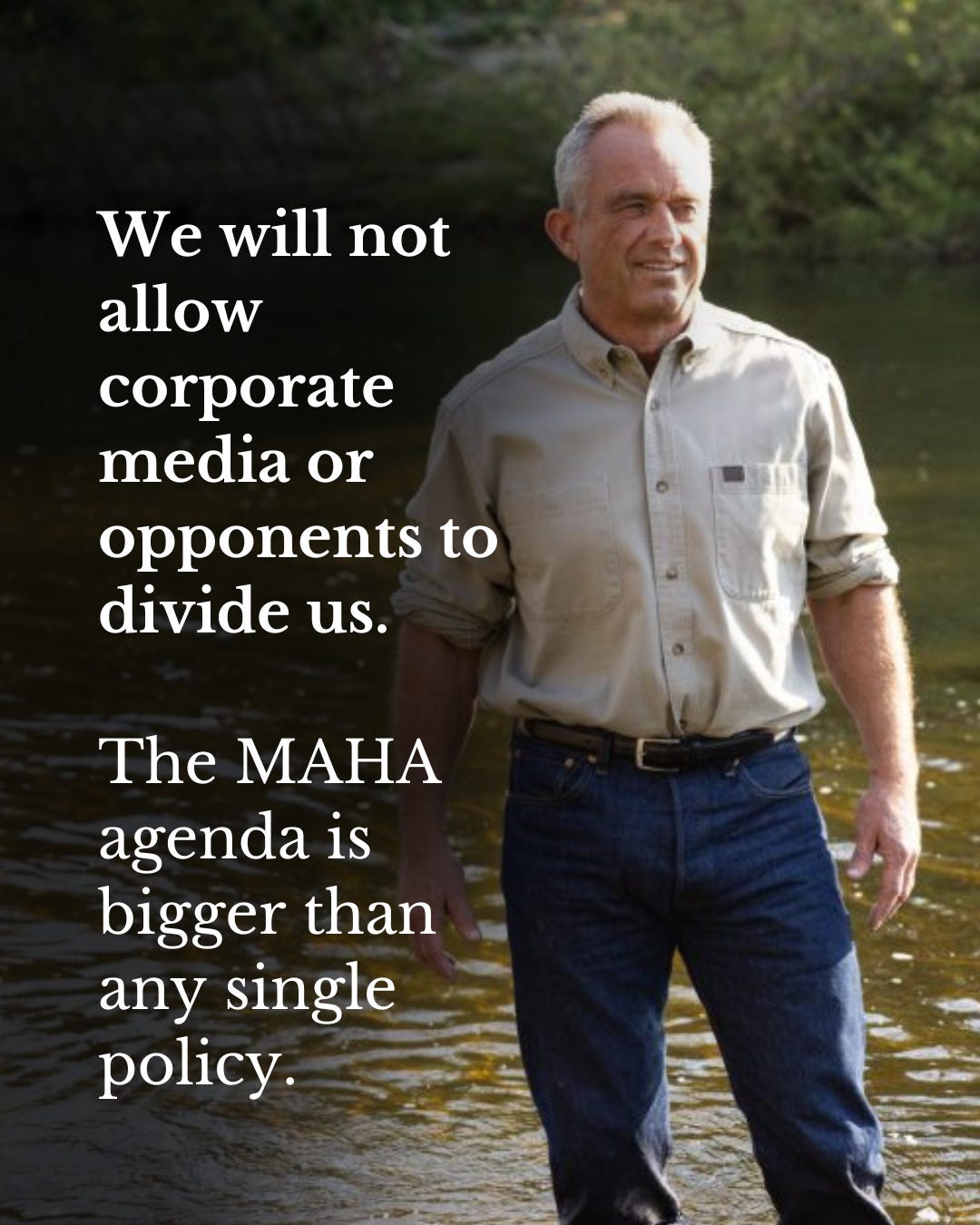
We know many of you are angry. That anger is understandable, and we share the urgency behind it. We also know that this movement is most powerful when it is precise, factual, and strategic. Corporate media and political opponents would love nothing more than to see the MAHA coalition fracture. We will not give them that.
The MAHA agenda is bigger than any single policy action. It is a generational commitment to restoring the health of American families, reforming the food system, and holding both government and industry accountable.
We support this President because he promised to take on the forces making Americans sick. We will continue to hold this administration to that promise, constructively and relentlessly, because the health of our families depends on it.
Stay informed. Stay engaged. Stay loud. The work of making America healthy again has only just begun.
MAHA Action Inc. is a 501(c)(4) social welfare organization dedicated to advancing policies that protect and improve the health of all Americans. This statement represents the organization’s analysis and official position. It does not constitute legal advice.
Sources
1. Executive Order, “Promoting the National Defense by Ensuring an Adequate Supply of Elemental Phosphorus and Glyphosate-Based Herbicides,” The White House, February 18, 2026. https://www.whitehouse.gov/presidential-actions/2026/02/promoting-the-national-defense-by-ensuring-an-adequate-supply-of-elemental-phosphorus-and-glyphosate-based-herbicides/
2. International Agency for Research on Cancer (IARC), Monographs on the Evaluation of Carcinogenic Risks to Humans, Volume 112: “Some Organophosphate Insecticides and Herbicides,” March 2015. https://www.ncbi.nlm.nih.gov/books/NBK436774/pdf/Bookshelf_NBK436774.pdf
3. National Health and Nutrition Examination Survey (NHANES) 2013–2014, Glyphosate (GLYP) Urine Data (SSGLYP_H), Centers for Disease Control and Prevention, First Published June 2022. See also: “‘Disturbing’: weedkiller ingredient tied to cancer found in 80% of US urine samples,” The Guardian, July 9, 2022. https://wwwn.cdc.gov/Nchs/Data/Nhanes/Public/2013/DataFiles/SSGLYP_H.htm
4. Mills PJ, Kania-Korwel I, Fagan J, et al., “Excretion of the Herbicide Glyphosate in Older Adults Between 1993 and 2016,” JAMA, 2017;318(16):1610–1611. https://jamanetwork.com/journals/jama/fullarticle/2658306
5. USDA Economic Research Service, “Adoption of Genetically Engineered Crops in the U.S.” https://www.ers.usda.gov/data-products/adoption-of-genetically-engineered-crops-in-the-u-s/
7. Department of the Interior, Critical Minerals List Update pursuant to the Energy Act of 2020, November 7, 2025. Referenced in Executive Order, Section 1.
8. Defense Production Act of 1950, Section 707, 50 U.S.C. § 4557. https://www.fema.gov/sites/default/files/2020-03/Defense_Production_Act_2018.pdf
10. U.S. Department of Agriculture Press Release No. 0242.25, “USDA Launches New Regenerative Pilot Program to Lower Farmer Production Costs and Advance MAHA Agenda,” December 10, 2025. https://www.usda.gov/about-usda/news/press-releases/2025/12/10/usda-launches-new-regenerative-pilot-program-lower-farmer-production-costs-and-advance-maha-agenda
11. RETRACTED: Williams GM, Kroes R, Munro IC, “Safety Evaluation and Risk Assessment of the Herbicide Roundup and Its Active Ingredient, Glyphosate, for Humans,” Regulatory Toxicology and Pharmacology, Vol. 31, Issue 2, 2000. https://pubmed.ncbi.nlm.nih.gov/10854122/
Retraction published November 28, 2025. See also: Kaurov AA, Oreskes N, “The afterlife of a ghost-written paper: How corporate authorship shaped two decades of glyphosate safety discourse,” Environmental Science & Policy, Vol. 171, 2025. https://www.sciencedirect.com/science/article/pii/S1462901125001765
See also: “Landmark glyphosate safety study retracted for Monsanto ghostwriting, other ethics problems,” U.S. Right to Know, December 3, 2025. https://usrtk.org/pesticides/landmark-glyphosate-safety-study-retracted-for-monsanto-ghostwriting/
12. Contact BioSolutions, “FireHawk Bioherbicide Receives Long-Awaited DPR Regulatory Approval in California — Now Available for Online Purchase,” PR Newswire. https://www.prnewswire.com/news-releases/contact-biosolutions-firehawk-bioherbicide-receives-long-awaited-dpr-regulatory-approval-in-california--now-available-for-online-purchase-302457782.html
13. Greenfield Robotics, “Robotic Weeding Systems for Regenerative Agriculture.” https://www.greenfieldincorporated.com/
14. “Exclusive: RootWave bags $15m to expand its chemical-free weeding platform to Europe, US,” AgFunder News, June 10, 2025. https://agfundernews.com/exclusive-rootwave-bags-15m-to-expand-its-autonomous-weeding-platform-to-europe-us
15. Antichi D, et al., “Targeted Timing of Roller-Crimped Hairy Vetch Termination in No-Till Sunflower: Equal Agronomic and Economic Performance to Glyphosate,” Agronomy for Sustainable Development 42, 2022. https://doi.org/10.1007/s13593-022-00815-2
16. Böcker T, et al., “Modelling the Effect of a Glyphosate Ban on Weed Management in Maize Production,” Paper presented at EAAE Congress, 2017. http://ageconsearch.umn.edu/record/261982/files/Boecker_109.pdf
17. Global Wellness Forum, “A National Strategy to Improve Public Health and Build More Profitable Farms: From Chemical Dependency to Regenerative Resilience,” Confidential Policy Memorandum prepared for the MAHA Commission and the United States Department of Agriculture, February 2026. Detailed sourcing and endnotes available in the full memorandum.
This Substack is reader-supported. To receive new posts and support my work, consider becoming a free or paid subscriber.
There are many good points toward the end of your post on glyphosate, but there are also important omissions.
1) President Trump has not been consistent in any strategy to reduce dependence on China, and this reaction, like many others, has been more a result of lobbying by certain corporations than any programmatic effort.
2) The call for Congressional action needs to be louder. And at the center needs to be a specific program to phase out glyphosate....a timeline which can include specific financial support to farmers to incentivize.
3) Limit glyphosate sales to farmers who demonstrate their need. Make it a controlled substance. Take it off the shelves of garden centers for casual gardeners to use on their gardens, grass or home landscape. Have documentation as to why available for consumers who ask where it has gone.
4) Break up the monopolies who exploit farmers, who control access to seed, determine the price for grain, the monopolize butchering of animals, etc., as well as the retail grocery monopolies who can raise prices at will because there is no competition....e.g., Albertson's Walmart.
The entire chain of food production in this country is distorted, and we have become, absurdly, and dangerously, a net importer because of the role of giant corporate profiteers at many strategic points.
We cannot MAHA without looking at every step in that process
Our grandparents used to tell us when the rabbits ate the carrots in our garden to plant more carrots! So maybe for the public good and national security we should eminent domain all that farmland Gates bought.



There are many good points toward the end of your post on glyphosate, but there are also important omissions.
1) President Trump has not been consistent in any strategy to reduce dependence on China, and this reaction, like many others, has been more a result of lobbying by certain corporations than any programmatic effort.
2) The call for Congressional action needs to be louder. And at the center needs to be a specific program to phase out glyphosate....a timeline which can include specific financial support to farmers to incentivize.
3) Limit glyphosate sales to farmers who demonstrate their need. Make it a controlled substance. Take it off the shelves of garden centers for casual gardeners to use on their gardens, grass or home landscape. Have documentation as to why available for consumers who ask where it has gone.
4) Break up the monopolies who exploit farmers, who control access to seed, determine the price for grain, the monopolize butchering of animals, etc., as well as the retail grocery monopolies who can raise prices at will because there is no competition....e.g., Albertson's Walmart.
The entire chain of food production in this country is distorted, and we have become, absurdly, and dangerously, a net importer because of the role of giant corporate profiteers at many strategic points.
We cannot MAHA without looking at every step in that process
,
Our grandparents used to tell us when the rabbits ate the carrots in our garden to plant more carrots! So maybe for the public good and national security we should eminent domain all that farmland Gates bought.